Overview
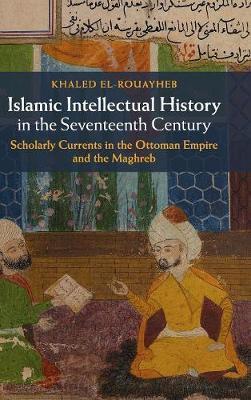
For much of the twentieth century, the intellectual life of the Ottoman and Arabic-Islamic world in the seventeenth century was ignored or mischaracterized by historians. Ottomanists typically saw the seventeenth century as marking the end of Ottoman cultural florescence, while modern Arab nationalist historians tended to see it as yet another century of intellectual darkness under Ottoman rule. This book is the first sustained effort at investigating some of the intellectual currents among Ottoman and North African scholars of the early modern period. Examining the intellectual production of the ranks of learned ulema (scholars) through close readings of various treatises, commentaries, and marginalia, Khaled El-Rouayheb argues for a more textured - and text-centered - understanding of the vibrant exchange of ideas and transmission of knowledge across a vast expanse of Ottoman-controlled territory.
Full Product Details
Author: Khaled El-Rouayheb (Harvard University, Massachusetts)
Publisher: Cambridge University Press
Imprint: Cambridge University Press
Dimensions:
Width: 15.20cm
, Height: 2.80cm
, Length: 23.10cm
Weight: 0.680kg
ISBN: 9781107042964
ISBN 10: 1107042968
Pages: 416
Publication Date: 08 July 2015
Audience:
Professional and scholarly
,
Professional & Vocational
Format: Hardback
Publisher's Status: Active
Availability: Manufactured on demand

We will order this item for you from a manufactured on demand supplier.
Reviews
'A labor of admirable erudition, this book by Professor Khaled El-Rouayheb establishes a new standard for the intellectual history of Islam in general and for Ottoman intellectual history in particular. By focusing on the hitherto unexplored technical arguments of the textual traditions and by deftly placing them within the larger systems in which they developed, the author goes far beyond previous studies of Ottoman intellectual history that concerned themselves primarily with the social, cultural and legal locations of ideas. The history of ideas has finally taken center stage in Islamic studies as the guiding principle of intellectual history. This is pioneering work.' Asad Q. Ahmed, University of California, Berkeley 'A book like this would rank as a fine piece of scholarship in the intellectual history of any time and place. For the Islamic world of the sixteenth to eighteenth centuries, it transforms the field almost beyond recognition.' Michael Cook, Princeton University 'Khaled El-Rouayheb's Islamic Intellectual History in the Seventeenth Century is a most welcome contribution to an understudied subject and period, which sets out to challenge many preconceived notions of intellectual and scientific sclerosis. The author sets a perfect example as to how a period stigmatized by such negative perceptions should be investigated. Rather than seeking some Islamic 'Renaissance' or 'Enlightenment', he simply sets out to look at which significant works were produced during the period that contradict this general opinion, in order to understand the dynamics of reflection, transmission, inspiration and emulation in an interconnected Ottoman/Islamic world. The result is a meticulous and fascinating intellectual history enriched by textual and network analysis.' Edhem Eldem, Bogazici University 'In Islamic Intellectual History in the Seventeenth Century, Khaled El-Rouayheb probes tahqiq or 'verification', whether based on dialectic, deep reading, or mystical illumination. In the process, he uncovers a vibrant intellectual world throughout the Ottoman Empire, North Africa and beyond. This is a groundbreaking work on the Islamic intellectual history of the early modern period.' Th. Emil Homerin, University of Rochester 'Khaled El-Rouayheb's groundbreaking study deals with Islamic intellectual history in the Ottoman Empire and North Africa during the seventeenth century - a century that was until now thought to be devoid of any intellectual achievements worth mentioning. ... Both the geographical scope of this book and its analytical depth set an entirely new benchmark for any future study of Islamic intellectual thought in the so-called post-classical period.' Sabine Schmidtke, Institute for Advanced Study, School of Historical Studies
Advance praise: 'A labor of admirable erudition, this book by Professor Khaled El-Rouayheb establishes a new standard for the intellectual history of Islam in general and for Ottoman intellectual history in particular. By focusing on the hitherto unexplored technical arguments of the textual traditions and by deftly placing them within the larger systems in which they developed, the author goes far beyond previous studies of Ottoman intellectual history that concerned themselves primarily with the social, cultural and legal locations of ideas. The history of ideas has finally taken center stage in Islamic studies as the guiding principle of intellectual history. This is pioneering work.' Asad Q. Ahmed, University of California, Berkeley Advance praise: 'A book like this would rank as a fine piece of scholarship in the intellectual history of any time and place. For the Islamic world of the sixteenth to eighteenth centuries, it transforms the field almost beyond recognition.' Michael Cook, Princeton University Advance praise: 'Khaled El-Rouayheb's Islamic Intellectual History in the Seventeenth Century is a most welcome contribution to an understudied subject and period, which sets out to challenge many preconceived notions of intellectual and scientific sclerosis. The author sets a perfect example as to how a period stigmatized by such negative perceptions should be investigated. Rather than seeking some Islamic 'Renaissance' or 'Enlightenment', he simply sets out to look at which significant works were produced during the period that contradict this general opinion, in order to understand the dynamics of reflection, transmission, inspiration and emulation in an interconnected Ottoman/Islamic world. The result is a meticulous and fascinating intellectual history enriched by textual and network analysis.' Edhem Eldem, Bogazici University Advance praise: 'In Islamic Intellectual History in the Seventeenth Century, Khaled El-Rouayheb probes tahqiq or 'verification', whether based on dialectic, deep reading, or mystical illumination. In the process, he uncovers a vibrant intellectual world throughout the Ottoman Empire, North Africa and beyond. This is a groundbreaking work on the Islamic intellectual history of the early modern period.' Th. Emil Homerin, University of Rochester Advance praise: 'Khaled El-Rouayheb's groundbreaking study deals with Islamic intellectual history in the Ottoman Empire and North Africa during the seventeenth century - a century that was until now thought to be devoid of any intellectual achievements worth mentioning. ... Both the geographical scope of this book and its analytical depth set an entirely new benchmark for any future study of Islamic intellectual thought in the so-called post-classical period.' Sabine Schmidtke, Institute for Advanced Study, School of Historical Studies
Author Information
Khaled El-Rouayheb is a Professor of Islamic Intellectual History in the Department of Near Eastern Languages and Civilizations at Harvard University, Massachusetts. He specializes in Arabic and Islamic intellectual history, especially in the period from the thirteenth to the eighteenth centuries. He is the author of Before Homosexuality in the Arab-Islamic World, 1500-1800 (2005) and Relational Syllogisms and the History of Arabic Logic, 900-1900 (2010). He is also co-editor of The Oxford Handbook of Islamic Philosophy (with Sabine Schmidtke, 2016).