Overview
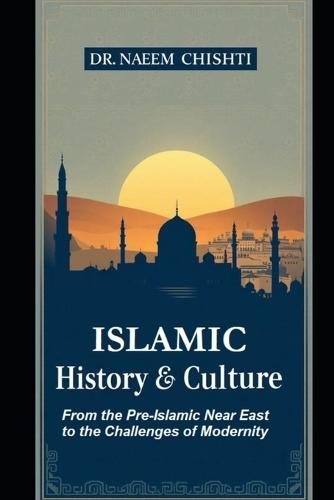
Islamic History & Culture: From the Pre-Islamic Near East to the Challenges of Modernity offers a comprehensive, carefully structured, and intellectually engaging survey of Islamic civilisation from its historical foundations to its contemporary encounters with the modern world. Although closely aligned with the FPSC syllabus for the CSS examination in Pakistan, the book's scope and clarity extend well beyond any single examination. It is equally valuable for students of history, general readers, and anyone seeking a balanced and historically grounded understanding of Islam as a civilisation shaped by faith, culture, power, and ideas. The book begins by situating the rise of Islam within the broader world of the pre-Islamic Near East. Rather than presenting Islam as an abrupt or isolated phenomenon, the opening chapters explore the political, social, economic, and religious landscapes of late antiquity. The Byzantine-Sassanian rivalry, tribal organisation in Arabia, vibrant oral cultures, and diverse religious traditions are examined to reveal the continuities and tensions that framed Islam's emergence. At the core of the book is a nuanced and respectful account of the Prophetic age. The life of the Prophet Muhammad (PBUH) is presented both chronologically and thematically, highlighting his role as a spiritual leader, moral reformer, community builder, and statesman. Particular emphasis is placed on the ethical foundations of his mission, the constitutional framework of Medina, and the principles of justice, consultation, and coexistence that defined the first Muslim community. Avoiding both hagiography and reductionism, these chapters offer an analytically grounded yet accessible portrayal of early Islam. The discussion then turns to the Pious Caliphate, examining the formative decades of Muslim political experience. The reigns of the four Rightly Guided Caliphs are analysed in terms of governance, law, social welfare, and expansion, while also addressing internal conflicts and emerging divisions. The abdication of Imam Hasan and the transition to Umayyad rule are treated as a pivotal moment, marking the shift from elective leadership to dynastic governance. A major strength of the book lies in its systematic treatment of Islamic political theory and institutions. Core concepts such as divine sovereignty, khilafah, shura, accountability, and welfare governance are explored alongside early administrative, judicial, educational, military, and financial systems, illustrating how ethical ideals were translated into durable structures. The middle sections trace the Umayyad and Abbasid periods, weaving political history with cultural and intellectual developments. The Abbasid era is presented as a peak of global intellectual exchange, while a dedicated chapter on al-Andalus captures both the brilliance and fragility of Muslim Spain and its influence on Europe. The later chapters address the Crusades, the Ottoman Empire, and the institutional role of Sufism, presenting Islam as a lived civilisation shaped by conflict, spirituality, governance, and cultural creativity. The final section on Islam and modernity brings the historical narrative into dialogue with contemporary challenges, examining reform movements, modernist thought, and ongoing intellectual exchanges between the Muslim world and the West. Written in an elegant yet accessible style, Islamic History & Culture balances narrative flow with analytical depth. It avoids polemics, resists reductionist readings, and foregrounds complexity, continuity, and change. While designed as a rigorous academic resource for competitive examinations, the book ultimately offers something more enduring: a coherent, humane, and historically grounded understanding of one of the world's most influential civilisations.
Full Product Details
Author: Dr Naeem Chishti
Publisher: Independently Published
Imprint: Independently Published
Dimensions:
Width: 15.20cm
, Height: 2.70cm
, Length: 22.90cm
Weight: 0.692kg
ISBN: 9798246222515
Pages: 522
Publication Date: 30 January 2026
Audience:
General/trade
,
General
Format: Paperback
Publisher's Status: Active
Availability: Available To Order

We have confirmation that this item is in stock with the supplier. It will be ordered in for you and dispatched immediately.