|
|
|||
|
||||
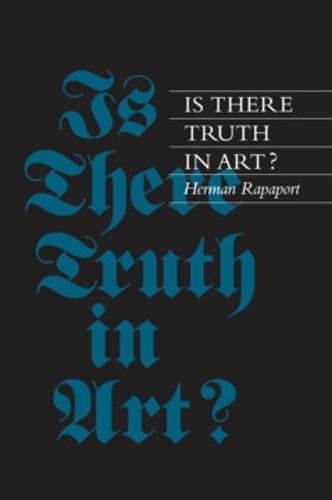
OverviewThe question posed by Herman Rapaport, in the title of this book, is intended both seriously and ironically. It is not Rapaport's purpose to debate whether or not truth resides in art. The title points rather to his belief that truth needs to be reconceptualized in the light of continuing efforts to deconstruct and to discredit the notion of truthfulness in art. The question of art's truthfulness persists because truth in art is neither an entity or content that has been injected into the work, nor a transcendental concept or ground that exists outside it. Moreover, when used in relation to art, Rapaport says, truth means something quite different from conventional definitions of the term. Indeed, a central question that informs the book is the return of truth at the far side of its deconstruction. Is There Truth in Art? includes chapters on atonal music, environmental art, modern German and French poetry, contemporary French fiction, experimental French film, and a photograph taken by the National Socialists during the destruction of the Warsaw ghetto. Determining how truth can be said to occur in these examples, Rapaport maintains, requires analysis in each instance. He draws chiefly upon the thinkers who have radically reformulated questions about truth—Nietzsche, Heidegger, Derrida, and Levinas—and uses their writings to explore the works under analysis. Full Product DetailsAuthor: Herman RapaportPublisher: Cornell University Press Imprint: Cornell University Press Dimensions: Width: 15.20cm , Height: 2.40cm , Length: 22.90cm Weight: 0.907kg ISBN: 9780801432750ISBN 10: 0801432758 Pages: 240 Publication Date: 19 December 1996 Audience: College/higher education , General/trade , Undergraduate , General Format: Hardback Publisher's Status: Active Availability: Manufactured on demand We will order this item for you from a manufactured on demand supplier. Table of ContentsReviewsRapaport calmly and thoroughly engages the relation between Heidegger and art. This is an area that deserves further study, and Rapaport's book is an innovative contribution to it. * Choice * Rapaport calmly and thoroughly engages the relation between Heidegger and art. This is an area that deserves further study, and Rapaport's book is an innovative contribution to it. --Choice Author InformationHerman Rapaport holds the Helen L. DeRoy chair in the Department of English at Wayne State University. He is the author of Between the Sign and the Gaze, also from Cornell. Tab Content 6Author Website:Countries AvailableAll regions |
||||