Overview
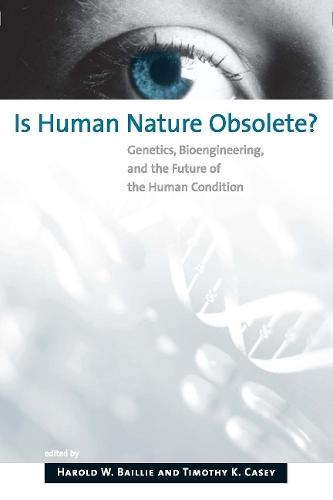
As our scientific and technical abilities expand at breathtaking speeds, concern that modern genetics and bioengineering are leading us to a posthuman future is growing. Is Human Nature Obsolete? poses the overarching question of what it is to be human against the background of these current advances in biotechnology. Its perspective is philosophical and interdisciplinary rather than technical; the focus is on questions of fundamental ontological importance rather than the specifics of medical or scientific practice. The authors—all distinguished scholars in their fields—take on questions about technology's goals and values that are often ignored or sidelined in the face of rapid scientific advances and the highly specialized nature of technical knowledge. The essays included represent a rich variety of thought, ranging from finely nuanced philosophical and theological arguments to historical studies and cultural commentaries. Several explore the historical background of today's biotechnology: Timothy Casey traces such developments as the emergence of cybernetic humanity from Cartesian dualism, and Diane Paul presents the history of ""positive"" versus coerced eugenics. Jean Bethke Elshtain discusses cloning as a ""messianic project"" to perfect the body and exclude natural diversity—giving as an example the elimination of Down Syndrome as an acceptable human type—while Harold Baillie calls for an examination of the metaphysical roots of personhood. Robert Proctor finds no evidence in paleontology for any ""essence of humanity,"" and Tom Shannon argues against materialist reductionism. Addressing social concerns, Lisa Sowle Cahill finds the possibility of a political solution to the problems raised by genetic engineering in Catholic teachings on social justice, and Langdon Winner looks critically at the ""scientific enthusiasts of a posthuman future."" Taken as a whole, the book provides a humanistic overview of a subject too often considered only in its technological aspect.
Full Product Details
Author: Harold W. Baillie ,
Timothy K. Casey ,
Arthur L. Caplan (Director, NYU Langone Medical Center)
Publisher: MIT Press Ltd
Imprint: MIT Press
Dimensions:
Width: 15.20cm
, Height: 2.50cm
, Length: 22.90cm
Weight: 0.590kg
ISBN: 9780262524285
ISBN 10: 0262524287
Pages: 440
Publication Date: 08 October 2004
Recommended Age: From 18 years
Audience:
Professional and scholarly
,
Professional & Vocational
Format: Paperback
Publisher's Status: No Longer Our Product
Availability: Awaiting stock

The supplier is currently out of stock of this item. It will be ordered for you and placed on backorder. Once it does come back in stock, we will ship it out for you.
Reviews
Modifying ourselves through molecular biology is a humanitarian utopia to some, an imminent nightmare to others. But to all, the prospect should be a challenge because it touches on so many basic and unresolved questions. This excellent, probing collection of papers--spanning philosophy, history, social science, and theology--will be welcomed by professionals and lay readers alike. --Edward Tenner, author of Why Things Bite Back: Technology and the Revenge of Unintended Consequences and Our Own Devices: How Technology Remakes Humanity
Author Information
Harold W. Baillie is Professor of Philosophy at the University of Scranton. Timothy K. Casey is Professor of Philosophy at the University of Scranton.