Overview
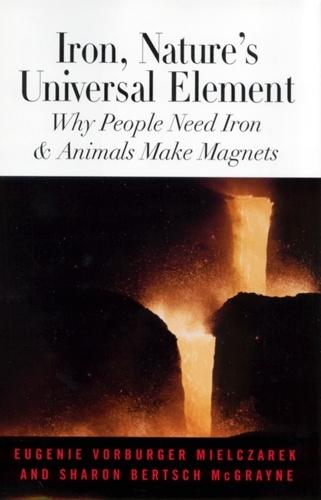
Virtually all life on Earth, from bacteria to humans, needs iron to survive. From facilitating oxygen flow in mammals to assisting migrating birds in finding their way south for the winter, iron serves a variety of definitive roles for nearly all living creatures. Our knowledge of iron’s role in life is the result of recent discoveries about iron and magnetism in bacteria, in myriad animals and plant species,and in humans. Personal stories of scientists illustrate the lively interplay between molecular biologists, ornithologists, physicists, oceanographers, chemists, geologists, physicians, and ecologists. The authors start with the discovery of iron-rich hot springs on the ocean floor. Was this life’s nursery? Other chapters describe why there is iron in our blood and how the body safely cages excess iron. The physiology of exercise and the genetic blood diseases, sickle cell anemia, hemochromatosis, and the thalessemias are explained. One of nature’s most dramatic mysteries-the migration of birds, turtle, salmon and other animals-depends on iron magnets. The bodies of some animals contain minute deposits of magnetite that are sensory navigators. Far reaching in scope, Iron, Nature’s Universal Element also looks at global issues including iron’s power over the earth’s oceans, vegetation, and populations; and the low-protein diets that lead to long-term cognitive damage in iron-deficient children in poor countries.
Full Product Details
Author: Sharon Bertsch McGrayne ,
Eugenie Vorburger Mielczarek
Publisher: Rutgers University Press
Imprint: Rutgers University Press
Dimensions:
Width: 15.20cm
, Height: 2.00cm
, Length: 22.90cm
Weight: 0.510kg
ISBN: 9780813528311
ISBN 10: 0813528313
Pages: 224
Publication Date: 01 September 2000
Audience:
General/trade
,
College/higher education
,
General
,
Undergraduate
Format: Hardback
Publisher's Status: Active
Availability: Temporarily unavailable

The supplier advises that this item is temporarily unavailable. It will be ordered for you and placed on backorder. Once it does come back in stock, we will ship it out to you.
Reviews
Iron, NatureÆs Universal Element is a well-researched and extremely well-written book. . . . a highly entertaining read as well as an informative one. It is suitable for the lay reader who only encounters details about iron on a vitamin bottle, but is also valuable for any scientist with an interest in iron, and particularly those teaching undergraduates about it. * Journal of Chemical Education * Mielczarek and McGrayne describe in their readable book the importance of iron for life. The book is entertaining, amusing, and challenging and . . . contains some new information for most readers . . . One could expect that a popular book, covering topics from the origin of life to bird migration and the ecosystem, would contain some mistakes. I did not find any. . . . A clear glossary and an extensive and excellent bibliography complete the slim book and permit the reader to dig deeper. In summary, I can recommend the book without reservation. In particular, physicists who have not delved into the life sciences may find it stimulating. * Physics Today * The theme of this book dwells on the development of early life and the dependence of living organisms, from simple bacteria to the higher forms, on the abundance of iron. . . . The reader will appreciate the volumeÆs nontechnical format. . . . Besides the glossary, another valuable aid is the bibliography, alphabetically arranged by chapter and consisting of articles relevant to pursuing oneÆs interests. * Science Books & Film * [The authors] introduce the chemistry of iron and its role in the biology or organisms. . . . The authors employ a nontechnical style appropriate for general readers, explain complex concepts simply, and recount many interesting scientific discoveries. . . . An interesting and very readable introduction to this critically important element and its impact on our world. * Choice * Provides fascinating details about ironÆs role in living organisms, ranging from bacteria and plants to people and other animals. * Planting & Surface Finishing * Readers will be surprised to find out how exciting the element iron can be. The authors bring us a vast amount of material in a thoroughly understandable way. -- Harold Morowitz * Krasnow Institute, George Mason University * ..a well-researched and extremely well-written book. . . . a highly entertaining read as well as an informative one. It is suitable for the lay reader who only encounters details about iron on a vitamin bottle, but is also valuable for any scientist with an interest in iron . . . I would have loved this book as a high school student and I imagine the text accessible to advanced middle school students also. . . . I highly recommend this book . . . the text could compliment an environmental science course, serve as an example for writing about science to a lay audience, supplement biochemistry or bioinorganic chemistry classes, or just entertain you on your next travel segment. * Journal of Chemical Education * The story of iron on Earth begins with the role of iron atoms in the formation of our planet and moves through the world of evolving life, primitive microorganisms, and progressively more complicated iron-managing molecules to global systems for migrating animals, fertilizing the surface of Earth, and feeding its human population. From the simple to the complex, from the microscopic to the planetary scale, from the thoroughly understood to current research frontiers, this book follows iron through the biological world. We inherited our dependence on iron from EarthÆs iron-rich beginnings This is the story of our legacy of iron and the scientists who are uncovering it. -- From Iron * NatureÆs Universal Element *
Author Information
EUGENIE VORBURGER MIELCZAREK is a professor emeritus of physics at George Mason University and primary editor of Key Papers on Biological Physics. SHARON BERTSCH MCGRAYNE is a science writer and former physics writer/editor for Encyclopedia Britannica. Her books include Nobel Women in Science and Blue Genes and Polyester Plants.