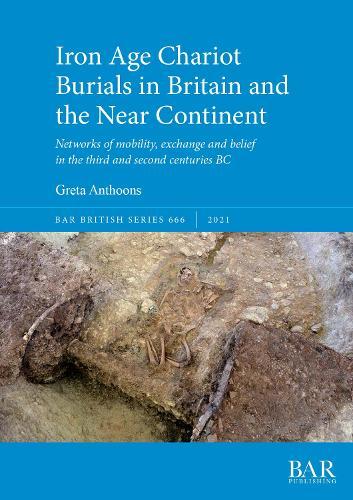
Iron Age Chariot Burials in Britain and the Near Continent: Networks of mobility, exchange and belief in the third and second centuries BC

Author:   Greta Anthoons
Publisher:   BAR Publishing
ISBN:  

9781407316840


Pages:   281
Publication Date:   29 October 2021
Format:   Paperback
Availability:   Available To Order   Availability explained
We have confirmation that this item is in stock with the supplier. It will be ordered in for you and dispatched immediately.

Our Price $168.19 Quantity:  
Add to Cart

Share |

Iron Age Chariot Burials in Britain and the Near Continent: Networks of mobility, exchange and belief in the third and second centuries BC


Overview

The British chariot burials, mainly concentrated in East Yorkshire, reveal a strong link with continental Europe, which has led some scholars to believe that this burial rite was introduced by immigrants from northern Gaul. Other scholars do not accept migration as the key explanation for cultural changes and argue that new rites and customs may also be adopted through social networks that often stretch over great distances. To determine which model best explains the introduction of new burial rites in East Yorkshire in the third century BC, this book describes the similarities and differences between the British chariot burials and those of contemporary chariot burials in northern Gaul. The comparison shows that elite networks, and possibly religious networks, lie at the basis of the emergence of new burial rites in East Yorkshire. This book also discusses various types of long-distance contacts that can forge and maintain social networks.

Full Product Details

Author:   Greta Anthoons
Publisher:   BAR Publishing
Imprint:   BAR Publishing
Weight:   1.121kg
ISBN:  

9781407316840


ISBN 10:   1407316842
Pages:   281
Publication Date:   29 October 2021
Audience:   Professional and scholarly ,  Professional & Vocational
Format:   Paperback
Publisher's Status:   Active
Availability:   Available To Order   Availability explained
We have confirmation that this item is in stock with the supplier. It will be ordered in for you and dispatched immediately.

Table of Contents

List of Figures List of Tables Foreword Abstract 1. Introduction 1.1. A decade of new discoveries and research 1.2. The Arras Culture 1.3. Methodology 1.4. Use of historical sources 1.5. Terminology 1.6. Chronology 2. The Arras Culture of eastern Yorkshire 2.1. Eastern Yorkshire in its British context 2.2. Yorkshire and the Arras Culture 2.3. Geographical study area 2.4. Funerary practices in eastern Yorkshire 2.4.1. Inhumation 2.4.2. From round to square barrows 2.4.3. From isolated barrows to large size cemeteries? 2.4.4. The large cemeteries of the Yorkshire Wolds 2.4.5. Burial types 2.4.5.1. Type A burials 2.4.5.2. Type B burials 2.4.5.3. Type B and C warrior burials 2.4.5.4. Type C burials with mirrors 2.4.5.5. Type C burials with vehicles and horse harness 2.4.5.6. Type D burials 2.4.5.7. Animal burials 2.4.6. Organic grave goods 2.4.7. Location of cemeteries in the landscape 2.5. Chariot burials 2.5.1. Location 2.5.2. Barrows and grave pits 2.5.3. Complete versus dismantled chariots 2.5.4. The interior organisation of dismantled chariot burials 2.5.5. Coffin or vehicle body? 2.5.6. Vehicle parts and horse harness 2.5.7. Weapons 2.5.8. The deceased 2.5.9. The horses 2.5.10. Other animal bones 2.6. The start of the Arras Culture 2.6.1. Overview 2.6.2. The earliest brooches 2.6.3. The chariot burials 2.6.4. Bayesian analysis of radiocarbon dates 2.6.5. Heirlooms and antiques 2.7. Natural sciences and the population of East Yorkshire 2.7.1. Radiocarbon dating 2.7.2. Isotope evidence 2.7.3. Skeletal evidence for engendered violence 2.8. Non-funerary features of the East Yorkshire landscape 2.8.1. Linear earthworks 2.8.2. Settlements 2.8.3. Means of subsistence 2.9. A few preliminary conclusions 2.9.1. Burials: a reflection of social status? 2.9.2. Import of ideas and luxury materials from the Continent 2.10. British chariot burials outside Yorkshire 2.10.1. Scotland 2.10.2. Wales 2.10.3. Other regions 3. The Middle Rhine - Moselle region 3.1. Chariot burials and general funerary practices 3.1.1. Location and history 3.1.2. Disposal of the dead 3.1.3. Superstructures and enclosures 3.1.4. Grave pits 3.1.5. General arrangement of chariot burials 3.1.5.1. Position of the vehicle 3.1.5.2. Position and orientation of the deceased (inhumations) 3.1.5.3. Dismantled chariot burials 3.1.6. The deceased 3.1.7. Vehicle parts and horse harness 3.1.8. Grave goods 3.2. The Middle Rhine - Moselle region versus the Arras Culture 4. The Netherlands 5. The Aisne-Marne and neighbouring regions 5.1. General funerary practices 5.1.1. Data 5.1.2. Disposal of the dead 5.1.3. Position and orientation of the deceased 5.1.4. Multiple burials 5.1.5. Disturbance and reopening of graves 5.1.6. Enclosures 5.1.7. Superstructures: barrows and mortuary houses 5.1.8. Grave pits 5.1.9. Cemetery organisation 5.1.10. Grave goods 5.1.11. The funerary scene in LT B2 5.2. Chariot burials - southern Champagne and northern Burgundy (LT A1) 5.3. Chariot burials - Marne, Aisne, southern Ardennes and Meuse (LT A-B) 5.3.1. Location and history 5.3.2. Chariot burials and cemeteries 5.3.3. Disposal of the dead 5.3.4. Superstructures and enclosures 5.3.5. Grave pits 5.3.6. General burial arrangement 5.3.7. The deceased 5.3.8. Vehicle parts and horse harness 5.3.9. Grave goods 5.4. Chariot burials - Aisne and northern Ardennes (LT C-D1) 5.5. The Aisne-Marne during LT B2 5.6. The Aisne-Marne region versus the Arras Culture 6. The Belgian Ardennes 6.1. Chariot burials and general funerary practices 6.1.1. Chariot burials and cemeteries 6.1.2. Disposal of the dead 6.1.3. Superstructures and enclosures 6.1.4. Grave pits 6.1.5. The deceased 6.1.6. General arrangement of chariot burials 6.1.7. Vehicle parts and horse harness 6.1.8. Grave goods 6.2. The origins of the La Tène culture of the Belgian Ardennes 6.3. The Belgian Ardennes and the origins of the Arras Culture 6.3.1. Demographic fluctuations in the Belgian Ardennes 6.3.2. 'Poor grave goods' and 'plain vehicles'? 6.3.3. Other issues 6.3.4. Conclusion 7. The Luxembourg Ardennes 8. The Paris area 8.1. Chariot burials and general funerary practices 8.1.1. Chariot burials and cemeteries 8.1.2. Disposal of the dead 8.1.3. Superstructures and enclosures 8.1.4. Grave pits 8.1.5. The deceased 8.1.6. General arrangement of chariot burials 8.1.7. Vehicle parts and horse harness 8.1.8. Grave goods 8.1.9. Settlements 8.2. The origins 8.2.1. A new population of mixed origins? 8.2.2. A local development? 8.2.3. Conclusion 8.3. The Paris area versus the Arras Culture 8.3.1. The Parisi and the Parisii 8.3.2. The burial tradition 8.3.3. Vehicle parts and horse harness 8.3.4. Art style 8.3.5. Settlements 8.3.6. Same origins? 8.3.7. Conclusion 9. The 'Groupe de la Haine' (Belgium) 9.1. Sites 9.2. Disposal of the dead 9.3. Vehicle parts and horse harness 9.4. Types of chariot b

Reviews

{\rtf1\ansi\ansicpg1252\deff0\deflang2057{\fonttbl{\f0\fswiss\fprq2\fcharset0 Calibri;}{\f1\fnil\fcharset0 Verdana;}} \viewkind4\uc1\pard\sa160\sl252\slmult1\f0\fs22\lquote This will become a cornerstone of new chariot burial research, allowing future scholars easy access to the nearest Continental comparators, and providing for the first time an in-depth summary of the British material as a coherent body of examples. There is no other publication available with this focus and breadth of comparison, and it will make an essential text particularly for students, field practitioners and academics.\rquote Dr Melanie Giles, University of Manchester\par \lquote The book is a significant contribution in this field of research. It provides a new and interesting suggestion for explaining the similar yet not identical chariot burial traditions in the 3\super rd\nosupersub -2\super nd\nosupersub BC Europe, which are separated by considerable distances in space, yet share many commonalities. It also establishes a new and better dating of the chariot burials in question, as well as a typological dating mechanism by make of the iron tyres.\rquote Professor Raimund Karl, Bangor University \par \pard\f1\fs17\par }


{\rtf1\fbidis\ansi\ansicpg1252\deff0\deflang2057{\fonttbl{\f0\fswiss\fprq2\fcharset0 Calibri;}{\f1\fnil\fcharset0 Verdana;}} \viewkind4\uc1\pard\ltrpar\sa160\sl252\slmult1\lang1033\f0\fs22\lquote Greta Anthoons\rquote monograph a must-read to expand how we approach analysis of our insular material culture. It is, simply, one of the most important Iron Age books you may read for several years to come.\rquote Rena Maguire, Ulster Journal of Archaeology 77 (2022)\par \pard\ltrpar\par \lquote Anthoons combines her PhD thesis with the most up to date research available, and provides the most comprehensive analysis to date of chariot burials both in Britain and on the near Continent. This volume is a success in almost every respect and can be considered essential reading.\rquote Rebecca L. Ellis, Prehistoric Society, March 2022\par \lang2057\par \pard\ltrpar\sa160\sl252\slmult1\lquote This will become a cornerstone of new chariot burial research, allowing future scholars easy access to the nearest Continental comparators, and providing for the first time an in-depth summary of the British material as a coherent body of examples. There is no other publication available with this focus and breadth of comparison, and it will make an essential text particularly for students, field practitioners and academics.\rquote Dr Melanie Giles, University of Manchester\par \lquote The book is a significant contribution in this field of research. It provides a new and interesting suggestion for explaining the similar yet not identical chariot burial traditions in the 3\super rd\nosupersub -2\super nd\nosupersub BC Europe, which are separated by considerable distances in space, yet share many commonalities. It also establishes a new and better dating of the chariot burials in question, as well as a typological dating mechanism by make of the iron tyres.\rquote Professor Raimund Karl, Bangor University \par \pard\ltrpar\f1\fs17\par }


Author Information

Greta Anthoons is an independent researcher with a PhD in Celtic Archaeology from Bangor University. She is interested in long-distance social contacts, especially in elite networks as these are reflected in the archaeology of Iron Age Britain and Gaul, and in mechanisms like strategic marriages which create and underpin these networks.

Tab Content 6

Author Website:  

Countries Available

All regions
Latest Reading Guide

April RG 26_2


Shopping Cart
Your cart is empty
Shopping cart
Mailing List