Overview
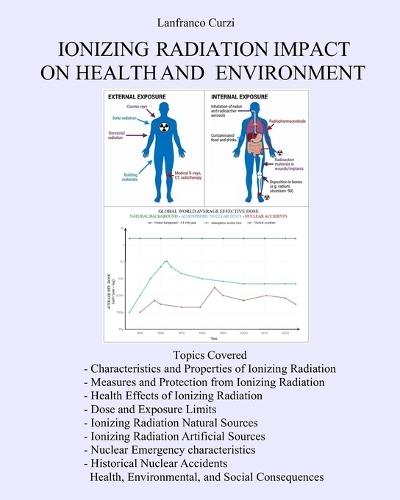
I believe that few realize that the average impact of ionizing radiation on human health essentially depends on the contribution of natural radiation sources. If you are interested in truly evaluating the real dangers of ionizing radiation from natural sources and that resulting from nuclear emergencies and explosions, this book is for you. Thanks to the contribution of 42 tables and 112 figures and explanatory diagrams, you will be able to independently evaluate the actual impact on health of: - natural radioactive sources (e.g. radon 222, polonium 210, etc.) - medical and diagnostic activities - nuclear emergencies for civil and military activities You will also be able to evaluate whether the information you have received or will receive on these topics is real or was provided for undeclared purposes This book has the following objectives: 1. Explain from a technical-scientific point of view the nature and effects of ionizing radiation on human health and the environment, whether of natural origin or generated by activities (and unfortunately accidents) linked to both civil and military operations. 2. Allow readers, thanks to the presence of specific figures/drawings and tables, to carry out their own evaluation and discernment of the information, compared to the often misleading and imprecise information which, for various biased reasons, is produced and provided to the public The book contains specific technical information which in some cases is not easily digestible by the reader, however this technical information is necessary for a correct analysis and interpretation of the topics developed. The book is developed in chapters, each of which can be read independently of one's knowledge of the technical-scientific sector. The reader can ignore the more difficult technical and mathematical aspects present in some chapters without losing their fundamental meaning, at least this is the informative purpose I have set myself. A significant chapter is dedicated to the analysis of a series of nuclear accidents, selected not only for their severity but also for their typology. From this analysis it emerges that, in terms of impact on human health and the environment, they are less dangerous than one might think, this explains why they were placed in last place (in the graph on the cover) in terms of impact on human health. The most serious nuclear accidents (such as Windscale, Mayak, Chernobyl, Fukushima), however, have had particularly devastating social and economic impacts. Topics covered - Characteristics and properties of ionizing radiation - Measurements and Protection from Ionizing Radiations - Health effects of ionizing radiation - Dose and exposure limits - Natural sources of ionizing radiation - Artificial sources of ionizing radiation - Characteristics of the nuclear emergency - Historic nuclear accidents: health, environmental and social consequences The undersigned is a nuclear engineer, therefore clearly in favor of the civil use of nuclear energy, and although I do not represent any economic, industrial or political interest, I would like to offer a contribution of clarity also to the neophyte, in a 360° vision of nuclear energy, its characteristics and its problems, regardless of party interests.
Full Product Details
Author: Curzi Lanfranco
Publisher: Independently Published
Imprint: Independently Published
Dimensions:
Width: 20.30cm
, Height: 1.10cm
, Length: 25.40cm
Weight: 0.413kg
ISBN: 9798241912008
Pages: 204
Publication Date: 30 December 2025
Audience:
General/trade
,
General
Format: Paperback
Publisher's Status: Active
Availability: Available To Order

We have confirmation that this item is in stock with the supplier. It will be ordered in for you and dispatched immediately.