Overview
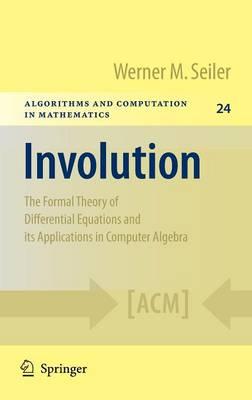
As long as algebra and geometry proceeded along separate paths, their advance was slow and their applications limited. But when these sciences joined company they drew from each other fresh vitality and thenceforward marched on at rapid pace towards perfection Joseph L. Lagrange The theory of differential equations is one of the largest elds within mathematics and probably most graduates in mathematics have attended at least one course on differentialequations. But differentialequationsare also offundamentalimportance in most applied sciences; whenever a continuous process is modelled mathem- ically, chances are high that differential equations appear. So it does not surprise that many textbooks exist on both ordinary and partial differential equations. But the huge majority of these books makes an implicit assumption on the structure of the equations: either one deals with scalar equations or with normal systems, i. e. with systems in Cauchy-Kovalevskaya form. The main topic of this book is what happens, if this popular assumption is dropped. This is not just an academic exercise; non-normal systems are ubiquitous in - plications. Classical examples include the incompressible Navier-Stokes equations of uid dynamics, Maxwell's equations of electrodynamics, the Yang-Mills eq- tions of the fundamental gauge theories in modern particle physics or Einstein's equations of general relativity. But also the simulation and control of multibody systems, electrical circuits or chemical reactions lead to non-normal systems of - dinary differential equations, often called differential algebraic equations. In fact, most of the differentialequationsnowadaysencounteredby engineersand scientists are probably not normal.
Full Product Details
Author: Werner M. Seiler
Publisher: Springer-Verlag Berlin and Heidelberg GmbH & Co. KG
Imprint: Springer-Verlag Berlin and Heidelberg GmbH & Co. K
Edition: 2010 ed.
Volume: 24
Dimensions:
Width: 15.50cm
, Height: 4.10cm
, Length: 23.50cm
Weight: 1.285kg
ISBN: 9783642012860
ISBN 10: 3642012868
Pages: 650
Publication Date: 15 November 2009
Audience:
Professional and scholarly
,
Professional & Vocational
Format: Hardback
Publisher's Status: Active
Availability: In Print

This item will be ordered in for you from one of our suppliers. Upon receipt, we will promptly dispatch it out to you. For in store availability, please contact us.
Reviews
From the reviews: The first book that provides a self-contained treatment of constructive and algorithmic ideas and methods in FTDE ! . the book Involution is unique, self-contained ! complete and, in addition, well-written with numerous instructive examples and comprehensive bibliography devoted to the constructive differential-geometric and computer-algebraic aspects of involutivity analysis of differential and polynomial equations and their applications. It can be recommended to researchers, postgraduate and advanced graduate students. (Vladimir P. Gerdt, Computeralgebra-Rundbrief, October, 2010) This book deals with the formal theory of general ! systems of differential equations. ! starts with an introduction to a geometric approach to differential equations via the jet bundle formalism. ! this is a very interesting book with many instructive examples and strong emphasis placed on a constructive approach leading to effective algorithms. It is well written, so it is suitable for and recommended to anyone who is interested in computer-algebraic aspects of involutivity analysis of differential and polynomial equations and their applications. (Lech Slawik, Mathematical Reviews, Issue 2011 h)
From the reviews: The first book that provides a self-contained treatment of constructive and algorithmic ideas and methods in FTDE ! . the book Involution is unique, self-contained ! complete and, in addition, well-written with numerous instructive examples and comprehensive bibliography devoted to the constructive differential-geometric and computer-algebraic aspects of involutivity analysis of differential and polynomial equations and their applications. It can be recommended to researchers, postgraduate and advanced graduate students. (Vladimir P. Gerdt, Computeralgebra-Rundbrief, October, 2010)
Author Information
W.M. Seiler is professor for computational mathematics (algorithmic algebra) at Kassel University. His research fields include differential equations, commutative algebra and mechanics. He is particularly interested in combining geometric and algebraic approaches. For many years, he has been an external developer for the computer algebra system MuPAD.