|
|
|||
|
||||
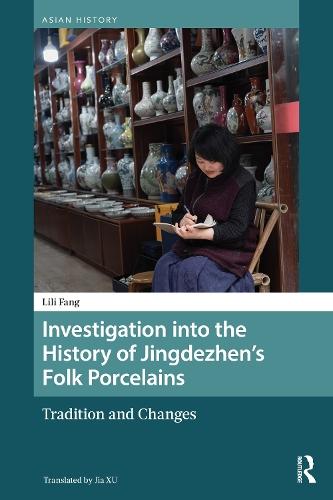
OverviewThis book seeks to understand the evolution of Jingdezhen handicraft culture from the micro to the macro perspective by comparing the recently arising ceramic workshops with the traditional approach to the craft. Following 1978 and China’s economic reforms, Jingdezhen, known as “the capital city of porcelain,” adopted a new look under the impetus of modernization. The author examines the change of social structure, people’s reaction, as well as the cultural motivation behind the change through research into the disappearance and reappearance of family porcelain workshops in Jingdezhen in the 1990s. This volume further discusses culture and techniques of Jingdezhen handicraft, as well as changes in art forms and art production during the process of China’s modernization. Representing an ethnographic account of the revival of local traditions within the broader context of globalization, this work is perfect for scholars of history, political science, sociology and cultural studies. Full Product DetailsAuthor: Lili Fang , Jia XUPublisher: Pallas Publications Imprint: Pallas Publications Weight: 0.720kg ISBN: 9789048566204ISBN 10: 9048566207 Pages: 296 Publication Date: 29 April 2026 Audience: Professional and scholarly , College/higher education , Professional & Vocational , Postgraduate, Research & Scholarly Format: Hardback Publisher's Status: Active Availability: Not yet available This item is yet to be released. You can pre-order this item and we will dispatch it to you upon its release. Table of ContentsIntroduction Part 1. The reconstruction of tradition in the process of modernization Chapter 1. The ecological and social environment of Jingdezhen porcelain production: Geographical distribution and change Chapter 2. The rise and social background of the new handicraft workshops Chapter 3. Organization of Community Businesses Chapter 4. Fanjiajing village: The antique porcelain center Chapter 5. Changes and reconstruction Part 2. Thinking about tradition Chapter 6. Porcelain trade associations in Jingdezhen Chapter 7. Guild Halls in Jingdezhen Chapter 8. The varieties of Jingdezhen porcelain Hangbang Chapter 9. Summary Part 3. The rise and decline of Jingdezhen folk kilns in the past 500 years Chapter 10. Jingdezhen folk kilns in the early Ming dynasty: Hardship and development Chapter 11. Jingdezhen folk kilns in the Mid-Ming period: Stable development Chapter 12. Jingdezhen folk kilns in the late Ming period: A turning point Chapter 13. Jingdezhen folk kiln in the early Qing period: A period of renaissance Chapter 14. Jingdezhen folk kiln in the Mid-Qing period: Coprosperity with official kiln Chapter 15. Jingdezhen folk kilns in the late Qing dynasty: Toward the bottom Chapter 16. Jingdezhen folk kilns in the late Qing dynasty and the early Republic of China: Pains and gains of early Modernization Part 4. Conclusion Chapter 17. Beyond artistic productivity Chapter 18. Disappearance of the empirical world Chapter 19. Interpreting the present and looking forward to the future in terms of tradition AfterwordsReviewsAuthor InformationLili Fang is Professor at the Institute of Art Anthropology, China National Academy of Arts. Her recent works include Construction of Localization in the Theory of Anthropology of Art (2023), From Production Centre to Art District: The Hyper-modern Development Model of Jingdezhen (2024), The Millennium Evolution of Jingdezhen’s Folk Kilns: Volume I (2025), The Formation and Development Toward a World Ceramic Center: Volume II (2025), The Construction and Transformation of Artisan Knowledge and Culture (2025) and Rethinking From the Soil (2025). Her book A History of Chinese Ceramics (2013) has been translated into English, Spanish and Russian. Translator: Jia XU is Professor of English at Beijing Institute of Technology. Her recent monographs include Shakespeare in China’s Academic Journals: A Research on Shakespearean Criticism in the Field of Foreign Literature, Theatre and Film (1949–2019) (2022) and Childhood and Coming of Age in Shakespeare’s Plays (2016). Her translated books (English to Chinese) include On Colour (2018) and DK the Shakespeare Book (2015). Tab Content 6Author Website:Countries AvailableAll regions |
||||