Overview
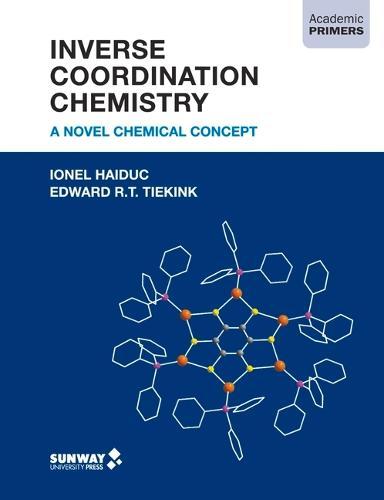
Presents the fascinating array of inverse coordination complexes, from monoatomic centres to those with organic molecules as centres, in a systematic manner with colour illustrative examples. This book is a timely and comprehensive introduction to this largely overlooked field of inverse coordination in inorganic chemistry. Inverse Coordination Chemistry features and discusses the interesting array of inverse coordination complexes, from those with monoatomic or polyatomic centres to those with organic molecules as centres. While traditional coordination complexes consist of a metal atom at the centre surrounded by inorganic ligands, inverse coordination complexes show a reversed topology: a central non-metal atom surrounded by metallic ligands. Concisely written, this book is a timely and comprehensive introduction to this exciting but largely overlooked field of inverse coordination in inorganic chemistry. This book serves as an invaluable resource for chemists, educators, and students.
Full Product Details
Author: Ionel Haiduc ,
Edward R.T. Tiekink
Publisher: Sunway University Press
Imprint: Sunway University Press
Weight: 0.327kg
ISBN: 9789675492181
ISBN 10: 967549218
Pages: 112
Publication Date: 30 June 2020
Audience:
Professional and scholarly
,
Professional & Vocational
Format: Paperback
Publisher's Status: Active
Availability: Out of stock

The supplier is temporarily out of stock of this item. It will be ordered for you on backorder and shipped when it becomes available.
Author Information
Ionel Haiduc is Professor Emeritus at Babes-Bolyai University in Cluj-Napoca, Romania. A distinguished chemist and prolific researcher, he has published over 340 journal articles and authored several books including The Chemistry of Inorganic Ring Systems (1970), Basic Organometallic Chemistry (1985), The Chemistry of Inorganic Homo- and Heterocycles (1987), Organometallics in Cancer Chemotherapy (1990), and Supramolecular Organometallic Chemistry (1999). He is a member of the Romanian Academy (former President from 2006 to 2014) and the Academia Europea (London), as well as an honorary or correspondent member of Göttingen Academy of Sciences and Humanities, Hungarian Academy of Sciences, Academy of Sciences of Moldova, and Montenegrin Academy of Sciences. Edward R.T. Tiekink is Distinguished Professor and Head of the Research Centre for Crystalline Materials at Sunway University, Malaysia. He is a graduate of the University of Melbourne, Australia (D.Sc. 2006), where his passion for structural chemistry was nurtured. He has published in excess of 2,000 research papers/reviews and co-edited a number of books reflecting his interests in crystallography and metal-based drugs, including Metallotherapeutic Drugs and Metal-Based Diagnostic Agents: The Use of Metals in Medicine (2005), Frontiers in Crystal Engineering (2006), Organic Crystal Engineering—Frontiers in Crystal Engineering (2010), and Multi-Component Crystals: Synthesis, Concepts, Function (2017). He is a Fellow of the Royal Society of Chemistry and the Royal Australian Chemical Institute.