Overview
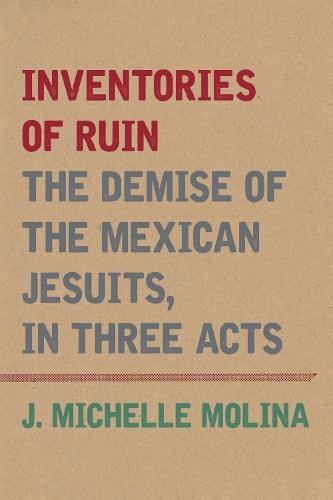
An innovative historical analysis that draws upon performance and theatre studies to stage the ruination and demise of the eighteenth-century Mexican Jesuits Inventories of Ruin dramatizes the ruination of the Mexican Province of the Society of Jesus as their power and influence waned over a period of approximately fifty years in the eighteenth-century Spanish Atlantic world. To tell the story of the arrest, migration, and ultimate dissolution of this powerful organization of missionary men, three sets of ""inventories"" are juxtaposed. The first is composed by notaries, who record the objects left behind by the Jesuits at a college in Puebla de Los Angeles when they were arrested on June 25, 1767. The second is an ""inventory of the self,"" a conversion narrative composed by a Swedish convert who encounters the Jesuit refugees while shipboard on the Mediterranean Sea. The last is an inventory of the dead written by an exiled ex-Jesuit in Bologna, Italy, whose necrology memorializes the life and death of his brethren from the now defunct Mexican province. Inventories of Ruin is about the ruination and disappearance of Jesuit ways of being that counters Jesuit historiography’s framing of this period as a moment of ""suppression."" At the same time, Inventories of Ruin is about how this story of ruination appears in the archives. The book studies the epistemological drama of inventorying, as writers labor to uproot religious power, to locate and secure a religious self, and to capture religious histories. What weighs upon these texts is a sense of anxiety because the question of what will be found animates authors whose literary exertions appear as historiographical struggles to have a say over what appears and what vanishes before leaving the stage, or before pushing others toward the exit.
Full Product Details
Author: J. Michelle Molina
Publisher: Fordham University Press
Imprint: Fordham University Press
Edition: New edition
ISBN: 9781531512293
ISBN 10: 1531512291
Pages: 304
Publication Date: 06 March 2026
Audience:
Professional and scholarly
,
Professional & Vocational
Format: Paperback
Publisher's Status: Active
Availability: Not yet available

This item is yet to be released. You can pre-order this item and we will dispatch it to you upon its release.
Reviews
""Following inventories of objects, souls, and the dead, Molina offers us a beautiful meditation, cast as a tragedy in three acts, on the material, ritual, and affective scaffoldings of early modern societies. This is a relentless exploration of the sociological undoing of the Mexican Jesuit Order after its 1767 expulsion, a deeply imaginative probe into the performative dimension and origins of Jesuit power and charisma."" - Jorge Cañizares-Esguerra, co-author of The Radical Spanish Empire: How Paperwork Politics Remade the New World
Following inventories of objects, souls, and the dead, Molina offers us a beautiful meditation, cast as a tragedy in three acts, on the material, ritual, and affective scaffoldings of early modern societies. This is a relentless exploration of the sociological undoing of the Mexican Jesuit Order after its 1767 expulsion, a deeply imaginative probe into the performative dimension and origins of Jesuit power and charisma.---Jorge Cañizares-Esguerra, co-author of The Radical Spanish Empire: How Paperwork Politics Remade the New World
Author Information
J. Michelle Molina is Associate Professor of Religious Studies at Northwestern University. Her most recent book is To Overcome Oneself: The Jesuit Ethic and the Spirit of Global Expansion, 1542–1767.