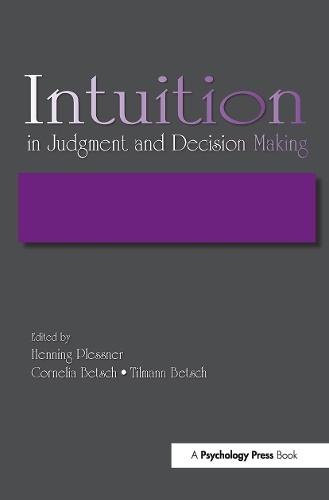
Full Product Details
Author: Henning Plessner ,
Cornelia Betsch ,
Tilmann Betsch
Publisher: Taylor & Francis Ltd
Imprint: Psychology Press Ltd
Weight: 0.476kg
ISBN: 9781138004252
ISBN 10: 1138004251
Pages: 356
Publication Date: 30 May 2014
Audience:
Professional and scholarly
,
Professional & Vocational
Format: Paperback
Publisher's Status: Active
Availability: In Print

This item will be ordered in for you from one of our suppliers. Upon receipt, we will promptly dispatch it out to you. For in store availability, please contact us.
Reviews
"""Psychology and decision sciences have for too long been out of the mainstream of the other natural sciences, mainly evolutionary biology and neuroscience, by putting the conscious cart before the unconscious horse. Finally, a collection of essays by leading experts in human reasoning and decision making that takes the unconscious seriously as a force in producing important decisions. This book provides a much needed counterweight to the dominant 'conscious and rational' model of human decision making. Hats off to the editors for gathering just those authors who are doing the cutting edge research in this area, as well as for the original idea to produce this much needed collection."" - John A. Bargh, Yale University ""This volume examines in depth ""intuition"", one of the most often mentioned and yet least systematically investigated concepts of lay psychology. It provides a well rounded discussion that covers the manifold aspects of this fascinating phenomenon. The book is successful in bringing together ample cutting edge insights into what intuitive judgment might entail. It is timely, thought provoking and comprehensive. A must read for anyone interested in the intricacies of human judgment and impression formation."" - Arie W. Kruglanski, University of Maryland ""Intuition in Judgment and Decision Making is the most insightful scholarly book about intuition ever written. For years to come, future scholarship on intuition will draw on its ideas and fascinating revelations."" - David G. Myers, Hope College, author of Intuition: Its Powers and Perils ""The study of human cognition is replete with dichotomies: controlled vs. automatic, implicit vs. explicit, analytic vs. heuristic, associative vs. rule based, experiential vs. rational, procedural vs. declarative or just plain and simple System 1 vs. System 2. The common theme is that we have access to two distinct modes of processing-one that is ""intuitive"" and the other ""deliberate"". This invaluable book provides an extensive exploration of how these modes might be used in judgment and decision making, with a particular emphasis on the perhaps underestimated role of intuition. Leading researchers present new data on how these two modes might work alone and in concert to improve our judgments and decisions. The impressive breadth and depth of coverage will allow readers to draw informed conclusions about the power of intuitive thought."" - Ben Newell, University of New South Wales, Sydney ""Overall, Intuition provides an excellent overview of many different fields of research within this intriguing area..."" - Stuart W. G. Derbyshire, PsycCRITIQUES ""The role of intuition in human performance has been often overlooked, or even treated with disdain. The contributions to this volume catalogue a wide variety of scientific research aimed at uncovering the mechanisms underlying the acquisition of intuitive knowledge...such a volume is possible suggests that perhaps intuition is finally beginning to get the respect it deserves."" - Robert C. Mathews, Applied Cognitive Psychology ""Psychology and decision sciences have for too long been out of the mainstream of the other natural sciences, mainly evolutionary biology and neuroscience, by putting the conscious cart before the unconscious horse. Finally, a collection of essays by leading experts in human reasoning and decision making that takes the unconscious seriously as a force in producing important decisions. This book provides a much needed counterweight to the dominant 'conscious and rational' model of human decision making. Hats off to the editors for gathering just those authors who are doing the cutting edge research in this area, as well as for the original idea to produce this much needed collection."" —John A. Bargh Yale University “This volume examines in depth ""intuition"", one of the most often mentioned and yet least systematically investigated concepts of lay psychology. It provides a well rounded discussion that covers the manifold aspects of this fascinating phenomenon. The book is successful in bringing together ample cutting edge insights into what intuitive judgment might entail. It is timely, thought provoking and comprehensive. A must read for anyone interested in the intricacies of human judgment and impression formation.” —Arie W. Kruglanski University of Maryland"
Psychology and decision sciences have for too long been out of the mainstream of the other natural sciences, mainly evolutionary biology and neuroscience, by putting the conscious cart before the unconscious horse. Finally, a collection of essays by leading experts in human reasoning and decision making that takes the unconscious seriously as a force in producing important decisions. This book provides a much needed counterweight to the dominant 'conscious and rational' model of human decision making. Hats off to the editors for gathering just those authors who are doing the cutting edge research in this area, as well as for the original idea to produce this much needed collection. - John A. Bargh, Yale University This volume examines in depth intuition , one of the most often mentioned and yet least systematically investigated concepts of lay psychology. It provides a well rounded discussion that covers the manifold aspects of this fascinating phenomenon. The book is successful in bringing together ample cutting edge insights into what intuitive judgment might entail. It is timely, thought provoking and comprehensive. A must read for anyone interested in the intricacies of human judgment and impression formation. - Arie W. Kruglanski, University of Maryland Intuition in Judgment and Decision Making is the most insightful scholarly book about intuition ever written. For years to come, future scholarship on intuition will draw on its ideas and fascinating revelations. - David G. Myers, Hope College, author of Intuition: Its Powers and Perils The study of human cognition is replete with dichotomies: controlled vs. automatic, implicit vs. explicit, analytic vs. heuristic, associative vs. rule based, experiential vs. rational, procedural vs. declarative or just plain and simple System 1 vs. System 2. The common theme is that we have access to two distinct modes of processing-one that is intuitive and the other deliberate . This invaluable book provides an extensive exploration of how these modes might be used in judgment and decision making, with a particular emphasis on the perhaps underestimated role of intuition. Leading researchers present new data on how these two modes might work alone and in concert to improve our judgments and decisions. The impressive breadth and depth of coverage will allow readers to draw informed conclusions about the power of intuitive thought. - Ben Newell, University of New South Wales, Sydney Overall, Intuition provides an excellent overview of many different fields of research within this intriguing area... - Stuart W. G. Derbyshire, PsycCRITIQUES The role of intuition in human performance has been often overlooked, or even treated with disdain. The contributions to this volume catalogue a wide variety of scientific research aimed at uncovering the mechanisms underlying the acquisition of intuitive knowledge...such a volume is possible suggests that perhaps intuition is finally beginning to get the respect it deserves. - Robert C. Mathews, Applied Cognitive Psychology
""Psychology and decision sciences have for too long been out of the mainstream of the other natural sciences, mainly evolutionary biology and neuroscience, by putting the conscious cart before the unconscious horse. Finally, a collection of essays by leading experts in human reasoning and decision making that takes the unconscious seriously as a force in producing important decisions. This book provides a much needed counterweight to the dominant 'conscious and rational' model of human decision making. Hats off to the editors for gathering just those authors who are doing the cutting edge research in this area, as well as for the original idea to produce this much needed collection."" - John A. Bargh, Yale University ""This volume examines in depth ""intuition"", one of the most often mentioned and yet least systematically investigated concepts of lay psychology. It provides a well rounded discussion that covers the manifold aspects of this fascinating phenomenon. The book is successful in bringing together ample cutting edge insights into what intuitive judgment might entail. It is timely, thought provoking and comprehensive. A must read for anyone interested in the intricacies of human judgment and impression formation."" - Arie W. Kruglanski, University of Maryland ""Intuition in Judgment and Decision Making is the most insightful scholarly book about intuition ever written. For years to come, future scholarship on intuition will draw on its ideas and fascinating revelations."" - David G. Myers, Hope College, author of Intuition: Its Powers and Perils ""The study of human cognition is replete with dichotomies: controlled vs. automatic, implicit vs. explicit, analytic vs. heuristic, associative vs. rule based, experiential vs. rational, procedural vs. declarative or just plain and simple System 1 vs. System 2. The common theme is that we have access to two distinct modes of processing-one that is ""intuitive"" and the other ""deliberate"". This invaluable book provides an extensive exploration of how these modes might be used in judgment and decision making, with a particular emphasis on the perhaps underestimated role of intuition. Leading researchers present new data on how these two modes might work alone and in concert to improve our judgments and decisions. The impressive breadth and depth of coverage will allow readers to draw informed conclusions about the power of intuitive thought."" - Ben Newell, University of New South Wales, Sydney ""Overall, Intuition provides an excellent overview of many different fields of research within this intriguing area..."" - Stuart W. G. Derbyshire, PsycCRITIQUES ""The role of intuition in human performance has been often overlooked, or even treated with disdain. The contributions to this volume catalogue a wide variety of scientific research aimed at uncovering the mechanisms underlying the acquisition of intuitive knowledge...such a volume is possible suggests that perhaps intuition is finally beginning to get the respect it deserves."" - Robert C. Mathews, Applied Cognitive Psychology ""Psychology and decision sciences have for too long been out of the mainstream of the other natural sciences, mainly evolutionary biology and neuroscience, by putting the conscious cart before the unconscious horse. Finally, a collection of essays by leading experts in human reasoning and decision making that takes the unconscious seriously as a force in producing important decisions. This book provides a much needed counterweight to the dominant 'conscious and rational' model of human decision making. Hats off to the editors for gathering just those authors who are doing the cutting edge research in this area, as well as for the original idea to produce this much needed collection."" —John A. Bargh Yale University “This volume examines in depth ""intuition"", one of the most often mentioned and yet least systematically investigated concepts of lay psychology. It provides a well rounded discussion that covers the manifold aspects of this fascinating phenomenon. The book is successful in bringing together ample cutting edge insights into what intuitive judgment might entail. It is timely, thought provoking and comprehensive. A must read for anyone interested in the intricacies of human judgment and impression formation.” —Arie W. Kruglanski University of Maryland
Author Information
Cornelia Betsch, Henning Plessner, Tilmann Betsch