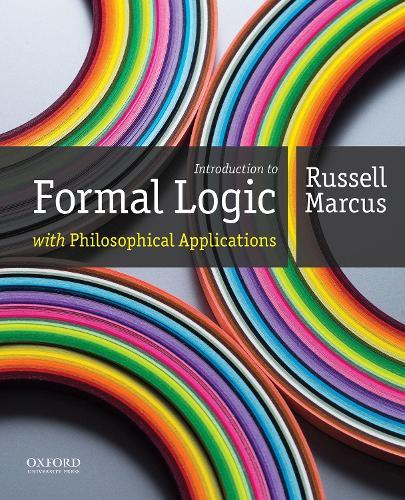
Full Product Details
Author: Marcus
Publisher: Oxford University Press Inc
Imprint: Oxford University Press Inc
Dimensions:
Width: 19.10cm
, Height: 2.30cm
, Length: 23.40cm
Weight: 1.039kg
ISBN: 9780199386482
ISBN 10: 019938648
Pages: 624
Publication Date: 15 December 2017
Audience:
College/higher education
,
Tertiary & Higher Education
Format: Paperback
Publisher's Status: Active
Availability: To order

Stock availability from the supplier is unknown. We will order it for you and ship this item to you once it is received by us.
Reviews
Introduction to Formal Logic with Philosophical Applications is a superb treatment of the subject. It is unusually lucid, meeting students where they are and guiding them in a step-by-step manner through the rigors of symbolic logic. All of this without sacrificing the kind of detail and precision that is a sine qua non for textbooks of this kind. --Michael Futch, University of Tulsa This is a superb treatment of formal logic. In my opinion, it's not too difficult and not too easy. --Leemon McHenry, California State University, Northridge This is a book that enables students to become comfortable with the basics of logic while also allowing them to understand why they are doing logic. --Andrew Winters, Slippery Rock University of Pennsylvania Hurley has the advantage of breadth, but lacks the depth, whereas Hausman has depth, but lacks the clarity of Marcus. Chapter 7 is my favorite chapter, as Marcus addresses philosophical issues of logic. What I like is that this chapter can be used throughout the semester. And I loved the paper topics suggested throughout the book. --Reginald Raymer, University of North Carolina, Charlotte Introduction to Formal Logic with Philosophical Applications is better than what I now use. It's an excellent introductory text--precise, detailed, and clear, with lots of exercises and a wealth of interesting supplementary material. --Jeff Buechner, Rutgers University, Newark Marcus's text is invitingly written, lucid, and often intuitive, providing students with easy-to-follow conceptual development. None of this, however, comes at the expense of a thorough presentation and suitable opportunities to practice. --Mia Wood, Pierce College Introduction to Logic with Philosophical Applications does an excellent job of addressing the connections between logic and philosophy. It is thorough and rigorous in presentation, yet the prose is conversational and easy to follow. The tone is appropriately conversational and engaging, and the explanations are clear. Pedagogically, the book is excellent. The very large number of exercises at the end of each section is one of the very first things that stood out to me. This will give students plenty of exercise in learning to use logic. I am also always concerned about pricing for my students. The fact that Introduction to Logic with Philosophical Applications is $50.00 less than The Logic Book definitely counts in this text's favor. --Joseph Long, The College at Brockport, State University of New York
Introduction to Formal Logic with Philosophical Applications is a superb treatment of the subject. It is unusually lucid, meeting students where they are and guiding them in a step-by-step manner through the rigors of symbolic logic. All of this without sacrificing the kind of detail and precision that is a sine qua non for textbooks of this kind. --Michael Futch, University of Tulsa This is a superb treatment of formal logic. In my opinion, it's not too difficult and not too easy. --Leemon McHenry, California State University, Northridge This is a book that enables students to become comfortable with the basics of logic while also allowing them to understand why they are doing logic. --Andrew Winters, Slippery Rock University of Pennsylvania Hurley has the advantage of breadth, but lacks the depth, whereas Hausman has depth, but lacks the clarity of Marcus. Chapter 7 is my favorite chapter, as Marcus addresses philosophical issues of logic. What I like is that this chapter can be used throughout the semester. And I loved the paper topics suggested throughout the book. --Reginald Raymer, University of North Carolina, Charlotte Introduction to Formal Logic with Philosophical Applications is better than what I now use. It's an excellent introductory text--precise, detailed, and clear, with lots of exercises and a wealth of interesting supplementary material. --Jeff Buechner, Rutgers University, Newark
Author Information
Russell Marcus is Associate Professor of Philosophy at Hamilton College.