Overview
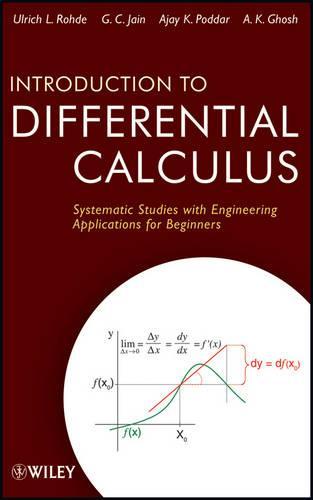
Enables readers to apply the fundamentals of differential calculus to solve real-life problems in engineering and the physical sciences Introduction to Differential Calculus fully engages readers by presenting the fundamental theories and methods of differential calculus and then showcasing how the discussed concepts can be applied to real-world problems in engineering and the physical sciences. With its easy-to-follow style and accessible explanations, the book sets a solid foundation before advancing to specific calculus methods, demonstrating the connections between differential calculus theory and its applications. The first five chapters introduce underlying concepts such as algebra, geometry, coordinate geometry, and trigonometry. Subsequent chapters present a broad range of theories, methods, and applications in differential calculus, including: Concepts of function, continuity, and derivative Properties of exponential and logarithmic function Inverse trigonometric functions and their properties Derivatives of higher order Methods to find maximum and minimum values of a function Hyperbolic functions and their properties Readers are equipped with the necessary tools to quickly learn how to understand a broad range of current problems throughout the physical sciences and engineering that can only be solved with calculus. Examples throughout provide practical guidance, and practice problems and exercises allow for further development and fine-tuning of various calculus skills. Introduction to Differential Calculus is an excellent book for upper-undergraduate calculus courses and is also an ideal reference for students and professionals alike who would like to gain a further understanding of the use of calculus to solve problems in a simplified manner.
Full Product Details
Author: Ulrich L. Rohde (Synergy Microwave Corp.) ,
G. C. Jain (Defense Research and Development Organization) ,
Ajay K. Poddar (Synergy Microwave Corp.) ,
A. K. Ghosh (Indian Institute of Technology)
Publisher: John Wiley & Sons Inc
Imprint: John Wiley & Sons Inc
Dimensions:
Width: 16.50cm
, Height: 4.50cm
, Length: 24.30cm
Weight: 1.229kg
ISBN: 9781118117750
ISBN 10: 1118117751
Pages: 784
Publication Date: 09 February 2012
Audience:
Professional and scholarly
,
Professional & Vocational
Format: Hardback
Publisher's Status: Active
Availability: Available To Order

We have confirmation that this item is in stock with the supplier. It will be ordered in for you and dispatched immediately.
Reviews
The book is addressed mainly to students studyingnon-mathematical subjects. It will be also helpful for those whowant to understand why it is important to study Calculus and how toapply it. (Zentralblatt MATH, 1 December2012)
The book is addressed mainly to students studying non-mathematical subjects. It will be also helpful for those who want to understand why it is important to study Calculus and how to apply it. (Zentralblatt MATH, 1 December 2012)
The book is addressed mainly to students studying non-mathematical subjects. It will be also helpful for those who want to understand why it is important to study Calculus and how to apply it. ( Zentralblatt MATH , 1 December 2012)
Author Information
Ulrich L. Rohde, PhD, ScD, Dr-Ing, is Chairman of Synergy Microwave Corporation, President of Communications Consulting Corporation, and a Partner of Rohde & Schwarz. A Fellow of the IEEE, Professor Rohde holds several patents and has published more than 200 scientific papers. G. C. Jain, BSc, is a retired scientist from the Defense Research and Development Organization in India. Ajay K. Poddar, PhD, is Chief Scientist at Synergy Microwave Corporation. A Senior Member of the IEEE, Dr. Poddar holds several dozen patents and has published more than 180 scientific papers. A. K. Ghosh, PhD, is Professor in the Department of Aerospace Engineering at IIT Kanpur, India. He has published more than 120 scientific papers.