Overview
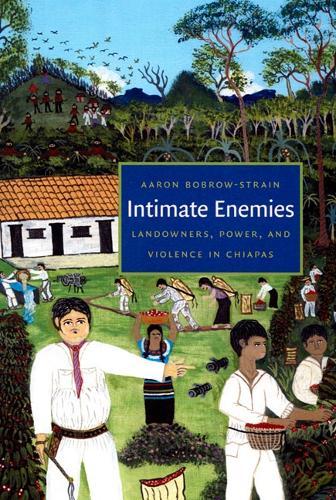
Intimate Enemies is the first book to explore conflicts in Chiapas from the perspective of the landed elites, crucial but almost entirely unexamined actors in the state's violent history. Scholarly discussion of agrarian politics has typically cast landed elites as ""bad guys"" with predetermined interests and obvious motives. Aaron Bobrow-Strain takes the landowners of Chiapas seriously, asking why coffee planters and cattle ranchers with a long and storied history of violent responses to agrarian conflict reacted to land invasions triggered by the Zapatista Rebellion of 1994 with quiescence and resignation rather than thugs and guns. In the process, he offers a unique ethnographic and historical glimpse into conflicts that have been understood almost exclusively through studies of indigenous people and movements. Weaving together ethnography, archival research, and cultural history, Bobrow-Strain argues that prior to the upheavals of 1994 landowners were already squeezed between increasingly organized indigenous activism and declining political and economic support from the Mexican state. He demonstrates that indigenous mobilizations that began in 1994 challenged not just the economy of estate agriculture but also landowners' understandings of progress, masculinity, ethnicity, and indigenous docility. By scrutinizing the elites' responses to land invasions in relation to the cultural politics of race, class, and gender, Bobrow-Strain provides timely insights into policy debates surrounding the recent global resurgence of peasant land reform movements. At the same time, he rethinks key theoretical frameworks that have long guided the study of agrarian politics by engaging political economy and critical human geography's insights into the production of space. Describing how a carefully defended world of racial privilege, political dominance, and landed monopoly came unglued, Intimate Enemies is a remarkable account of how power works in the countryside.
Full Product Details
Author: Aaron Bobrow-Strain
Publisher: Duke University Press
Imprint: Duke University Press
Dimensions:
Width: 15.90cm
, Height: 1.80cm
, Length: 24.10cm
Weight: 0.408kg
ISBN: 9780822340041
ISBN 10: 0822340046
Pages: 288
Publication Date: 27 June 2007
Audience:
Professional and scholarly
,
Professional & Vocational
Format: Paperback
Publisher's Status: Active
Availability: In Print

This item will be ordered in for you from one of our suppliers. Upon receipt, we will promptly dispatch it out to you. For in store availability, please contact us.
Reviews
Aaron Bobrow-Strain has made an invaluable, important contribution to our understanding of political conflict in Chiapas. This is the first book-length analysis in English that closely documents the landowners' perspectives on the Zapatista uprising and the struggle for land since 1994. This is a very timely analysis that sheds light on the complex and shifting relationships between landowners, government officials, and agrarian organizations. --Neil Harvey, author of The Chiapas Rebellion: The Struggle for Land and Democracy Whether we knew it or not, Intimate Enemies is the book that we have been waiting for since at least 1994: the book about the other side of Chiapas's rural society, its ladino landowners. Gracefully written, evocative, and wise, it is just superb. --Jan Rus, coeditor of Mayan Lives, Mayan Utopias: The Indigenous Peoples of Chiapas and the Zapatista Rebellion Intimate Enemies is a well-written, engaging, and carefully argued account of agrarian change in Chiapas. Its focus on the struggles over territoriality that accompany land conflict, as well as emphasis on the views of the indigenous other, allow it to provide an alternative understanding of hte Chiapas story. I see this as the greatest contribution of the book. --Environment and Planning A 2008 Volume 40 Bobrow-Strain's book provides a fascinating examination of the structures of elite landowner power and attitudes that have been so forcefully attacked and to a surprising degree undermined by indigenous rebellion during the last decade...original and fascinating - Harry Cleaver in Bulletin of Latin American Research, Vol. 28, No. 2, April 2009
Intimate Enemies is a fascinating interdisciplinary book that will be valuable to social scientists interested in questions of land reform, landed production, state-society relations, and indigenous politics... Bobrow-Strain has written a nuanced thick description deeply informed by the literature on landed production and hegemony. I recommend this book highly. -- Shannan L. Mattiace, Journal of Latin American and Caribbean Anthropology [A] a fascinating ethnography and cultural history of the landed elites of Chilon in the northern zone of Mexico's southernmost state of Chiapas... The lesson of Bobrow-Strain's excellent book is that not only peasants but also landowners respond to shifting circumstances in ways not predetermined by a generic class label. -- Richard Stahler-Sholk, Journal of Latin American Studies [T]his is an important book that, in a logical and convincing manner, explains how landowners responded to the various pressures and tensions of their positions as local elites in an isolated area of Chiapas and why they ultimately accepted the loss of the land that had provided them with status and almost unassailable power... Bobrow-Strain is to be commended for his facility in using oral and archival sources to provide what had been one of the missing pieces in the Chiapas puzzle. -- Todd Hartch, American Historical Review Bobrow-Strain makes a subtle and sympathetic contribution to understanding how landowning elites respond to agrarian conflict. An unexpected bonus is that the sensitivity and integrity of his insights is matched by the quality of his writing, making the book not only highly informative but a positive delight to read... [Intimate Enemies] deserves to be read by anyone wishing to understand how complex power relations play out in the warp and weave of agrarian politics. -- Deborah Eade, Development in Practice The book is lyrically written, theoretically rich, and very interesting. It tells a story that has not been told before, and it challenges some deeply held conceptions of the history of land in Chiapas. For those who study Chiapas, it will immediately become an indispensable text. For those who study land, peasants, and agriculture-anywhere-this book makes clear that the other side of the story is part of the story itself. -- Courtney Jung, Comparative Politics Aaron Bobrow-Strain has made an invaluable, important contribution to our understanding of political conflict in Chiapas. This is the first book-length analysis in English that closely documents the landowners' perspectives on the Zapatista uprising and the struggle for land since 1994. This is a very timely analysis that sheds light on the complex and shifting relationships between landowners, government officials, and agrarian organizations. -Neil Harvey, author of The Chiapas Rebellion: The Struggle for Land and Democracy Whether we knew it or not, Intimate Enemies is the book that we have been waiting for since at least 1994: the book about the other side of Chiapas's rural society, its ladino landowners. Gracefully written, evocative, and wise, it is just superb. -Jan Rus, coeditor of Mayan Lives, Mayan Utopias: The Indigenous Peoples of Chiapas and the Zapatista Rebellion
"""Aaron Bobrow-Strain has made an invaluable, important contribution to our understanding of political conflict in Chiapas. This is the first book-length analysis in English that closely documents the landowners' perspectives on the Zapatista uprising and the struggle for land since 1994. This is a very timely analysis that sheds light on the complex and shifting relationships between landowners, government officials, and agrarian organizations.""--Neil Harvey, author of The Chiapas Rebellion: The Struggle for Land and Democracy ""Whether we knew it or not, Intimate Enemies is the book that we have been waiting for since at least 1994: the book about the other side of Chiapas's rural society, its ladino landowners. Gracefully written, evocative, and wise, it is just superb.""--Jan Rus, coeditor of Mayan Lives, Mayan Utopias: The Indigenous Peoples of Chiapas and the Zapatista Rebellion ""Intimate Enemies is a well-written, engaging, and carefully argued account of agrarian change in Chiapas. Its focus on the struggles over territoriality that accompany land conflict, as well as emphasis on the views of the indigenous other, allow it to provide an alternative understanding of hte Chiapas story. I see this as the greatest contribution of the book.""--Environment and Planning A 2008 Volume 40 ""Bobrow-Strain's book provides a fascinating examination of the structures of elite landowner power and attitudes that have been so forcefully attacked and to a surprising degree undermined by indigenous rebellion during the last decade...original and fascinating""- Harry Cleaver in Bulletin of Latin American Research, Vol. 28, No. 2, April 2009"
Author Information
Aaron Bobrow-Strain is Assistant Professor of Politics at Whitman College.