Overview
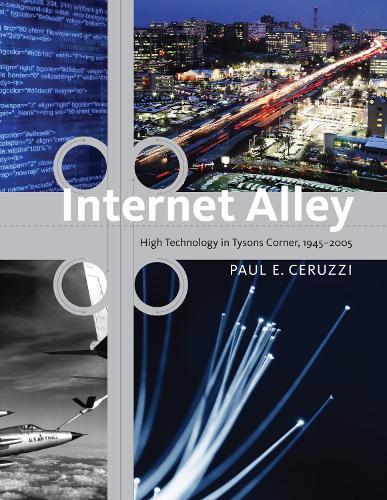
How government military contractors and high-tech firms transformed an unincorporated suburban crossroads into the center of the world's Internet management and governance. Much of the world's Internet management and governance takes place in a corridor extending west from Washington, DC, through northern Virginia toward Washington Dulles International Airport. Much of the United States' military planning and analysis takes place here as well. At the center of that corridor is Tysons Corner—an unincorporated suburban crossroads once dominated by dairy farms and gravel pits. Today, the government contractors and high- tech firms—companies like DynCorp, CACI, Verisign, and SAIC—that now populate this corridor have created an “Internet Alley” off the Washington Beltway. In From Tysons Corner to Internet Alley, Paul Ceruzzi examines this compact area of intense commercial development and describes its transformation into one of the most dynamic and prosperous regions in the country. Ceruzzi explains how a concentration of military contractors carrying out weapons analysis, systems engineering, operations research, and telecommunications combined with suburban growth patterns to drive the region's development. The dot-com bubble's burst was offset here, he points out, by the government's growing national security-related need for information technology. Ceruzzi looks in detail at the nature of the work carried out by these government contractors and how it can be considered truly innovative in terms of both technology and management. Today in Tysons Corner, clusters of sleek new office buildings housing high-technology companies stand out against the suburban landscape, and the upscale Tysons Galleria Mall is neighbor to a government-owned radio tower marked by a sign warning visitors not to photograph or sketch it. Ceruzzi finds that a variety of perennially relevant issues intersect here, making it both a literal and figurative crossroads: federal support of scientific research, the shift of government activities to private contractors, local politics of land use, and the postwar movement from central cities to suburbs.
Full Product Details
Author: Paul E. Ceruzzi (Curator of Aerospace Electronics and Computing, National Air & Space Museum/ Smithsonian Institution)
Publisher: MIT Press Ltd
Imprint: MIT Press
Dimensions:
Width: 17.80cm
, Height: 1.60cm
, Length: 22.90cm
Weight: 0.408kg
ISBN: 9780262516686
ISBN 10: 0262516683
Pages: 256
Publication Date: 23 September 2011
Recommended Age: From 18
Audience:
Professional and scholarly
,
Professional & Vocational
Format: Paperback
Publisher's Status: Out of Stock Indefinitely
Availability: In Print

Limited stock is available. It will be ordered for you and shipped pending supplier's limited stock.
Reviews
"""An exemplar of how the history of technology can help us understand our own cities, this book not only adds critical new information regarding such prominent but enigmatic corporations as SAIC and the Carlyle Group (not to mention AOL and NRA), but also unites the strains of 'regionalism' and 'federalism' in the history of technology.""--David Mindell, Director, Program in Science, Technology, and Society, MIT ""This is a visionary look at Tyson's Corner as the driving force of the nation's technological economy. Paul Ceruzzi has taken a story of regional history and woven it with the history of internet development, creating a unique and compelling read that reveals the little-understood symbiosis between government and private enterprise in the realm of computers.""--Michael R. Williams, Professor Emeritus, Department of Computer Science, University of Calgary -- Michael R. Williams ""Rich in persuasive detail, Cerruzi's Internet Alley is a lively narrative and eye-opening account that tells the unheralded story of a rival to Silicon Valley.""--Tom Hughes author of Human-Built World -- Thomas Parke Hughes ""Rich in persuasive detail, Ceruzzi's Internet Alley is a lively narrative and eye-opening account that tells the unheralded story of a rival to Silicon Valley."" Tom Hughes , author of Human-Built World ""This is a visionary look at Tysons Corner as the driving force of the nation's technological economy. Paul Ceruzzi has taken a story of regional history and woven it with the history of internet development, creating a unique and compelling read that reveals the little-understood symbiosis between government and private enterprise in the realm of computers."" Michael R. Williams , Professor Emeritus, Department of Computer Science, University of Calgary"
An exemplar of how the history of technology can help us understand our own cities, this book not only adds critical new information regarding such prominent but enigmatic corporations as SAIC and the Carlyle Group (not to mention AOL and NRA), but also unites the strains of 'regionalism' and 'federalism' in the history of technology. --David Mindell, Director, Program in Science, Technology, and Society, MIT This is a visionary look at Tyson's Corner as the driving force of the nation's technological economy. Paul Ceruzzi has taken a story of regional history and woven it with the history of internet development, creating a unique and compelling read that reveals the little-understood symbiosis between government and private enterprise in the realm of computers. --Michael R. Williams, Professor Emeritus, Department of Computer Science, University of Calgary -- Michael R. Williams Rich in persuasive detail, Cerruzi's Internet Alley is a lively narrative and eye-opening account that tells the unheralded story of a rival to Silicon Valley. --Tom Hughes author of Human-Built World -- Thomas Parke Hughes Rich in persuasive detail, Ceruzzi's Internet Alley is a lively narrative and eye-opening account that tells the unheralded story of a rival to Silicon Valley. Tom Hughes , author of Human-Built World This is a visionary look at Tysons Corner as the driving force of the nation's technological economy. Paul Ceruzzi has taken a story of regional history and woven it with the history of internet development, creating a unique and compelling read that reveals the little-understood symbiosis between government and private enterprise in the realm of computers. Michael R. Williams , Professor Emeritus, Department of Computer Science, University of Calgary
Author Information
Paul E. Ceruzzi is Curator at the National Air and Space Museum at the Smithsonian Institution. He is the author of Computing: A Concise History,A History of Modern Computing, and Internet Alley: High Technology in Tysons Corner, 1945–2005, all published by the MIT Press, and other books.