Overview
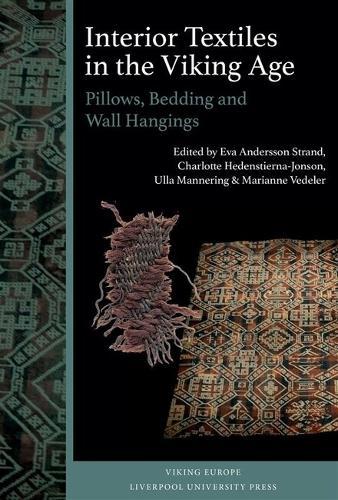
When Viking Age house interiors are reconstructed, the focus is usually on the fireplace and the placement of tables, benches and beds. These features help us understand how people lived. However, we often forget that textiles, such as blankets, sheets, tablecloths and wall hangings, were also important in everyday life. Textiles were used for comfort, cleaning and decoration, and they helped tell stories as well as signal a person’s or family’s social status. Most Viking Age textiles that have survived are found in graves. These include not only clothing but also bedding, pillows and fabrics used to wrap objects. A burial can be seen as a kind of room for the dead, filled with items that reflect how people lived and what they valued. Because of this, grave finds are important when discussing the interior textiles used in Viking Age houses. Wall hangings are mentioned as status symbols in the Icelandic sagas, and examples from the late Viking Age and early medieval period have been found and preserved in churches, giving us insight into their use and value. Old Norse texts also mention soft furnishings such as tablecloths and handcloths, and the use of interior textiles can be seen on the Bayeux embroidery. Other types of iconography, such as on rune stones and picture stones, help us understand how interior textiles may have been used. By combining information from textiles, written sources and iconography, and by applying different approaches, the chapters in this book offer various perspectives on how interior textiles were used in the Viking Age, why they were needed and how valuable they were.
Full Product Details
Author: Eva Andersson Strand ,
Charlotte Hedenstierna-Jonson ,
Ulla Mannering ,
Marianne Vedeler
Publisher: Liverpool University Press
Imprint: Liverpool University Press
ISBN: 9781836245131
ISBN 10: 1836245130
Pages: 232
Publication Date: 27 March 2026
Audience:
Professional and scholarly
,
Professional & Vocational
Format: Hardback
Publisher's Status: Active
Availability: In Print

This item will be ordered in for you from one of our suppliers. Upon receipt, we will promptly dispatch it out to you. For in store availability, please contact us.
Author Information
Eva Andersson Strand is a Professor of Archaeology at the University of Copenhagen. Her research focuses on the social, cultural and economic impact of textiles on ancient societies. She has many years of experience studying the organisation and production of textile crafts, using archaeological materials, practical experiments and digital tools. Charlotte Hedenstierna-Jonson is an Associate Professor of Archaeology at Uppsala University. She has spent many years researching the Viking town of Birka, focusing on warriors, cultural exchange and connections between Scandinavia, Eastern Europe and Eurasia. Ulla Mannering is a Research Professor in Textile Archaeology at the National Museum of Denmark. She looks after the museum’s collection of prehistoric textiles and clothing, and has over twenty-five years of experience studying ancient fabrics and using science to learn more about them. Marianne Vedeler is a Professor of Archaeology at the Museum of Cultural History, University of Oslo. She has more than thirty years of experience working with museum collections and studying textiles. Her research focuses on clothing, textile trade and food culture.