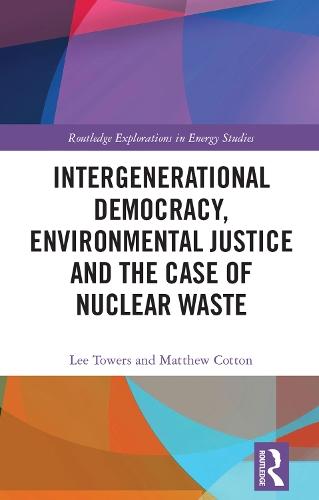
Intergenerational Democracy, Environmental Justice and the Case of Nuclear Waste

Author:   Lee Towers ,  Matthew Cotton
Publisher:   Taylor & Francis Ltd
ISBN:  

9781032728001


Pages:   190
Publication Date:   21 May 2026
Format:   Paperback
Availability:   Not yet available   Availability explained
This item is yet to be released. You can pre-order this item and we will dispatch it to you upon its release.

Our Price $119.00 Quantity:  
Pre-Order

Share |

Intergenerational Democracy, Environmental Justice and the Case of Nuclear Waste


Overview

Full Product Details

Author:   Lee Towers ,  Matthew Cotton
Publisher:   Taylor & Francis Ltd
Imprint:   Routledge
ISBN:  

9781032728001


ISBN 10:   1032728000
Pages:   190
Publication Date:   21 May 2026
Audience:   College/higher education ,  Tertiary & Higher Education
Format:   Paperback
Publisher's Status:   Forthcoming
Availability:   Not yet available   Availability explained
This item is yet to be released. You can pre-order this item and we will dispatch it to you upon its release.

Table of Contents

Introduction Defining Intergenerational Justice Three Features of Intergenerational Justice Children as Proxies of Future Generations Indigenous Societies and the World System Humanity, Ethnoclass, Ability, Gender, and Sexuality Book Outline Part One – Intergenerational justice dilemmas Chapter 1: The philosophical challenge of intergenerational justice Philosophical challenges and concepts in intergenerational justice Can future people have rights? The non-identity problem What obligations do we hold to future generations? The problem of reciprocity The weighting of future obligations – the issue of social discounting Sufficientarianism, or is enough, enough? Environmental Rights Ontological challenges Conclusions Chapter 2: Alternative philosophical traditions Social Relations of the Gift Indigenous Perspectives on Justice and Time Defining the Human Across Deep Time The Over-determination of Man Conclusions – a new/old subjectivity for intergenerational justice Chapter 3: Mainstream Economics and Scarce Justice Generational Wealth Transfers Trading Justice The Economics of the Anthropocene Conclusions Chapter 4: Abundant Justice and Democracy Intergenerational Dilemmas Children and Young People as Future Generational Proxies Intergenerational Democracy Media Framings of Youth Protestors Youth as Proxies The UN Convention on the Rights of Children The Intergenerational Capability Approach Future Studies, Decoloniality, and Backcasting Mainstream Future Studies Backcasting Decolonised? Conclusions Part Two – Nuclear Waste and Intergenerational Democracy Chapter 5: Critical Nuclear Concepts Nuclear Landscapes & Communities Peripheralisation Energopower Nuclear Colonialism Conclusions Chapter 6: Canada and the Nuclear Waste Management Organisation Context and Histories NWMO – Aims, Scope and Assumptions The Search for a GDF Site and Implementation Conclusions Chapter 7: The World’s First GDF – Finland Context and History Aims, Scope and Assumptions of NWMOs in Finland STUK TVO & Fortum Posiva Shared Assumptions Implementation of the Most Advanced GDF in the World Finland’s Search for a GDF Media Representations and Consumption Intragenerational and Intergeneration Justice and Finland’s GDF Conclusions Chapter 8: The United Kingdom and Nuclear Power and Waste Context and history of nuclear technologies in the United Kingdom Period one – Economic and Military Securitisation Period 2. Nuclear energy expansion and the recognition of waste as an environmental concern Period 3. The Deliberative Turn Period 4. Climate change securitisation Current UK Nuclear Waste Policy Implementation of the GDF Expanding Costs and Expanding Inventories Democratic Deficits and the Nuclear Conclusion Conclusion: Justice for All Nuclear Waste Management and Justice Distributional Justice Procedural Justice The Justice of Recognition The Justice of Redress and Reparation Ghosts of Seppo and Western Science The Darkness of the Grave or the Womb? References Index

Reviews

Author Information

Lee Towers is a postdoctoral researcher working at Teesside University looking into aspects of intra- and intergenerational justice and nuclear waste solutions. He holds a PhD in applied social sciences from Brighton University. This PhD explored energy justice with a focus on community energy organisations and their work on energy poverty and climate mitigation in the United Kingdom. Previous published work includes an examination of community energy work on reducing energy poverty in the UK privatised energy system and an exploration of the intergenerational aspects of the pandemic published by Brighton University. His current postdoctoral position is funded by the Nuclear Waste Services. Matthew Cotton is professor of environmental justice and public policy in the School of Social Sciences, Humanities, and Law at Teesside University. He holds a PhD in environmental science from the University of East Anglia. His research explores the social and ethical dimensions of technology development and environmental planning, and the effective involvement of stakeholders in questions of socio-economic and ecological justice. His previous published works on these topics include the monographs: Virtual Reality, Empathy and Ethics; Nuclear Waste Politics (Routledge); and Ethics and Technology Assessment; and co-edited volumes: Governing Shale Gas (Routledge) and Engaging Environmental Justice. His research in the field of environmental justice is funded by Nuclear Waste Services; Research England; The Economic and Social Research Council; Euratom; The Foreign, Commonwealth and Development Office; and the National Institute for Public Health Research.

Tab Content 6

Author Website:  

Countries Available

All regions
Latest Reading Guide

April RG 26_2


Shopping Cart
Your cart is empty
Shopping cart
Mailing List