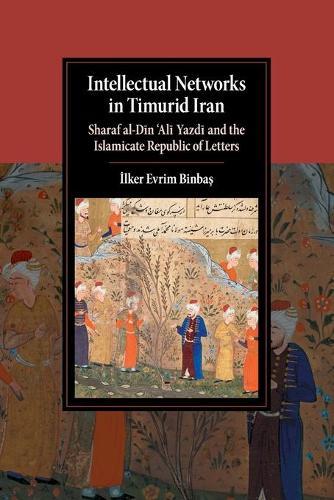
Full Product Details
Author: İlker Evrim Binbaş (Royal Holloway, University of London)
Publisher: Cambridge University Press
Imprint: Cambridge University Press
Dimensions:
Width: 15.50cm
, Height: 2.00cm
, Length: 23.00cm
Weight: 0.540kg
ISBN: 9781107689336
ISBN 10: 1107689333
Pages: 366
Publication Date: 26 April 2018
Audience:
Professional and scholarly
,
Professional & Vocational
Format: Paperback
Publisher's Status: Active
Availability: Manufactured on demand

We will order this item for you from a manufactured on demand supplier.
Reviews
'... it is really two books - one on a smallish network of Muslim intellectuals with occult leanings, and the other on Persian historical writing under the Timurid dynasty - with Yazdi serving as the connecting link. Moreover, the author breaks so much new ground on both scores that he sometimes feels compelled to provide with minute, and even inconsequential, details that impede the flow of his argument. ... it provides a window on a circle of uber-sophisticated Muslim intellectuals in a part of the world that, sadly, is associated in contemporary minds with anything but intellectual activity.' Maria Subtelny, The Times Literary Supplement 'The book is a splendid introduction to one of the key periods in Iranian history. Written with a smooth pen, it studies Yazdi's life with many original and profound analyses. We should be thankful to Binbas who has painstakingly analyzed the life, the transregional network, and the works of Sharaf al-Din 'Ali Yazdi. I warmly recommend the book to everyone who is interested in the Timurid era.' Ali-Asghar Seyed-Gohrab, Renaissance Quarterly '... it is really two books - one on a smallish network of Muslim intellectuals with occult leanings, and the other on Persian historical writing under the Timurid dynasty - with Yazdi serving as the connecting link. Moreover, the author breaks so much new ground on both scores that he sometimes feels compelled to provide with minute, and even inconsequential, details that impede the flow of his argument. ... it provides a window on a circle of uber-sophisticated Muslim intellectuals in a part of the world that, sadly, is associated in contemporary minds with anything but intellectual activity.' Maria Subtelny, The Times Literary Supplement 'The book is a splendid introduction to one of the key periods in Iranian history. Written with a smooth pen, it studies Yazdi's life with many original and profound analyses. We should be thankful to Binbas who has painstakingly analyzed the life, the transregional network, and the works of Sharaf al-Din `Ali Yazdi. I warmly recommend the book to everyone who is interested in the Timurid era.' Ali-Asghar Seyed-Gohrab, Renaissance Quarterly
'... it is really two books - one on a smallish network of Muslim inyellectuals with occult leanings, and the other on Persian historical writing under the Timurid dynasty - with Yazdi serving as the connecting link. Moreover, the author breaks so much new ground on both scores that he sometimes feels compelled to provide with minute, and even inconsequential, details that impede the flow of his argument. ... it provides a window on a circle of uber-sophisticated Muslim intellectuals in a part of the world that, sadly, is associated in contemporary minds with anything but intellectual activity.' Maria Subtelny, The Times Literary Supplement 'The book is a splendid introduction to one of the key periods in Iranian history. Written with a smooth pen, it studies Yazdi's life with many original and profound analyses. We should be thankful to Binbas who has painstakingly analyzed the life, the transregional network, and the works of Sharaf al-Din 'Ali Yazdi. I warmly recommend the book to everyone who is interested in the Timurid era.' Ali-Asghar Seyed-Gohrab, Renaissance Quarterly
Author Information
İlker Evrim Binbaş is a lecturer in Early Modern Asian Empires in the Department of History at Royal Holloway, University of London.