Overview
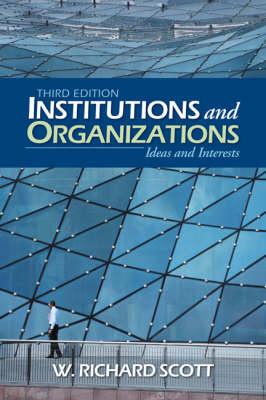
The bestselling Institutions and Organizations remains the key source for a comprehensive overview of the institutionalist approach to organization theory. The author presents: an historical overview of the theoretical literature; an integrative analysis of current institutional approaches, and a review of empirical research related to institutions and organization in addition to an extensive review and critique of institutional analysis in sociology, political science, and economics as it relates to recent theory and research on organizations. Key features for the Third Edition: - Further developed theoretical framework in chapters 3 and 4 is updated and amplified with the latest research - New material on institutional construction, maintenance, and diffusion - An added chapter on transnational institutions - Original research on the intersection of institutional and ecological processes, the emergence of new organizational forms, and the latest research on the co-evolution of institutions and organizational forms.
Full Product Details
Author: W. Richard Scott
Publisher: SAGE Publications Inc
Imprint: SAGE Publications Inc
Edition: 3rd Revised edition
Dimensions:
Width: 15.20cm
, Height: 1.40cm
, Length: 22.80cm
Weight: 0.370kg
ISBN: 9781412950909
ISBN 10: 1412950902
Pages: 280
Publication Date: 05 December 2007
Audience:
College/higher education
,
Undergraduate
Replaced By: 9781452242224
Format: Paperback
Publisher's Status: Out of Print
Availability: In Print

Limited stock is available. It will be ordered for you and shipped pending supplier's limited stock.
Reviews
This book is an absolute tribute to the theorists that helped to shape organizational theory; theory that both explains and can offer solutions for today's complex organizational issues. The importance of Scott's book cannot be overlooked as it contains lessons that offer explanation and predictions of procedures to drive both an organization's functions and its economic successes. -Shari Carpenter, Eastern Oregon University -- Shari Carpenter 20071129
This book is an absolute tribute to the theorists that helped to shape organizational theory; theory that both explains and can offer solutions for today's complex organizational issues. The importance of Scott's book cannot be overlooked as it contains lessons that offer explanation and predictions of procedures to drive both an organization's functions and its economic successes. -Shari Carpenter, Eastern Oregon University -- Shari Carpenter 20071129
Author Information
W. Richard (Dick) Scott received his PhD from the University of Chicago and is currently Professor Emeritus in the Department of Sociology with courtesy appointments in the Graduate School of Business, Graduate School of Education, and School of Medicine at Stanford University. He has spent his entire professional career at Stanford, serving as chair of the Sociology Department (1972–1975), as director of the Training Program on Organizations and Mental Health (1972–1989), and as director of the Stanford Center for Organizations Research (1988–1996). Scott is an organizational sociologist who has concentrated his work on the study of professional organizations, including educational, engineering, medical, research, social welfare, and nonprofit advocacy organizations. During the past three decades, he has concentrated his writing and research on the relation between organizations and their institutional environments. He is the author or editor of about a dozen books and more than 200 articles and book chapters. He was elected to membership in the Institute of Medicine (1975), served as editor of the Annual Review of Sociology (1987–1991), and as president of the Sociological Research Association (2006–2007). Scott was the recipient of the Distinguished Scholar Award from the Management and Organization Theory Division of the Academy of Management in 1988, the Distinguished Educator Award from the same Division in 2013, and of the Richard D. Irwin Award for Distinguished Scholarly Contributions to Management from the Academy of Management in 1996. In 2000, the Section on Organization, Occupations and Work of the American Sociological Association created the W. Richard Scott Award to annually recognize an outstanding article-length contribution to the field. He has received honorary doctorates from the Copenhagen School of Business (2000), the Helsinki School of Economics and Business (2001), and Aarhus University in Denmark (2010).