|
|
|||
|
||||
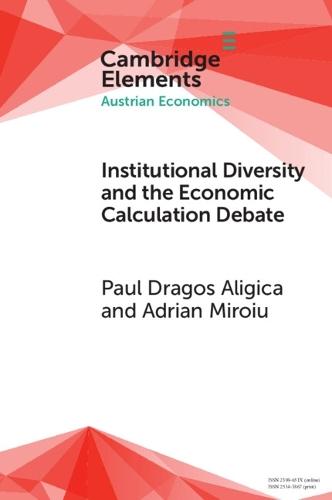
OverviewThis Element brings together the problems of economic calculation, institutional diversity, and institutional feasibility, arguing that these themes are deeply interconnected and mutually reinforcing. Building on recent developments in institutional theory, political economy, social philosophy, and logical analysis, the Element revisits the classic debates surrounding alternative economic and governance systems. The discussion is organized around three core elements: (1) an overview of recent developments in institutional theory and social philosophy, that driven by technological advances have revitalized debates on alternative economic and governance systems; (2) a reexamination of the economic calculation debate, tracing its evolution from Austrian economics to a broader theoretical synthesis incorporating institutional political economy and conflict theory; and (3) a discussion of the formal, logical, and philosophical foundations for thinking about feasibility and realizability, offering analytical tools for evaluating the plausibility of institutional alternatives within specific historical and social contexts. Full Product DetailsAuthor: Paul Dragos Aligica (University of Bucharest) , Adrian Miroiu (The Romanian Academy)Publisher: Cambridge University Press Imprint: Cambridge University Press Weight: 0.130kg ISBN: 9781009677486ISBN 10: 1009677489 Pages: 80 Publication Date: 24 July 2025 Audience: General/trade , General Format: Paperback Publisher's Status: Active Availability: Manufactured on demand We will order this item for you from a manufactured on demand supplier. Table of Contents1. Introduction; 2. Institutional diversity, institutional feasibility, and the challenge of possibilism; 3. Institutional structure and performance: comparative economic systems, institutional analysis, and the endogenization of feasibility; 4. The economic calculation debate revisited: exchange, rivalry, and institutions; 5. The feasible: conceptualization and formalization at the boundaries of ideal theory; 6. Conclusions; References.ReviewsAuthor InformationTab Content 6Author Website:Countries AvailableAll regions |
||||