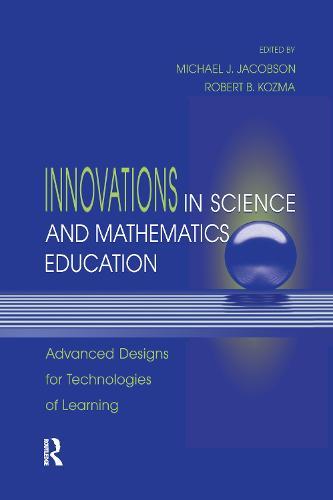
Full Product Details
Author: Michael J. Jacobson, Jr. ,
Robert B. Kozma
Publisher: Taylor & Francis Ltd
Imprint: Routledge
Weight: 0.453kg
ISBN: 9781138972797
ISBN 10: 1138972797
Pages: 448
Publication Date: 21 July 2016
Audience:
Professional and scholarly
,
Professional & Vocational
Format: Paperback
Publisher's Status: Active
Availability: In Print

This item will be ordered in for you from one of our suppliers. Upon receipt, we will promptly dispatch it out to you. For in store availability, please contact us.
Reviews
""Chapters are well organized, making the book easy to follow....good resource for graduate students, faculty, and university libraries."" —CHOICE ""The articles included are clearly written at a level that should be accessible to any educational professional familiar with learning theory and technology. The chapters of the book are essentially research papers and, as such, meet a high standard of timeliness."" —Horizon Research ""The greatest strength of this book is in its ability to demonstrate the ways in which technological learning tools foster deep understandings of difficult scientific and mathematical knowledge and ideas. Innovations clearly encapsulates the role of visualization, simulation, modeling, and computer-based manipulation in the development of increasingly complex scientific concepts and abstractions."" —Science Education ""Represents the state of the art in designing learning environments....An important collection."" —David Jonassen Pennsylvania State University
"""Chapters are well organized, making the book easy to follow....good resource for graduate students, faculty, and university libraries."" —CHOICE ""The articles included are clearly written at a level that should be accessible to any educational professional familiar with learning theory and technology. The chapters of the book are essentially research papers and, as such, meet a high standard of timeliness."" —Horizon Research ""The greatest strength of this book is in its ability to demonstrate the ways in which technological learning tools foster deep understandings of difficult scientific and mathematical knowledge and ideas. Innovations clearly encapsulates the role of visualization, simulation, modeling, and computer-based manipulation in the development of increasingly complex scientific concepts and abstractions."" —Science Education ""Represents the state of the art in designing learning environments....An important collection."" —David Jonassen Pennsylvania State University"
Chapters are well organized, making the book easy to follow....good resource for graduate students, faculty, and university libraries. -CHOICE The articles included are clearly written at a level that should be accessible to any educational professional familiar with learning theory and technology. The chapters of the book are essentially research papers and, as such, meet a high standard of timeliness. -Horizon Research The greatest strength of this book is in its ability to demonstrate the ways in which technological learning tools foster deep understandings of difficult scientific and mathematical knowledge and ideas. Innovations clearly encapsulates the role of visualization, simulation, modeling, and computer-based manipulation in the development of increasingly complex scientific concepts and abstractions. -Science Education Represents the state of the art in designing learning environments....An important collection. -David Jonassen Pennsylvania State University
Author Information
Jacobson, Michael J.; Kozma, Robert B.