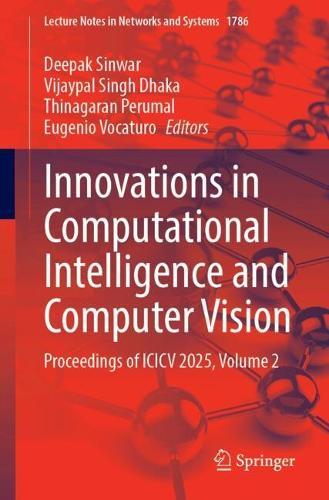
Innovations in Computational Intelligence and Computer Vision: Proceedings of ICICV 2025, Volume 2

Author:   Deepak Sinwar ,  Vijaypal Singh Dhaka ,  Thinagaran Perumal ,  Eugenio Vocaturo
Publisher:   Springer Nature Switzerland AG
ISBN:  

9783032147561


Pages:   702
Publication Date:   04 March 2026
Format:   Paperback
Availability:   Not yet available   Availability explained
This item is yet to be released. You can pre-order this item and we will dispatch it to you upon its release.

Our Price $739.17 Quantity:  
Pre-Order

Share |

Innovations in Computational Intelligence and Computer Vision: Proceedings of ICICV 2025, Volume 2


Overview

Full Product Details

Author:   Deepak Sinwar ,  Vijaypal Singh Dhaka ,  Thinagaran Perumal ,  Eugenio Vocaturo
Publisher:   Springer Nature Switzerland AG
Imprint:   Springer Nature Switzerland AG
ISBN:  

9783032147561


ISBN 10:   3032147565
Pages:   702
Publication Date:   04 March 2026
Audience:   General/trade ,  General
Format:   Paperback
Publisher's Status:   Forthcoming
Availability:   Not yet available   Availability explained
This item is yet to be released. You can pre-order this item and we will dispatch it to you upon its release.

Table of Contents

Enhancement of Medical Microscopic Images Using Segmentation and an Optical Attenuation Model as a Basis for Adaptive Histogram Equalization.- Crowd Counting: A VGG-Driven Convolutional Framework.- Benchmarking and Results of Auto-PCOS Classification Challenge.- Enhancing Human Action Recognition Using Convolutional Neural Networks with Squeeze, Excitation Blocks, and Optical Flow.- Dual-Path Encoder-Decoder (DPED) with Feature Fu-sion and Dual-Stage Decoding for Precise Tumor Seg-mentation in Breast Histopathology Images.- Understanding Customer Experience: Sentiment Analysis of Bengali Text-based Hotel Reviews Using Machine Learning Approach.- AI for Agriculture: Detecting Black Gram Diseases with Deep Learning and Explainable AI.- Brain Tumor Detection via MRI: A Dual AI Approach for Accurate Classification.- An Approach using EfficientNetB4 for Gender Determination.- PyEDA: A Python-Based Tool for Protein Dynamics Analysis Using Essential Dynamics Approach.- AI-Driven Breast Cancer Classification and Personalized Stage-Specific Treatment Recommendations.- Stress Monitoring in Healthcare: An Ensemble Machine Learning Framework Using Wearable Sensor Data.- Harnessing AI Agents to Advance Research on Refugee Child Mental Health.- Practical Portfolio Optimization with Metaheuristics: Pre-assignment Constraint and Margin Trading.- Deep Learning Based Weed Identification in Crops using Improved CNN-PFO.- Enhancing Squamous Cell Carcinoma Detection in Pap Smears Using Multiscale Feature Refinement with Dilated Spatial Pyramid Pooling.- Medical Images Fusion using Signal Decomposition Methods and Implementation on an Embedded Platform.- CA-ANN based Predictive Modeling of Land use Land cover, Urban Fragmentation and Seasonal Land Surface Tempera-ture: Insights from Semi-arid Climate City.- Distance aware Clustering and Path Construction in Mobile Sink-based Wireless Sensor Networks.- DeepTrafficFlow: A Deep Learning Approach for Real-Time Traffic Monitoring and Congestion Reduction in Smart Cities.- Progression of Idiopathic Pulmonary Fibrosis (IPF) using Deep Learning.- Predicting Pedestrian Intentions for Intelligent Transport Systems.- Deep Learning-Based Malayalam Sign Language Recognition Using 3D CNNs.- BlockEnhance: A Blockchain Based Secure & High-Quality Image Transfer.- Drought Analysis in Vidharbha Using ARIMA and LSTM.- Advancing Artificial Immune System-Based Anomaly Detection.- Integrating Language and Vision Models for Real-Time Assistance for the Visually Impaired.- ChampionView: A Recommendation Engine.- Web-Based Customer Review Analysis and Fake Review Detection Using NLP.- Comparative Analysis of Machine Learning Models for Electric Vehicle Charging Patterns.- Retrieval-Augmented Generation Approach for MediaSearch.- Advancing Soil Moisture Estimation Using Sentinel-1 and Deep Learning Techniques.- Investigation of Tidal Impacts on Mangrove Health and IoT-Driven System for Conservation.- Evolutionary Algorithm-Based Model Merging Framework for Small Multimodal Models.- SPY-BOT, a Robot that works on LIDAR SLAM.- Enhancing Data Security in Healthcare 4.0 Using Selective Encryption.- Car Price Prediction and Recommendation System using Machine Learning.- Real-Time Pothole Detection using YOLO and GIS Mapping.- Deep Neural Networks for Earth Observation: Satellite Classification with Modern Architectures.- Enhanced Liver Tumor Segmentation and Interpretation using Hybrid U-Net and Explainable AI for Clinical Diagnostics.- Alzheimer Diagnosis and Cost Estimation Bot.- Multi-Modal Boundary-Aware Attention U-Net for Brain Tumor Segmentation.- AI-Based Traffic Flow Optimization using Quantum- Inspired Techniques.- SEViT-GAN: Attention based GAN with SE Residual blocks for Image Inpainting.- Prevention of Examination Paper Leakage using Threshold Decryption.- Blind Data Hiding Approach Based on Digit Substitution for 3D Mesh Object.- Enhancing Smart Home Security Through Dynamic Authentication for Voice-Activated Commands.- High-Accuracy Speech Emotion Recognition Using MFCC and LSTM with Optimized Deep Learning Architecture.- Drone-based Parking Occupancy Monitoring and Recommendation.

Reviews

Author Information

Deepak Sinwar is an associate professor in the Department of IoT and Intelligent Systems, Manipal University, Jaipur, Rajasthan, India. He holds a Ph.D. and M.Tech. in Computer Science and Engineering (2016 and 2010, respectively) and a B.Tech. (with honors) in Information Technology (2008). He is an enthusiastic and motivating academician with more than 15 years of research and academic experience. His research interests span Computer Vision, Meta-heuristics, Ad-hoc Networks, Data Mining, and Reliability Engineering. He has authored more than 50 publications in reputed peer-reviewed journals, conference proceedings, and book chapters. He actively contributes to academic publishing through editorial roles, including book editing and guest editing special issues with leading publishers. Throughout his career, he has organized and participated in numerous international conferences and workshops.   Vijaypal Singh Dhaka is a dynamic and visionary professor of Computer Science with over two decades of academic and industry experience. Known for his motivational leadership and student-centric approach, he has chaired several international conferences and held key positions such as the dean-academics, director of CSE School, director of Entrepreneurship Cell, and chief editor of an international journal. With 130+ publications, 30+ IPRs, and supervision of 17 Ph.D. scholars, his contributions reflect a strong commitment to research excellence. He earned his Ph.D. from Dr. B. R. Ambedkar University, Agra, in handwriting recognition using image processing. His research interests include AI, ML, Image Processing, and Pattern Recognition. He is also actively engaged in executing government-funded research projects, contributing impactful solutions to pressing technological challenges. He is presently serving at Manipal University, Jaipur, as a professor of Computer Science and Dean Quality and Accreditation.   Thinagaran Perumal is the recipient of 2014 Early Career Award from IEEE Consumer Electronics Society for his pioneering contribution in the field of consumer electronics. He completed his Ph.D. at Universiti Putra Malaysia, in the area of smart technology and robotics. He is currently a senior lecturer at the Department of Computer Science, a faculty of Computer Science and Information Technology, Universiti Putra Malaysia. His research interests are toward interoperability aspects of smart homes and Internet of Things (IoT), wearable computing, and cyber-physical systems. Thina is also heading the National Committee on Standardization for IoT (IEC/ISO TC / G/16) as the chairman since 2018. He is an active member of IEEE Consumer Electronics Society and its Future Directions Committee on Internet of Things.   Eugenio Vocaturo is a researcher at the Institute of Nanotechnology, National Research Council of Italy (CNR–Nanotec), Rende, Italy, where he leads the Artificial Intelligence Laboratory. He holds Laurea in Management Engineering (2002), Master in Industrial Engineering Management (2006), Master in Finance (2016), and Ph.D. in Information and Communication Technologies (2020). He has decades of experience as the company director, production and logistics manager of business groups, head of editorial production of important IT publishing. His research focuses on AI, Machine Learning, Deep Learning, Explainable AI, and Computer Vision. Since 2024, he has been member of the Evaluation Expert Group (GEV) for sector ING-INF/05 within the framework of the Italian Research Quality Evaluation (VQR 2020–2024), promoted by ANVUR. 

Tab Content 6

Author Website:  

Countries Available

All regions
Latest Reading Guide

NOV RG 20252


Shopping Cart
Your cart is empty
Shopping cart
Mailing List