|
|
|||
|
||||
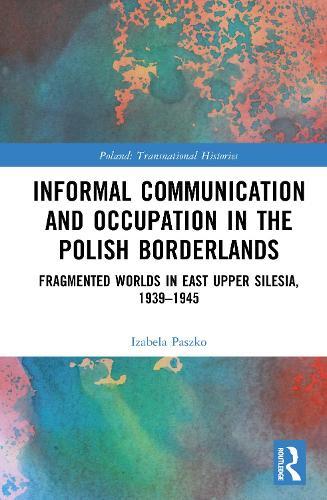
OverviewThe book explores the neglected role and social dynamics of informal communication – interpersonal channels not controlled ‘from above’ – in the region of Upper Silesia under the German occupation during the Second World War (1939–1945). Whereas the classic dichotomies, such as private-public and formal-informal, have been widely explored and discussed in the humanities, the main focus of this volume lies in the reconstruction of the information landscape of wartime and its deployment by families, co-workers, neighbours, and other social groups. Through the prism of personal stories, the book analyses functions and forms of informal communication that existed in a contextual and ephemeral way such as gossip, rumours, and workers’ conversations, offering an interdisciplinary perspective on everyday life during this period. Informal Communication and Occupation in the Polish Borderlands is primarily aimed at scholars of contemporary history, social history, and Eastern European history, while its important lens as a study of fake news and misinformation in modern times will also be engaging to undergraduate classrooms and general readers. Full Product DetailsAuthor: Izabela Paszko (German Historical Institute Warsaw, Poland)Publisher: Taylor & Francis Ltd Imprint: Routledge Weight: 0.810kg ISBN: 9781041073000ISBN 10: 1041073003 Pages: 332 Publication Date: 17 November 2025 Audience: Professional and scholarly , College/higher education , Professional & Vocational , Postgraduate, Research & Scholarly Format: Hardback Publisher's Status: Active Availability: Manufactured on demand We will order this item for you from a manufactured on demand supplier. Table of ContentsIntroduction 1. Upper Silesia – A Historical Context 2. Informality and Sense-Making Practices in the Borderland 3. It is said…: Communal Lives – Collective Talk 4. Communication and Relations in Places of Forced Co-Existence 5. So Close and Yet So Far: Maintaining Familial Relations and Friendships under the German Occupation, ConclusionReviews""Combining an interdisciplinary approach with the historian's keen eye for the sources, Paszko's innovative and richly documented study tests the borders between private and public, shedding new light on community, intimacy, adaptation, resistance, and survival under the German occupation."" Jonathan Huener, Miller Distinguished Professor of Holocaust Studies, University of Vermont, US Author InformationIzabela Paszko is a social anthropologist with a PhD in history and works at the German Historical Institute Warsaw. Her scientific interests evolve around social history, commemorating practices and anthropology of everyday life. Tab Content 6Author Website:Countries AvailableAll regions |
||||