Overview
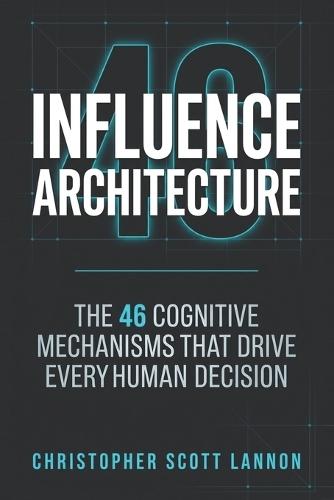
You deploy 4 cognitive mechanisms by instinct. There are 46. That gap has a name. Two campaigns. Same product, budget, audience. One team ran on instinct, pulling from the three Cialdini principles they could remember. The other team ran on architecture, stacking 46 mechanisms across one onboarding flow. The architecture converted at 4x the rate. Not because the writing was better. Because the builder could see 42 mechanisms the competitor could not name. Cialdini cataloged 7 principles in 1984 and published one update in 32 years. Kahneman diagnosed the biases but handed you no deployment system. Miller gave you one story template that made every brand sound identical. None of them gave you what a working practitioner actually needs: the complete operating system. Influence Architecture catalogs all 46 cognitive mechanisms that drive human attention, belief, desire, and action. It organizes them by the six jobs every piece of communication must do: CAPTURE, ENGAGE, TRUST, WANT, ACT, BOND. It gives you the Calibration Loop that turns a static framework into a living system, where each deployment starts from a better baseline than the last. And it includes Deploy It Now exercises at the end of every chapter so you build the architecture while you read, not after. In 1999, Reber and Schwarz showed that identical statements in an easy-to-read font were rated as more likely to be true than the same statements in a harder font. Same words. Different font. Different truth. That is one mechanism. You are deploying maybe four. A 1.3-billion-parameter AI model trained with a calibration loop outperformed a model 100x its size. The loop was worth more than raw power. So is the architecture. In Influence Architecture, you will find: The Architecture Gap -- why your content underperforms despite strong writing, and how to close the distance between deploying 4 mechanisms by instinct and 46 by design The Calibration Loop -- the four-stage cycle (Deploy, Measure, Diagnose, Calibrate) that no other persuasion framework offers, turning static principles into a system that improves with every iteration The Mixing Board -- 46 mechanism channels, each with a 1-10 intensity slider tuned to your audience, your genre, and mode. Not a checklist. An instrument. Every mechanism is backed by named researchers and specific experiments. The replication crisis is engaged honestly: the book separates studies that have survived replication from those that have not. No ""studies show"" without naming the study. Readers of Cialdini and Kahneman who finished those books thinking there has to be more than this will find what they were looking for. Early readers called it ""the best framework book since Kahneman"" and ""the first persuasion book that tells you which studies got debunked."" This is Book 1 of a 14-volume series. Each subsequent title applies the framework to a specific domain: marketing, sales, social media, writing, leadership, and beyond. Book 1 installs the lens. The niche books sharpen it. Every chapter deploys the framework it teaches. By Chapter 20, you will see exactly how. You have been inside the proof of concept since page one.
Full Product Details
Author: Christopher Scott Lannon
Publisher: Profitlab-Ai, Inc.
Imprint: Profitlab-Ai, Inc.
Dimensions:
Width: 15.20cm
, Height: 1.50cm
, Length: 22.90cm
Weight: 0.395kg
ISBN: 9781972731130
ISBN 10: 1972731130
Pages: 292
Publication Date: 30 April 2026
Audience:
General/trade
,
General
Format: Paperback
Publisher's Status: Active
Availability: Available To Order

We have confirmation that this item is in stock with the supplier. It will be ordered in for you and dispatched immediately.