Overview
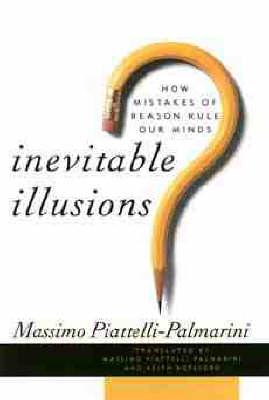
""A delightful informal survey...the best popular book yet in theis peculiar field"" - Nature ""A fascinating and insightful look."" - R.C. Lewontin, Harvard University A provocative and entertaining exploration of the tricks our minds play on us every day Writing with all the wit and charm that have made his books bestsellers in Europe, Massimo Piattelli-Palmarini takes readers on an enthralling journey through the twists and turns of the human mind's cognitive illusions. MASSIMO PIATTELLI-PALMARINI, PhD, (Milan, Italy) is Director of the Department of Cognitive Science at the Institute San Raffaele in Milan, Italy, and a research associate of the Center for Cognitive Science at MIT.
Full Product Details
Author: Massimo Piattelli-Palmarini
Publisher: John Wiley and Sons Ltd
Imprint: John Wiley & Sons Inc
Dimensions:
Width: 16.10cm
, Height: 2.20cm
, Length: 23.30cm
Weight: 0.556kg
ISBN: 9780471581260
ISBN 10: 0471581267
Pages: 256
Publication Date: 03 November 1994
Audience:
College/higher education
,
Professional and scholarly
,
General/trade
,
Undergraduate
,
Postgraduate, Research & Scholarly
Format: Hardback
Publisher's Status: Out of Stock Indefinitely
Availability: In Print

Limited stock is available. It will be ordered for you and shipped pending supplier's limited stock.
Reviews
To exorcise the demons of irrationality, turn to this rigorous - if overzealous - study of everyday logic. Cognitive illusions - like optical illusions - hold us in their thrall, says PiattelliPalmarini (Cognitive Science/Institute San Raffaele, Milan). But theoretical breakthroughs in cognitive science provide revolutionary new avenues for thought. Addressing everyone who wants to make more rational decisions, Piattelli-Palmarini unveils the discovery of the cognitive unconscious. This term, with its nod to Freud, refers to the reflexive patterns of reasoning in which we engage unreflectively, even though counterintuitive but logically correct thinking would serve us better. Asked, for instance, which outcome is more likely in a coin flip, heads-heads-heads or heads-tailsheads-tails, most people use incorrect logic to conclude that the latter is more likely (in fact, the longer the sequence, the less probable it is ). Piattelli-Palmarini explores the tunnels of cognitive illusion, showing how familiar problems, (drawn from the realms of medicine, demography, economics, and gambling) flummox most people. Then he corrects common misapprehensions, mapping the rational terrain that lies outside these tunnels, even making an arcane but crucial fact about statistics clear to the general reader. By revealing how most respondents err in, for instance, guessing someone's profession based on a personality profile, Piattelli-Palmarini rigorously defines the rules of probability and deduction. Some will object that what he calls irrationality is itself a function of the abstraction of such problems, but he vigorously defends cognitive science against such arguments. Perhaps less defensible is his pretense that its ideas represent a revolutionary breakthrough; the issues he raises are, after all, part of a 2,000-year-old philosophical debate. Whether or not his grand claims are justified, as a primer for problem-solvers, this book has great merit. (Kirkus Reviews)