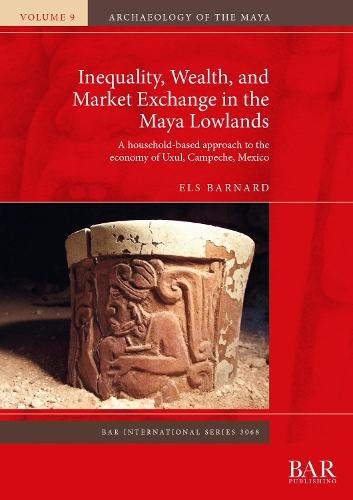
Inequality, Wealth, and Market Exchange in the Maya Lowlands: A household-based approach to the economy of Uxul, Campeche, Mexico

Author:   Els Barnard
Publisher:   BAR Publishing
ISBN:  

9781407359151


Pages:   360
Publication Date:   31 December 2021
Format:   Paperback
Availability:   Available To Order   Availability explained
We have confirmation that this item is in stock with the supplier. It will be ordered in for you and dispatched immediately.

Our Price $196.65 Quantity:  
Add to Cart

Share |

Inequality, Wealth, and Market Exchange in the Maya Lowlands: A household-based approach to the economy of Uxul, Campeche, Mexico


Overview

This volume examines the economic system of the Classic Maya Lowlands center of Uxul, Campeche, a secondary center under the political influence of Calakmul. A household-based approach is used to review the urban economic system in which these households played a central role. Multiple lines of evidence are combined here, using both quantitative and qualitative methods, to study economic inequality, settlement organization, social integration, power structures, consumption, production, and exchange at the site. The results suggest that the economy of Uxul was largely based on market exchange, and although wealth inequality was high, people along the socio-economic spectrum had significant economic agency, comparable quality of life, and economic mobility was possible. This study shows that the implementation of a multifaceted household-based approach allows for a more complete understanding of the complex economy of an ancient urban center.

Full Product Details

Author:   Els Barnard
Publisher:   BAR Publishing
Imprint:   BAR Publishing
Weight:   1.436kg
ISBN:  

9781407359151


ISBN 10:   1407359150
Pages:   360
Publication Date:   31 December 2021
Audience:   Professional and scholarly ,  Professional & Vocational
Format:   Paperback
Publisher's Status:   Active
Availability:   Available To Order   Availability explained
We have confirmation that this item is in stock with the supplier. It will be ordered in for you and dispatched immediately.

Table of Contents

List of Figures List of Tables Abstract 1. Introduction 1.1. Research questions 1.2. Book organization Part I Framework 2. Theory and Methods 2.1. Key Definitions 2.1.1. Economy 2.1.2. Household 2.1.3. City and urbanism 2.2. Theory and methods 2.2.1. Studying socio-economic inequality 2.2.2. Identifying market exchange 2.2.3. Studying socio-political and economic power structures 2.3. Methodological tools 2.3.1. Geographic Information Systems (GIS) 2.3.2. Social network analysis (SNA) 2.3.3. Portable X-ray fluorescence (pXRF) 3. Uxul: The Site and its Data 3.1. History of research 3.2. History and affiliation 3.3. Uxul's spatial and archaeological evidence 3.3.1. Maps 3.3.2. Artifacts and databases 3.3.3. Excavation reports 3.4. Methodological discussion: approaching the data 3.4.1. Household identification 3.4.2. Analyzing Uxul's artifact data 3.5. Presentation of the ten extensively excavated households 3.5.1. Group Ak' 3.5.2. Group Baak 3.5.3. Group G 3.5.4. Group K 3.5.5. Group K'áak' 3.5.6. Group M 3.5.7. Group Ma'ax 3.5.8. Group Pu'uk 3.5.9. Group Wob 3.5.10. Group Ya'ab Part II Analysis 4. Wealth Inequality and Stratification 4.1. Methodology and parameters 4.1.1. Methodological discussion 4.2. Wealth inequality in Uxul 4.2.1. Stratification 4.2.2. Economic distribution model 5. Settlement Organization: Household Location and Mobility 5.1. Methodological discussion 5.2. Neighborhoods in Uxul 5.2.1. Neighborhood composition 5.2.2. Neighborhood chronology 5.3. Household visibility 5.3.1. Visibility and wealth 5.3.2. Household visibility patterns and neighborhoods 5.3.3. Discussion of household visibility 5.4. Mobility and social integration 5.4.1. Social integration and wealth 5.4.2. Social integration and neighborhoods 5.5. Mobility and access to resources 5.5.1. Mobility and water: access to the aguadas 5.5.2. Mobility and religion: access to religious services 5.3.3. Mobility and storage: access to chultunes 5.6. Discussion of household location and intra-site mobility in Uxul 5.6.1. Elites vs. commoners 5.6.2. Neighborhoods 5.6.3. Implications of the Uxul settlement organization 5.6.4. Mobility and access in ancient Uxul in a comparative perspective 6. Household Economy: Production and Consumption 6.1. Ceramics: consumption, chronology, and sources 6.1.1. Uxul ceramics 6.1.2. Chronology of the extensively excavated households 6.1.3. Late Preclassic ceramics 6.1.4. Early Classic ceramics 6.1.5. Late Classic ceramics 6.1.6. Terminal Classic ceramics 6.1.7. Discussion of the distribution of ceramics in Uxul 6.2. Obsidian: consumption, production, and sources 6.2.1. Obsidian in Uxul 6.2.2. Sourcing the obsidian of Uxul: chemical analysis using pXRF 6.2.3. Distribution of obsidian sources in Uxul 6.2.4. Uxul obsidian and the long-distance exchange network 6.2.5. Discussion of the distribution of obsidian in Uxul 6.3. Greenstone: production and consumption 6.3.1. Greenstone in Uxul 6.3.2. Greenstone artifact production: the Ya'ab workshop 6.4. Shell: production and consumption 6.4.1. Shell in Uxul 6.4.2. Shell artifact production: the Ya'ab workshop 6.5. Textile: production 6.5.1. Malacates in Uxul 6.5.2. Additional textile production implements 6.5.3. Discussion of the organization of textile production in Uxul 6.6. Ceremonial services in household contexts: consumption, production, and services 6.6.1. Household ceremonial activities in Uxul 6.6.2. Discussion of ceremonial practices as specialized household services in Uxul 6.7. Thin-walled flared clay earspools: production and consumption 6.7.1. Thin-walled earspools in Uxul 6.7.2. Earspool production: the Ma'ax production site 6.8. Paper: production 6.9. Chert: production and consumption Part III Discussion and Conclusions 7. Discussion of the Ancient Uxul Economy 7.1. Wealth inequality and its implications 7.2. The existence of a middle class 7.3. Settlement organization and its implications 7.4. Consumption patterns 7.5. Production and specialization 7.6. Uxul in the wider economic network 7.7. Uxul in a comparative perspective 7.8. Chronology and development of the Uxul economy 8. Conclusions 8.1. Market exchange 8.2. Economy and political organization 8.3. Economic independence of Uxul 8.4. Concluding remarks Bibliography The Appendices are available at the following DOIs: Appendix 1: List of all identified households and their characteristics - https://doi.org/10.30861/9781407359151.app1 Appendix 2: Walking times from each source household group to each other household group (in seconds) - https:// doi.org/10.30861/9781407359151.app2 Appendix 3: Walking times from each household to various resource in Uxul - https://doi.org/10.30861/9781407359151.app3 Appendix 4: Results of pXRF measurements on Uxul ceramic samples - ht

Reviews

'The data are completely new and of high quality. Looking at marketplaces through the lens of households is a new and exciting approach to the study of Maya economies. This work will contribute greatly to the debates of this critical topic in Maya archaeology.' Professor Travis Stanton, University of California, Riverside 'This is one of the most in-depth and informative studies on household archaeology that has appeared within the last few decades.' Professor Arlen Chase, Pomona College 'Archaeologists in other parts of the world would find this monograph relevant because Barnard's research questions are broad issues in archaeology: how do we reconstruct social, economic and political regimes in ancient societies? Scholars all over the world ask the same questions and would benefit from reading how Barnard tackles these topics using a mixture of spatial/settlement and archaeological artefact data.' Professor Antonia Foias, Williams College


Author Information

Els Barnard is a researcher specialized in the study of ancient households, settlement systems, and urban economic processes, with a particular focus on Mesoamerican and Maya archaeology. She studied at Leiden University, the Netherlands, and obtained her PhD in archaeology at the University of Bonn, Germany, in 2021.

Tab Content 6

Author Website:  

Countries Available

All regions
Latest Reading Guide

April RG 26_2


Shopping Cart
Your cart is empty
Shopping cart
Mailing List