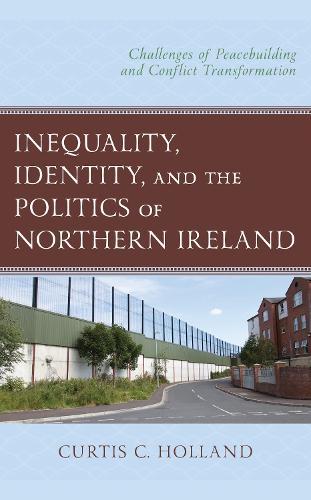
Full Product Details
Author: Curtis C. Holland
Publisher: Bloomsbury Publishing Plc
Imprint: Lexington Books
ISBN: 9781793648846
ISBN 10: 1793648840
Pages: 248
Publication Date: 27 November 2025
Audience:
Professional and scholarly
,
Professional & Vocational
Format: Paperback
Publisher's Status: Active
Availability: Manufactured on demand

We will order this item for you from a manufactured on demand supplier.
Reviews
“Curtis Holland uses a mixed-method case study to draw on data generated from forty-one in-depth interviews with Belfast community leaders and politicians and a content analysis of British and Irish newspapers. This wonderful, well-written book uses a constructivist and intersectional approach to analyze the impact of relational and ethno-social fields of power, resistance narratives, and class inequalities that shape local, everyday people’s agencies across and within their ethnopolitical groups in post-peace-accord Northern Ireland. This excellent study deserves a broad readership from academics, community activists, peacebuilders, policymakers, politicians, students, and those interested in the top-down and bottom-up dynamics of post-peace-accord societies like Northern Ireland.” -- Sean Byrne, University of Manitoba Curtis Holland provides an excellent and engaging overview of the main sociological and political processes that have emerged following the peace process in Northern Ireland. The book tackles head-on some of the major social issues that have arisen since the peace process and provides clear and forceful insights into the continuing effects that socioeconomic divisions and gender inequalities continue to have on shaping the nature of society in Northern Ireland. Holland is particularly compelling in his interpretation of the dynamics of change at the community level, outlining with great clarity the development of social and political movements. He uses intersectional analysis, bringing together issues of class, place, gender, and ethnonational identities in a book that should be read by anyone with an interest in contemporary Northern Irish society. -- James McAuley, University of Huddersfield This book provides fresh insights into the dynamics of peacebuilding in Northern Ireland. Its focus on the interactions between transforming conflict in the region, identity, and inequality means it will be an invaluable resource for those interested in Northern Ireland and peacebuilding globally. -- Fidelma Ashe, Ulster University The recent history of Northern Ireland inspired a small but significant body of scholarship in the field of post-conflict peace and reconciliation; Holland adds considerably to this scholarship. Theoretically rich and empirically grounded, this work looks to where the peace process has failed, 25 years after the peace agreement. Though the middle classes (particularly Catholics) and the globally oriented elites saw improvements and a reduction in their ethnonationalist orientation, residents of impoverished, working-class neighborhoods were left behind, resulting in their continued ethnonationalist identification. In fact, the very processes built around reconciliation—and how they were implemented over time—created this double dynamic of decreased ""horizontal"" and increased ""vertical"" cleavages. Well connected to post-conflict scholarship and methodologically interpretivist and constructivist, this work is an important contribution to existing scholarship. Recommended for advanced undergraduates through faculty and professionals. * Choice Reviews *
Author Information
Curtis C. Holland is assistant professor of criminology and sociology at the State University of New York at Old Westbury.