|
|
|||
|
||||
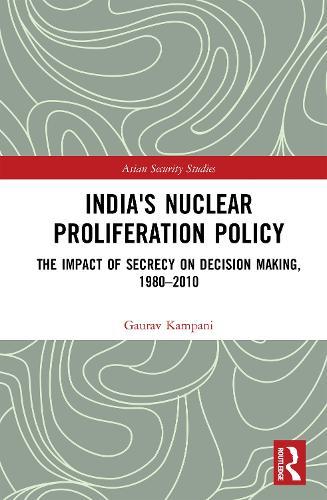
OverviewThis book examines India’s nuclear program, and it shows how secrecy inhibits learning in states and corrodes the capacity of decision-makers to generate optimal policy choices. Focusing on clandestine Indian nuclear proliferation during 1980–2010, the book argues that efficient decision-making is dependent on strongly established knowledge actors, high information turnover and the capacity of leaders to effectively monitor their agents. When secrecy concerns prevent states from institutionalizing these processes, leaders tend to rely more on heuristics and less on rational thought processes in choices involving matters of great political uncertainty and technical complexity. Conversely, decision-making improves as secrecy declines and policy choices become subject to higher levels of scrutiny and contestation. The arguments in this book draw on compelling evidence gathered from interviews conducted by the author, with interviewees including individuals who were involved in nuclear planning in India from 1980 to 2010, such as former cabinet and defence secretaries, the principal secretary to the prime minister, national security advisors, secretaries to the department of atomic energy, military chiefs of staff and their principal staff officers, and commanders of India’s strategic (nuclear) forces. This book will be of much interest to students of nuclear proliferation, Asian politics, strategic studies and International Relations. Full Product DetailsAuthor: Gaurav KampaniPublisher: Taylor & Francis Ltd Imprint: Routledge Weight: 0.408kg ISBN: 9780367356286ISBN 10: 0367356287 Pages: 12 Publication Date: 27 November 2019 Audience: College/higher education , Professional and scholarly , Tertiary & Higher Education , Professional & Vocational Format: Hardback Publisher's Status: Active Availability: In Print This item will be ordered in for you from one of our suppliers. Upon receipt, we will promptly dispatch it out to you. For in store availability, please contact us. Table of Contents1. The Oddities of Indian Nuclear Behavior 2. Secrecy and State Learning 3. A Disaggregated Weapons Nuclear Option (1980–1989) 4. Behind the Veil of Nuclear Opacity (1990–1998) 5. The Challenges of Nuclear Operationalization (1999–2010) 6. Conclusion: Variations in Practices of Secrecy and Its Impact on Nuclear OutcomesReviewsAuthor InformationGaurav Kampani is Assistant Professor of Political Science at the University of Tulsa, USA. Tab Content 6Author Website:Countries AvailableAll regions |
||||