Overview
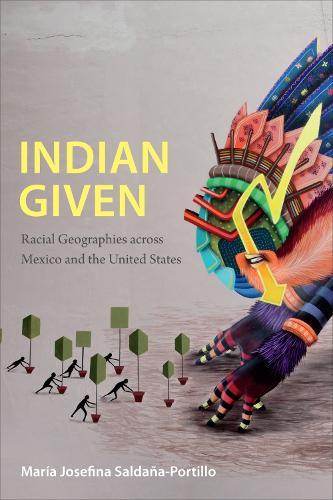
In Indian Given Maria Josefina Saldana-Portillo addresses current racialized violence and resistance in Mexico and the United States with a genealogy that reaches back to the sixteenth century. Saldana-Portillo formulates the central place of indigenous peoples in the construction of national spaces and racialized notions of citizenship, showing, for instance, how Chicanos/as in the U.S./Mexico borderlands might affirm or reject their indigenous background based on their location. In this and other ways, she demonstrates how the legacies of colonial Spain's and Britain's differing approaches to encountering indigenous peoples continue to shape perceptions of the natural, racial, and cultural landscapes of the United States and Mexico. Drawing on a mix of archival, historical, literary, and legal texts, Saldana-Portillo shows how los indios/Indians provided the condition of possibility for the emergence of Mexico and the United States.
Full Product Details
Author: María Josefina Saldaña-Portillo ,
Maraia Josefina Saldaana-Portillo
Publisher: Duke University Press
Imprint: Duke University Press
Dimensions:
Width: 15.20cm
, Height: 2.30cm
, Length: 22.90cm
Weight: 0.476kg
ISBN: 9780822360148
ISBN 10: 0822360144
Pages: 352
Publication Date: 29 March 2016
Audience:
Professional and scholarly
,
Professional & Vocational
,
Postgraduate, Research & Scholarly
Format: Paperback
Publisher's Status: Active
Availability: In Print

This item will be ordered in for you from one of our suppliers. Upon receipt, we will promptly dispatch it out to you. For in store availability, please contact us.
Reviews
"""Saldana-Portillo’s monograph makes critical contributions to the fields of indigenous studies, borderlands studies, American studies, Mexican studies, Chicano/a studies, gender studies, transnational studies, western legal studies, and Southwest studies—just to name a few. Indian Given truly has the potential to help set the agenda in multiple disciplines."" -- John Gram * H-Net Reviews * ""An eclectic, informative, and entertaining work. . . . Saldaña-Portillo’s work will certainly be an eye-opener for anyone who picks it up."" -- F. Todd Smith * American Historical Review * “Indian Given will be of great interest to scholars and university students who explore issues of Indigeneity in Mexico and the United States. Its interdisciplinary inquiry makes an important contribution to the field of Indigenous studies.” -- Emilio del Valle Escalante * Native American and Indigenous Studies * ""Saldaña-Portillo illuminates the racial process in which indigenous people have been central to the continuous colonial and national space-making projects of Mexico and the United States."" -- Jorge Ramirez * Radical History Review *"
Indian Given is an important interrogation of racial and knowledge production in the Americas and offers important analyses of how racial geographies figure in the U.S./Mexico borderlands. With Indian Given, Maria Josefina Saldana-Portillo gives us the most comprehensive study of Indigenous Mexican and Mexican American identity formations to date. --Sonia Saldivar-Hull, author of Feminism on the Border: Chicana Gender Politics and Literature
An eclectic, informative, and entertaining work. . . . Saldana-Portillo's work will certainly be an eye-opener for anyone who picks it up. -- F. Todd Smith * American Historical Review * Saldana-Portillo's monograph makes critical contributions to the fields of indigenous studies, borderlands studies, American studies, Mexican studies, Chicano/a studies, gender studies, transnational studies, western legal studies, and Southwest studies-just to name a few. Indian Given truly has the potential to help set the agenda in multiple disciplines. -- John Gram * H-Net Reviews * Indian Given is a transnational scholarly mural, offering a critical account of North America with both exacting specificity and stunning synthesis, all on one continuous canvas. Maria Josefina Saldana-Portillo's archival skills are formidable across centuries, languages, and geographies. Her archive includes not only Las Casas, La Malinche, and Geronimo, but also Javier Bardem, Oscar Zeta Acosta, and Osama bin Laden. As soon as I finished reading Indian Given, I wanted to start it again. -- Robert Warrior, editor of * The World of Indigenous North America * Indian Given is an important interrogation of racial and knowledge production in the Americas and offers important analyses of how racial geographies figure in the U.S./Mexico borderlands. With Indian Given, Maria Josefina Saldana-Portillo gives us the most comprehensive study of indigenous Mexican and Mexican American identity formations to date. -- Sonia Saldivar-Hull, author of * Feminism on the Border: Chicana Gender Politics and Literature *
Indian Given is a transnational scholarly mural, offering a critical account of North America with both exacting specificity and stunning synthesis, all on one continuous canvas. Maria Josefina Saldana-Portillo s archival skills are formidable across centuries, languages, and geographies. Her archive includes not only Las Casas, La Malinche, and Geronimo, but also Javier Bardem, Oscar Zeta Acosta, and Osama bin Laden. As soon as I finished reading Indian Given, I wanted to start it again. --Robert Warrior, editor of The Indigenous World of North America
Author Information
MarÍa Josefina SaldaÑa-Portillo is Professor of Social and Cultural Analysis at New York University and the author of The Revolutionary Imagination in the Americas and the Age of Development, also published by Duke University Press.