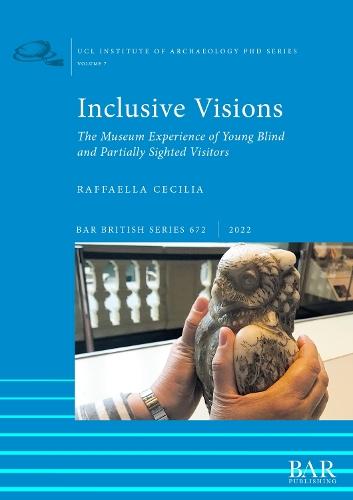
Inclusive Visions: The Museum Experience of Young Blind and Partially Sighted Visitors

Author:   Raffaella Cecilia
Publisher:   BAR Publishing
ISBN:  

9781407359656


Pages:   184
Publication Date:   30 June 2022
Format:   Paperback
Availability:   Available To Order   Availability explained
We have confirmation that this item is in stock with the supplier. It will be ordered in for you and dispatched immediately.

Our Price $139.73 Quantity:  
Add to Cart

Share |

Inclusive Visions: The Museum Experience of Young Blind and Partially Sighted Visitors


Overview

Inclusive Visions explores the embodied experience, situated interactions and identities of young blind and partially sighted visitors in the museum space. It investigates how they make meaning and form identities by physically encountering objects, resources and the environment with their companions and other visitors. The visit experience of blind and partially sighted participants is detailed at three London museums: the Victoria & Albert Museum, the Wallace Collection and the Museum of London. Using qualitative audio, fieldnotes, and video-based research methods, it provides a deep insight into how meaning-making and identity are formed in perceptual experiences through bodily states and shared situated action. How different characteristics of the embodied practice of blind and partially sighted visitors emerge, and how meaning-making and identity formation are enabled, is put in a holistic context.

Full Product Details

Author:   Raffaella Cecilia
Publisher:   BAR Publishing
Imprint:   BAR Publishing
Weight:   0.734kg
ISBN:  

9781407359656


ISBN 10:   1407359657
Pages:   184
Publication Date:   30 June 2022
Audience:   Professional and scholarly ,  Professional & Vocational
Format:   Paperback
Publisher's Status:   Active
Availability:   Available To Order   Availability explained
We have confirmation that this item is in stock with the supplier. It will be ordered in for you and dispatched immediately.

Table of Contents

Foreword 1. Introduction 1.1. Research context 1.2. Disability and museums 1.3. Book structure 2. The Embodiment Framework 2.1. Introduction 2.2. Embodiment 2.3. The impaired body 2.4. The body, habitus, and capital 2.4.1. Technology and capital 2.5. Sociocultural framework 2.5.1. Learning & identity 2.5.2. Funds of knowledge 2.5.3. Scaffolding 2.6. Conclusion 3. The Embodied Practice of Museums' Visitors 3.1. Introduction 3.2. Museums and the body 3.3. 'Normative' bodily practices 3.4. Gesturing and pointing 3.5. Walking 3.5.1. Walking with a vision impairment 3.5.2. Co-presence, co-awareness & co-walking 3.5.3. Walking as placemaking 3.6. Seeing and being seen 3.6.1. 'Being seen' as disabled 3.6.2. 'Being seen' as representation 3.7. Looking 3.8. Touching 3.9. Conclusion 4. Methodology 4.1. Introduction 4.2. Qualitative research: IPA 4.3. Methods 4.4. Recruiting participants 4.5. Data analysis and coding scheme 4.6. Categories of embodied practice 4.7. Ethics 5. Victoria & Albert Museum 5.1. Introduction 5.1.1. Description of the museum 5.2. Visitor profile 5.2.1. Visitors' demographics 5.2.2. Vision impairments 5.2.3. Visiting habits 5.3. Categories of the embodied practice 5.4. Getting to the museum 5.5. Co-walking 5.5.1. Planning 5.5.2. Co-presence and co-awareness 5.5.3. Affirmation of self-presence 5.6. Scaffolding 5.6.1. Guidance and support 5.6.2. Intimacy and humour 5.7. Identity formation 5.7.1. Identity and disability 5.7.2. Cultural and social identity 5.8. Looking 5.8.1. Looking forward 5.8.2. Looking back 5.9. Touching 5.9.1. Professional guidance 5.9.2. Co-touching 5.10. Using digital resources 5.10.1. Accessing content 5.10.2. Enabling shared meaning 5.11. Conclusion 6. Wallace Collection 6.1. Introduction 6.1.1. Description of the Museum 6.2. Visitors Profiles 6.2.1. Visitors' demographics 6.2.2. Vision impairments 6.2.3. Visiting habits 6.3. The identified categories of the embodied practice 6.4. Getting to the museum 6.5. Co-walking 6.5.1. Planning 6.5.2. Co-presence and co-awareness 6.6. Scaffolding 6.6.1. Guidance and support 6.6.2. Intimacy and humour 6.7. Identity formation 6.7.1. Identity and disability 6.7.2. Cultural and social identity 6.8. Looking 6.8.1. Residual vision and visual memory 6.8.2. Beyond perception: aesthetic capital 6.8.3. Looking back 6.9. Using digital resources 6.9.1. Interest in new technology 6.9.2. Technical capital 6.9.3. Accessibility and inclusion tools 6.9.4. Accessing content 6.10. Conclusion 7. Museum of London 7.1. Introduction 7.1.1. Description of the Museum 7.2. Visitors Profiles 7.2.1. Visitors' demographics 7.2.2. Vision impairments 7.2.3. Visiting habits 7.3. The identified categories of the embodied practice 7.4. Getting to the museum 7.5. Co-walking 7.5.1. Planning 7.5.2. Co-presence and co-awareness 7.6. Scaffolding 7.6.1. Guidance and support 7.7. Identity formation 7.7.1. Identity and disability 7.7.2. Social and cultural identity 7.7.3. Sense of place: 'Londoners' identity 7.8. Looking 7.8.1. Looking back 7.8.2. Beyond perception: aesthetic capital 7.9. Touching 7.9.1. Learning through touch 7.9.2. Co-touching 7.9.3. Forbidden touch 7.10. Using digitals resources 7.10.1. Inclusion tool 7.10.2. Accessing content 7.10.3. Social engagement tool 7.11. Conclusion 8. Conclusions and Implications 8.1. Introduction 8.2. Key findings 8.2.1. Embodiment 8.2.2. Meaning-making 8.2.3. Identity formation 8.3. Concluding recommendations and a view on the future 8.4. A note on the COVID-19 pandemic Bibliography

Reviews

'This is a fantastic exploration of disability innovation within museum studies, with practical applications for making museums more accessible. The excellent research allows the voice of museum visitors with sight loss to be fully heard whilst providing insights for future research and discussion.' Professor Cathy Holloway, UCL Interaction Centre 'An immersive, authentic, and holistic approach to exploring inclusive museum practice for persons with vision impairment. Contextualised with case studies, this book is a marvellous introduction (and reminder) of how museum spaces can be accessible, and enabling the reader to understand cultural capital from a different perspective.' Dr Jessica Hayton, UCL Institute of Education 'By placing the embodied experiences of visitors at the heart of their analysis, Dr Cecilia makes an enormously valuable contribution to the field. The rich insights that emerge hold potential to both inform and give impetus to wider efforts to open up culture for all.' Professor Richard Sandell, University of Leicester


'This is a fantastic exploration of disability innovation within museum studies, with practical applications for making museums more accessible. The excellent research allows the voice of museum visitors with sight loss to be fully heard whilst providing insights for future research and discussion.' Professor Cathy Holloway, UCL Interaction Centre 'An immersive, authentic, and holistic approach to exploring inclusive museum practice for persons with vision impairment. Contextualised with case studies, this book is a marvellous introduction (and reminder) of how museum spaces can be accessible, and enabling the reader to understand cultural capital from a different perspective.' Dr Jessica Hayton, UCL Institute of Education 'By placing the embodied experiences of visitors at the heart of their analysis, Dr Cecilia makes an enormously valuable contribution to the field. The rich insights that emerge hold potential to both inform and give impetus to wider efforts to open up culture for all.' Professor Richard Sandell, University of Leicester


Author Information

Raffaella Cecilia is a Research Fellow at UCL and the Global Disability Innovation Hub. She is an advocate for equality, social justice, and sustainable change. Her work is in service to the idea that cultural heritage must be accessible to everyone in society.

Tab Content 6

Author Website:  

Countries Available

All regions
Latest Reading Guide

April RG 26_2


Shopping Cart
Your cart is empty
Shopping cart
Mailing List