Overview
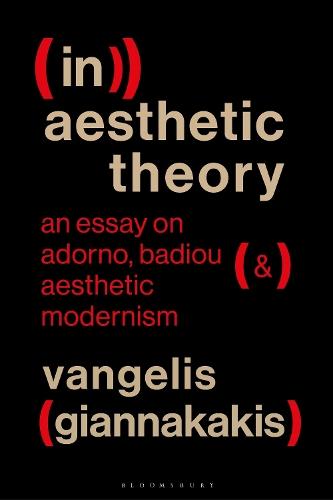
A reckoning with the radicalisation of modernist aesthetics that took hold in the mid-twentieth century, (In)aesthetic Theory illuminates the limits of aesthetic presentation by bringing Theodor Adorno and Alain Badiou’s divergent philosophies of art into critical proximity. Both theorists uncover moments in which art ceases to represent and begins to insist – where its truth is not stated outright but intimated in a gesture beyond the world as given. Their respective frameworks suggest that aesthetic experience can open an affective breach in which the reifying impulse of cognition is negated, and that which otherwise eludes the regime of established appearances is encountered obliquely. This shared structural insight anchors this book’s central hypothesis: that art’s power to produce truth lies precisely in this zone of interruption, of failure, of withdrawal, and vanishing intensity. Combining original theory with historically grounded comparative commentary, the text reflects on presence and absence, history and memory, politics and art, entropy and decay. With it, Vangelis Giannakakis offers a vitally current interpretation of aesthetic modernism.
Full Product Details
Author: Vangelis Giannakakis (Goethe-Universität Frankfurt, Germany)
Publisher: Bloomsbury Publishing PLC
Imprint: Bloomsbury Academic
ISBN: 9781350450653
ISBN 10: 1350450650
Pages: 208
Publication Date: 19 February 2026
Audience:
Professional and scholarly
,
Professional & Vocational
Format: Hardback
Publisher's Status: Forthcoming
Availability: Not yet available

This item is yet to be released. You can pre-order this item and we will dispatch it to you upon its release.
Reviews
How can we consider structural features intrinsic to art without, for that reason, abstracting from their historical embeddedness? Vangelis Giannakakis answers this vital question through the interpretation of aesthetic modernism by Theodor Adorno and Alain Badiou. Very few thinkers can generate a fruitful dialogue among classics without being repetitive, naive, and excessively scholarly. This is an original and erudite book by a first-rate philosopher of art and specialist on Adorno and Badiou.All those interested in contemporary aesthetics will find Giannakakis’s interpretation of events, reality, and aesthetic experience – all central concepts for Adorno and Badiou – a new paradigm to think with in the 21st century. This paradigm is called the (In)aesthetic. A must read. * Santiago Zabala, ICREA Research Professor of Philosophy at Pompeu Fabra University, Spain, and author of Signs from the Future (2025) * Giannakakis’ argument is new, sensitive, and critical—and attentive to the complexities that mark the theories of both Adorno and Badiou. He argues that Adorno’s negatively dialectical aesthetics share several features with Badiou’s program of inaesthetics: the confrontation with otherness (the shudder and/or the event); the imperative to resist instrumental reason through negation; the importance of recognising the priority of the object over reified subjectivity; and the nature of the aesthetic image—which allows fantasy, speculation, and the possibility of philosophical interpretation, capable of following and transcending the object. The concept of “art at the end” is also appropriate for our own era—which offers nightmarish repetition as well as the uncanny trace of difference. If history is a path of despair, it is also one of resistance, hope, and the ever-unforeseen. * Justin Neville Kaushall *
How can we consider structural features intrinsic to art without, for that reason, abstracting from their historical embeddedness? Vangelis Giannakakis answers this vital question through the interpretation of aesthetic modernism by Theodor Adorno and Alain Badiou. Very few thinkers can generate a fruitful dialogue among classics without being repetitive, naive, and excessively scholarly. This is an original and erudite book by a first-rate philosopher of art and specialist on Adorno and Badiou.All those interested in contemporary aesthetics will find Giannakakis’s interpretation of events, reality, and aesthetic experience – all central concepts for Adorno and Badiou – a new paradigm to think with in the 21st century. This paradigm is called the (In)aesthetic. A must read. * - Santiago Zabala, ICREA Research Professor of Philosophy at Pompeu Fabra University, Spain, and author of Signs from the Future (2025) *
Author Information
Vangelis Giannakakis is a Research Affiliate and Adjunct Lecturer in Philosophy at Goethe University Frankfurt, Germany.