Overview
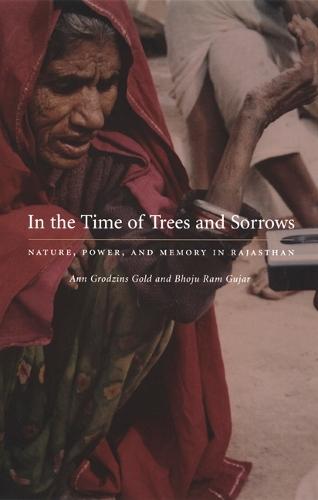
In the Time of Trees and Sorrows showcases peasants' memories of everyday life in North India under royal rule before Indian Independence and their musings on the contrast between the old days and the unprecedented shifts that a half century has wrought. It is an oral history of the former Kingdom of Sawar in the modern state of Rajasthan, India, as it was from the 1930s to the 1950s. Based on testimonies from the early 1990s, the book stands as a polyvocal account of the radical political and environmental changes the region and its people have faced in the twentieth century. Not just the story of modernity from the perspective of a rural village, these interviews and author commentaries narrate a relatively sudden transformation for this small community from subjection to a local despot and to a remote colonial power to citizenship in a modern postcolonial democracy. Unlike other recent studies of Rajasthan, whose former princes continue to fascinate particularly the Western imagination, the current study gives voice exclusively to former subjects who endured the double oppression of colonial and regional rulers.Gold and Gujar thus place subjective subaltern experiences of daily rural routines, manifestations of power relations, and sweeping changes to the environment (after the fall of kings) that turned lush forests into a barren landscape on equal footing with historical ""fact"" and archival sources. Nature as idea and concept, culturally laden as it is in Western thought, plays a central role in this ethnographic text. Ambiguous and complex, ""nature"" reflects the variegated responses Sawar informants had to their surroundings and to their ""beggar"" past (forced labour under the local king). The framing questions of this South Asian history are: what was it like in the time of kings? and what happened to the trees? Specialists of South Asian history, anthropology, subaltern studies, and the environment will welcome publication of this book.
Full Product Details
Author: Ann Grodzins Gold ,
Bhoju Ram Gujar
Publisher: Duke University Press
Imprint: Duke University Press
Dimensions:
Width: 15.40cm
, Height: 3.40cm
, Length: 22.80cm
Weight: 0.907kg
ISBN: 9780822328087
ISBN 10: 0822328089
Pages: 432
Publication Date: 01 March 2002
Audience:
Professional and scholarly
,
Professional & Vocational
Format: Hardback
Publisher's Status: Active
Availability: In Print

This item will be ordered in for you from one of our suppliers. Upon receipt, we will promptly dispatch it out to you. For in store availability, please contact us.
Reviews
A unique, densely textured historical and ethnographic account. Engaging scholarship on memory, environmental history, oral history, South Asian studies, and ethnographic experimentation, this book works on multiple registers. The authors' observations about the sweat, dust, tears, and delights of fieldwork are also remarkable in their evocative force. -Kirin Narayan, author of Mondays on the Dark Night of the Moon: Himalayan Foothill Folktales This is an extraordinary history of postcolonial India as told through the lives of peasants and pastoralists, artisans and housewives. Drawing on many years of research, Gold and Gujar explore changing relations between state and subject, changing structures of production and consumption and, most innovatively, changes in the natural world in rural Rajasthan. Their research is rich, their analyses subtle and empathetic, their writing uncommonly evocative. This landmark study is at once a major contribution to environmental history, political anthropology, and folklore. -Ramachandra Guha, author of The Unquiet Woods and Environmentalism: A Global History
This is an extraordinary history of postcolonial India as told through the lives of peasants and pastoralists, artisans and housewives. Drawing on many years of research, Gold and Gujar explore changing relations between state and subject, changing structures of production and consumption and, most innovatively, changes in the natural world in rural Rajasthan. Their research is rich, their analyses subtle and empathetic, their writing uncommonly evocative. This landmark study is at once a major contribution to environmental history, political anthropology, and folklore. -Ramachandra Guha, author of The Unquiet Woods and Environmentalism: A Global History
Author Information
Ann Grodzins Gold is Professor of Religion and Anthropology at Syracuse University. She is the author of several books, including Fruitful Journeys: The Ways of Rajasthani Pilgrims. Bhoju Ram Gujar is Headmaster at Government Middle School in Maganpura village, Rajasthan, India, and lives in Ghatiyali, in the former kingdom of Sawar.