Overview
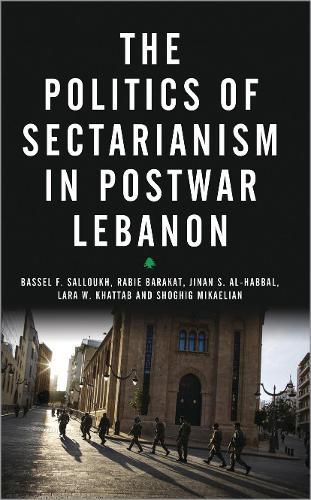
The wave of popular uprisings that swept across the Arab world starting in December 2010 rattled regimes from Morocco to Oman. However, Lebanon's sectarian system proved immune to the domestic and regional pressures unleashed by the Arab Spring. How can this be explained? How has the country's political elite dealt with challenges to the system? And, finally, what lessons can other Arab states draw from Lebanon's sectarian experience? This book looks at the mix of institutional, clientelist, and discursive practices that sustain the sectarian nature of Lebanon. It exposes snapshots of an ever-expanding sectarian web that occupies substantial areas of everyday life and surveys struggles waged by opponents of the system - by women, teachers, public sector employees, students or coalitions across NGOs - and how their efforts are often sabotaged or contained by numerous systematic forces.
Full Product Details
Author: Bassel F Salloukh (Lebanese American University) ,
Rabie Barakat (PhD candidate in Political Science, University of Edinburgh) ,
Jinan S Al-Habbal ,
Lara. W Khattab
Publisher: Pluto Press
Imprint: Pluto Press
Dimensions:
Width: 13.50cm
, Height: 1.50cm
, Length: 21.50cm
Weight: 0.290kg
ISBN: 9780745334134
ISBN 10: 074533413
Pages: 240
Publication Date: 20 July 2015
Audience:
Professional and scholarly
,
Professional & Vocational
Format: Paperback
Publisher's Status: Active
Availability: Out of stock

The supplier is temporarily out of stock of this item. It will be ordered for you on backorder and shipped when it becomes available.
Reviews
The Politics of Sectarianism in Postwar Lebanon provides a very thoughtful account of sectarianism in the Lebanese electoral system, military, media, and associational life. Above and beyond this, the authors' theoretically rich post-culturalist lens offers considerable insight into the role played by institutions, discourse, clientalism, economic power, political mobilization, and regional context. This book should be read by all those interested in both Lebanese politics and the broader dynamics of entrenched identity-based politics. -- Professor Rex Brynen, Department of Political Science, McGill University A must read for anyone interested in what is going on in Lebanon and the Middle East today. Adapting Foucault's tools of 'practices of governance and practices of freedom', Salloukh and his colleagues show in detail how a complex form of sectarian governance operates in Lebanon, and survey the practices of freedom for democratic change that have developed in response. The diffusion of similar practices in the post-popular uprisings Arab World bodes ill for the future of the region. -- James Tully, Distinguished Professor Emeritus of Political Science, Law, Indigenous Governance and Philosophy at the University of Victoria, Canada. The authors make an important contribution to the study of identity politics in the Middle East by showing how sectarianism is reproduced and reinforced as a socio-political force in Lebanon. Their account examines the ways in which sectarianism plays out in multiple policy areas such as the labor and women's movements, the media, and legal frameworks, and shows how sectarian political forces wittingly and unwittingly undercut the efforts of civil society actors to organize along alternative lines. The book offers a far more compelling treatment than many journalistic accounts of the dynamics of sectarianism and is a valuable complement to existing scholarly literature, which largely focuses on the emergence rather than reproduction and dynamic reconstitution of sectarianism in Lebanon. This is an important approach because it addresses the critical question of why sectarianism persists and why it is so difficult to undo. -- Melani Cammett, Professor of Government, Harvard University A judicious and well-argued case for why sectarianism continues to dominate the Lebanese political system, even though there is nothing inevitable about that result. Salloukh and his co-authors demonstrate that sectarianism is the result of a carefully constructed and mutually reinforcing system of political, economic and social institutions, not the product of some primordial Lebanese political culture. But they also demonstrate how hard it is to change the institutions that have entrenched sectarianism in the Lebanese system. -- F. Gregory Gause, III, John H. Lindsey '44 Chair, Professor of International Affairs and Head of the International Affairs Department at the Bush School of Government and Public Service, Texas A&M University By unpacking and critically assessing the production and reproduction of sectarian identities across a broad range of social, political, and economic domains, and how these processes intersect with and affect governance, political economy, and state-society relations, the authors of this exceptional volume have added immeasurably to our understanding of the role of sectarian identities in all spheres of Lebanese life. -- Steven Heydemann, Vice President, Applied Research on Conflict, United States Institute of Peace
The Politics of Sectarianism in Postwar Lebanon provides a very thoughtful account of sectarianism in the Lebanese electoral system, military, media, and associational life. Above and beyond this, the authors' theoretically rich post-culturalist lens offers considerable insight into the role played by institutions, discourse, clientalism, economic power, political mobilization, and regional context. This book should be read by all those interested in both Lebanese politics and the broader dynamics of entrenched identity-based politics. -- Professor Rex Brynen, Department of Political Science, McGill University
Author Information
Bassel F. Salloukh is Associate Professor of Political Science at the Lebanese American University. He is author, co-author, and co-editor of a number of books including Beyond the Arab Spring (Lynne Rienner Firm, 2012) and The Politics of Sectarianism in Postwar Lebanon (Pluto, 2015). Rabie Barakat is Lecturer in Media Studies in the Department of Sociology, Anthropology and Media Studies at the American University of Beirut. He is a former news presenter and field reporter in different Arab news outlets and co-author of The Politics of Sectarianism in Postwar Lebanon (Pluto, 2015). Jinan S. Al-Habbal is a PhD candidate in International Relations at the University of St Andrews. She is the co-author of The Politics of Sectarianism in Postwar Lebanon (Pluto, 2015). Lara W. Khattab is a PhD candidate in Political Science at Concordia University in Montreal, Canada. She is the co-author of The Politics of Sectarianism in Postwar Lebanon (Pluto, 2015). Shoghig Mikaelian is a PhD candidate in Political Science at Concordia University in Montreal, Canada. She is the co-author of The Politics of Sectarianism in Postwar Lebanon (Pluto, 2015).