Overview
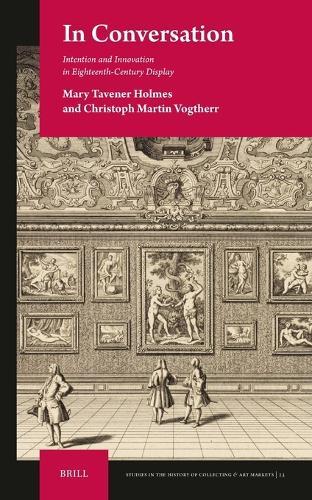
At the beginning of the eighteenth century, a generation of collectors in France and the Holy Roman Empire developed new principles for the display of paintings, principles based on comparison triggered by the mixture of schools and periods; its aim was to encourage analysis and connoisseurship through comparison and conversation. The ground-breaking theories of Roger de Piles were central to this novel approach, and essential to its understanding. These principles were predominant until the 1780s. This book examines case studies in France, the German Empire and the UK that exemplify these new principles.
Full Product Details
Author: Mary Tavener Holmes , Christoph Martin Vogtherr
Publisher: Brill
Imprint: Brill
Edition: c. 500 pp, 160 full-color illustrations
Volume: 23
Dimensions:
Width: 15.50cm
, Height: 3.30cm
, Length: 23.50cm
Weight: 0.877kg
ISBN: 9789004732858
ISBN 10: 9004732853
Pages: 452
Publication Date: 18 September 2025
Audience:
Professional and scholarly
,
Professional & Vocational
Format: Hardback
Publisher's Status: Active
Availability: Manufactured on demand 
We will order this item for you from a manufactured on demand supplier.
Table of Contents
Acknowledgements IX List of Figures Introduction 1 Social Spaces: Displaying and Discussing Paintings in Eighteenth-Century European Collections 2 A New Theoretical Framework 3 The Vanishing Role of Iconography 4 Setting the Stage: Vienna and Versailles at the Beginning of the Eighteenth Century Part 1: Pioneers of the New Principles Introduction to Part 1 1 Lothar Franz Graf Schönborn at Pommersfelden, Schloss Weißenstein 2 Eugen Prince of Savoy at Vienna, Upper Belvedere 3 Philippe II, Duc d’Orléans at Paris, Palais Royal 4 Pierre Crozat at Paris, rue de Richelieu Part 2: New Approaches by Private Collectors Introduction to Part 2 5 Jeanne-Baptiste d’Albert, Comtesse de Verrue at Paris, rue du Cherche-Midi 6 Jean de Jullienne at Paris, rue des Gobelins 7 François Berger at Paris, rue Saint-Marc Acknowledgments 8 Etienne-François, Duc de Choiseul at Paris, rue de Richelieu Part 3: Rulers and Institutions Introduction to Part 3 9 Elector Friedrich August II of Saxony / August III King of Poland at Dresden, Stallhof 10 The Electors Palatine at Düsseldorf, Schloss, and at Mannheim, Schloss 11 The French Royal Collection at Paris, Palais du Luxembourg 12 The Académie Royal de Peinture et de Sculpture at the Salon, Paris, Palais du Louvre 13 Abel-François Poisson de Vandières, Marquis de Marigny et de Menars at Paris, rue Saint-Thomas-du-Louvre 14 Friedrich II King of Prussia at Potsdam, Schloss Sanssouci and Bildergalerie Part 4: The British Contribution Introduction to Part 4 15 Sir Robert Walpole at Houghton Hall 16 Thomas Coke, Earl of Leicester at Holkham Hall 17 John Stuart, 3rd Earl of Bute at Luton Hoo Part 5: On the Verge of the Museum Age Introduction to Part 5 18 The Imperial Collection at Vienna, Upper Belvedere Conclusion: Principles of Eighteenth-Century Paintings Displays Bibliography Index
Reviews
Author Information
Mary Tavener Holmes, Ph.D., is an independent scholar with a specialty in the art of the eighteenth century. Her publications include De Watteau à Fragonard: Les fêtes galantes (with Christoph Vogtherr, 2014) and Nicolas Lancret’s Dance before a Fountain (2006). Christoph Martin Vogtherr is General Director of the Prussian Palaces and Gardens Foundation, Potsdam. Prior to that, he was director at the Hamburger Kunsthalle and the Wallace Collection. He is a specialist of French eighteenth-century art and the history of art collecting.
Tab Content 6
Author Website:
Countries Available
All regions
|