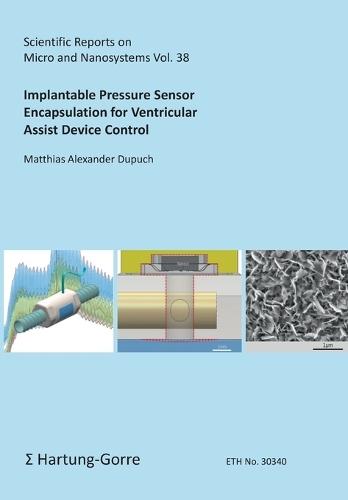
Implantable Pressure Sensor Encapsulation for Ventricular Assist Device Control

Author:   Matthias Alexander Dupuch ,  Christofer Hierold
Publisher:   Hartung & Gorre
ISBN:  

9783866288348


Pages:   194
Publication Date:   20 December 2024
Format:   Paperback
Availability:   In Print   Availability explained
This item will be ordered in for you from one of our suppliers. Upon receipt, we will promptly dispatch it out to you. For in store availability, please contact us.

Our Price $184.27 Quantity:  
Add to Cart

Share |

Implantable Pressure Sensor Encapsulation for Ventricular Assist Device Control


Overview

Autonomous feedback controlled ventricular assists device (VAD) operation promises a plethora of benefits such as increased patient safety, comfort, and reduced healthcare costs. Current generation VADs operate at static pump speeds due to the lack of available biocompatible, long-term stable pressure sensor systems. In this thesis, a pressure sensor encapsulation was developed and integrated in an inflow cannula for a VAD and in an implantable testing platform for animal trials. The encapsulation uses a media separating diaphragm embedded in a Parylene C coating. The approach is expanded to enable optimized diaphragm shapes, which allow significantly better control over the final device characteristics, especially the temperature cross sensitivity. Furthermore, a production processes was developed to minimize assembly induced internal overpressure. The produced capsules showed excellent pressure transmission of more than 99.7 % and a temperature cross sensitivity of less than 266 Pa from 35 °C to 42 °C for most capsules. However, a large temperature cross sensitivity was observed from room to body temperature in some capsules, adding relevant drift of 750 Pa (75 % quartile) after 42 days to the measurement. The observed drift is related to the viscoelastic nature of the Parylene C diaphragm and the capsule-to-capsule variation is attributed to production process variations, which can be further optimized. Systematic errors in the pressure transmission, temperature cross sensitivity (TCS), and drift were extracted and correction approaches for each were developed. This enabled the reduction of the pressure transmission error by 50 % by linear correction. A differential measurement approach reduced the temperature cross sensitivity to less than 70 Pa from 35 °C to 42 °C and drastically reduced the temperature induced drift to 300 Pa (75 % quartile) after a jump from room to body temperature. Half of all sensors even remained within a +- 100 Pa window in the same tim

Full Product Details

Author:   Matthias Alexander Dupuch ,  Christofer Hierold
Publisher:   Hartung & Gorre
Imprint:   Hartung & Gorre
Dimensions:   Width: 17.00cm , Height: 1.00cm , Length: 24.40cm
Weight:   0.318kg
ISBN:  

9783866288348


ISBN 10:   3866288344
Pages:   194
Publication Date:   20 December 2024
Audience:   General/trade ,  General
Format:   Paperback
Publisher's Status:   Active
Availability:   In Print   Availability explained
This item will be ordered in for you from one of our suppliers. Upon receipt, we will promptly dispatch it out to you. For in store availability, please contact us.

Table of Contents

Reviews

Author Information

Tab Content 6

Author Website:  

Countries Available

All regions
Latest Reading Guide

April RG 26_2


Shopping Cart
Your cart is empty
Shopping cart
Mailing List