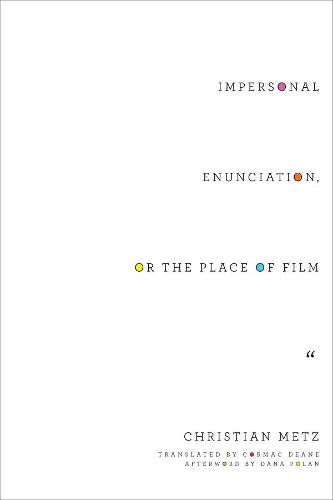
Full Product Details
Author: Christian Metz ,
Cormac Deane ,
Dana Polan
Publisher: Columbia University Press
Imprint: Columbia University Press
Dimensions:
Width: 15.20cm
, Height: 1.50cm
, Length: 22.90cm
Weight: 0.368kg
ISBN: 9780231173674
ISBN 10: 0231173679
Pages: 280
Publication Date: 02 February 2016
Audience:
General/trade
,
College/higher education
,
General
,
Tertiary & Higher Education
Format: Paperback
Publisher's Status: Active
Availability: Manufactured on demand

We will order this item for you from a manufactured on demand supplier.
Language: French
Reviews
Metz's generous personality is captured well here, something that no other English translation has accomplished. It is both an extension of Metz's path-breaking work in bringing the concepts and methods of linguistics and psychoanalysis to the study of film, and the articulation of fundamentally new directions in his thought. -- D. N. Rodowick, University of Chicago
Metz's generous personality is captured well here, something that no other English translation has accomplished. It is both an extension of Metz's path-breaking work in bringing the concepts and methods of linguistics and psychoanalysis to the study of film, and the articulation of fundamentally new directions in his thought. -- D. N. Rodowick, University of Chicago At long last, Christian Metz's final book, Impersonal Enunciation, is available in English, expertly translated by Cormac Deane. Metz's non-deictic, reflexive theory of enunciation, in which the film text continually references itself, constitutes the culmination of his lifelong semiotic analysis of the cinema. -- Warren Buckland, author of The Cognitive Semiotics of Film In this splendid new translation... Metz shines through, avoiding jargon, using richly illustrative examples, and writing with a persuasive voice.Publishers Weekly Publishers Weekly Metz returns to and develops the question of what speaks in the moving image: code, or something else. In meticulous and enlightening readings of films, television shows, and changing ways of watching them, Metz's posthumous text is a true ghost in the machine, a revenant who reopens many of the arguments we thought were closed and makes audiovisual media matter, once more, in every sense of the word -- Sean Cubitt, Goldsmiths, University of London The moments of poetry, wit, and charming cinephilia scattered throughout make this work as engaging as it is enlightening... Essential. CHOICE
Metz's generous personality is captured well here, something that no other English translation has accomplished. It is both an extension of Metz's path-breaking work in bringing the concepts and methods of linguistics and psychoanalysis to the study of film, and the articulation of fundamentally new directions in his thought. -- D. N. Rodowick, University of Chicago At long last, Christian Metz's final book, Impersonal Enunciation, is available in English, expertly translated by Cormac Deane. Metz's non-deictic, reflexive theory of enunciation, in which the film text continually references itself, constitutes the culmination of his lifelong semiotic analysis of the cinema. -- Warren Buckland, author of The Cognitive Semiotics of Film In this splendid new translation... Metz shines through, avoiding jargon, using richly illustrative examples, and writing with a persuasive voice.Publishers Weekly Publishers Weekly Metz returns to and develops the question of what speaks in the moving image: code, or something else. In meticulous and enlightening readings of films, television shows, and changing ways of watching them, Metz's posthumous text is a true ghost in the machine, a revenant who reopens many of the arguments we thought were closed and makes audiovisual media matter, once more, in every sense of the word -- Sean Cubitt, Goldsmiths, University of London
Author Information
Christian Metz (1931-1993) is also the author of Film Language: A Semiotics of the Cinema; The Imaginary Signifier: Psychoanalysis and the Cinema; and Language and Cinema.