|
|
|||
|
||||
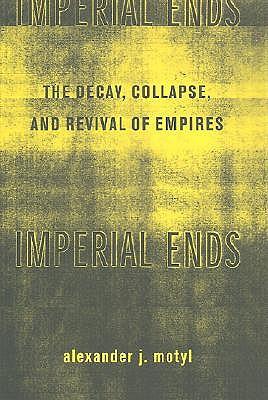
OverviewDespite their historical importance, empires have received scant attention from social scientists. Now, Alexander J. Motyl examines the structure, dynamics, and continuing relevance of empire-and asks, ""Why do empires decline? Why do some empires collapse? And why do some collapsed empires revive?"" Rejecting choice-centered theories of imperial decline, Motyl maintains that the very structure of empires promotes decay and that decay in turn facilitates the progressive loss of territory. Although most major empires have in fact declined in this manner, some, such as the Soviet Union, have collapsed suddenly and comprehensively. Motyl explains how and why collapse occurs, why such an outcome is hard to foresee, and why some collapsed empires revive. While broad-ranging historically and empirically, Imperial Ends focuses on five modern empires: the Soviet, Romanov, Ottoman, Habsburg, and Wilhelmine. Examining the possibility of a revival of the Soviet empire, Motyl points out that the expansion of NATO and the European Union, along with increasing globalization, will isolate Russia and its neighbors, promoting their dependence upon one another and perhaps facilitating the rise of the former core. With boldly stated conclusions and concise analytical interpretations, Imperial Ends cohesively illustrates to policymakers and social scientists alike the importance of possible imperial revivals and the rise of future empires. Full Product DetailsAuthor: Alexander J. MotylPublisher: Columbia University Press Imprint: Columbia University Press Dimensions: Width: 15.80cm , Height: 1.40cm , Length: 23.50cm Weight: 0.383kg ISBN: 9780231121101ISBN 10: 0231121105 Pages: 128 Publication Date: 01 August 2001 Audience: Professional and scholarly , Professional & Vocational Format: Hardback Publisher's Status: Active Availability: Manufactured on demand We will order this item for you from a manufactured on demand supplier. Language: English Table of ContentsReviewsOffers a refreshingly explicit explaination of his preferences. * Journal of Early Modern History * Offers a refreshingly explicit explaination of his preferences. -- Journal of Early Modern History Author InformationAlexander J. Motyl is associate professor of political science at Rutgers University, Newark, where he also serves as Deputy Director of the Center for Global Change and Governance. The editor-in-chief of the Encyclopedia of Nationalism, he is also the author of many books, most recently, Revolutions, Nations, Empires. He lives in New York City. Tab Content 6Author Website:Countries AvailableAll regions |
||||