Overview
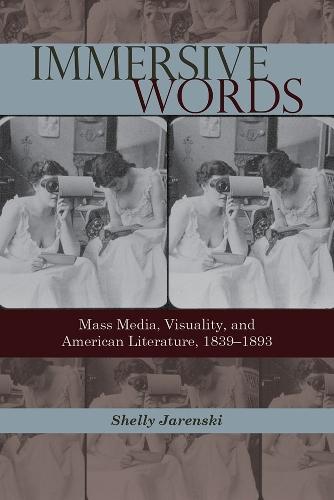
Immersive Words traces how innovations in visual practices and aesthetics in the nineteenth century changed the aesthetics of American literature with profound consequences for America’s evolving national identity. In Immersive Words, Michelle Jarenski demonstrates that the contemporary challenge that visual images and virtual environments in cinema and photography, on the web, and in video games pose to reading and writing are not contemporary developments but equally exercised the imaginations, anxieties, and works of nineteenth-century authors. The middle of the nineteenth century witnessed the emergence of numerous visual technologies and techniques: the daguerreotype, immersive exhibition spaces such as cycloramas and panoramas, mechanized tourism, and large-scale exhibitions and spectacles such as the World’s Fair. In closely argued chapters devoted to these four visual forms, Jarenski demonstrates that the popularity of these novelties catalysed a shift by authors of the period beyond narratives that merely described images to ones that invoked aesthetic experiences. She describes how Herman Melville adapts the aesthetic of the daguerreotype through his use of dramatic point-of-view and unexpected shifts that disorient readers. Frederick Douglass is shown to appropriate a panoramic aesthetic that severs spatial and temporal narratives from standard expectations. Immersive Words traces how Nathaniel Hawthorne’s The Marble Faun found success as a travel guide to Rome, though intended as a work of serious fiction. Finally, Sarah Orne Jewett simulates the interactivity of the World Columbian Exposition to promote racialized and gendered forms of aesthetic communication. These techniques and strategies drawn from visual forms blur the just-so boundary critics and theorists have traditionally drawn between text and image. In the mid-nineteenth century, the national identity of the United States remained fluid and hinged upon matters of gender, sexuality, and, crucially, race. Authors both reflected that evolving identity and contributed to its ongoing evolution. In demonstrating how the aesthetic and visual technologies of the nineteenth century changed the fundamental aesthetics of American literature, the importance of Immersive Words goes far beyond literary criticism.
Full Product Details
Author: Michelle Jarenski ,
Shelly Jarenski
Publisher: The University of Alabama Press
Imprint: The University of Alabama Press
Edition: 2nd
Dimensions:
Width: 15.40cm
, Height: 2.70cm
, Length: 22.80cm
Weight: 0.555kg
ISBN: 9780817318673
ISBN 10: 0817318674
Pages: 224
Publication Date: 30 April 2015
Audience:
Professional and scholarly
,
Professional & Vocational
Format: Hardback
Publisher's Status: Active
Availability: Temporarily unavailable

The supplier advises that this item is temporarily unavailable. It will be ordered for you and placed on backorder. Once it does come back in stock, we will ship it out to you.
Reviews
""This volume joins a growing body of scholarship that rejects the traditional word/image binary . . . A strength of this book is Jarenski's archival research, which enriches her readings of the works discussed and allows her to offer fresh perspectives on well-known writers. Recommended."" --CHOICE ""Immersive Words continues a line of argument about visual culture that has invigorated the study of nineteenth-century American literature, but it also forges new, interdisciplinary relations between literary studies and the burgeoning field of American studies. While its central texts are by nineteenth-century authors such as Melville, Douglass, and Hawthorne, Jarenski enriches her analysis with many other ancillary cultural texts, events, and subgenres that open the book up to other periods and forms of cultural production, ultimately making Immersive Words much more than the sum of its parts."" --Michael A. Chaney, author of Fugitive Vision: Slave Image and Black Identity in Antebellum Narrative and editor of Graphic Subjects: Critical Essays on Autobiography and Graphic Novels ""Immersive Words is a significant contribution to nineteenth-century American literary studies and to our understanding of visual culture of the era in its various manifestations. It provides numerous insights into the intersection of visual technologies and commodities with literary works, helping us to gain a better appreciation and sense of how the literary aesthetic achievements of authors such as Melville, Douglass, Hawthorne, and Jewett emerged from their engagement with and reworking of the aesthetic experience of daguerreotypes, panoramas, travel literature, and museum exhibits.""--Paul Gilmore, author of The Genuine Article: Race, Mass Culture, and American Literary Manhood and Aesthetic Materialism: Electricity and American Romanticism
<i> Immersive Words</i> is a significant contribution to nineteenth-century American literary studies and to our understanding of visual culture of the era in its various manifestations. It provides numerous insights into the intersection of visual technologies and commodities with literary works, helping us to gain a better appreciation and sense of how the literary aesthetic achievements of authors such as Melville, Douglass, Hawthorne, and Jewett emerged from their engagement with and reworking of the aesthetic experience of daguerreotypes, panoramas, travel literature, and museum exhibits. --Paul Gilmore, author of <i>The Genuine Article: Race, Mass Culture, and American Literary Manhood</i> and <i>Aesthetic Materialism: Electricity and American Romanticism</i>
Immersive Words continues a line of argument about visual culture that has invigorated the study of nineteenth-century American literature, but it also forges new, interdisciplinary relations between literary studies and the burgeoning field of American studies. While its central texts are by nineteenth-century authors such as Melville, Douglass, and Hawthorne, Jarenski enriches her analysis with many other ancillary cultural texts, events, and subgenres that open the book up to other periods and forms of cultural production, ultimately making Immersive Words much more than the sum of its parts. --Michael A. Chaney, author of Fugitive Vision: Slave Image and Black Identity in Antebellum Narrative and editor of Graphic Subjects: Critical Essays on Autobiography and Graphic Novels
Author Information
Shelly Jarenski is an assistant professor of English at the University of Michigan in Dearborn, USA. Her articles have appeared in American Quarterly, MELUS, and the Journal of the Midwest Modern Language Association.