Overview
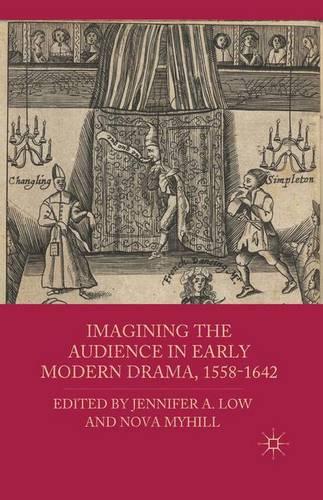
This essay collection builds on the latest research on the topic of theatre audiences in early modern England. In broad terms, the project answers the question, 'How do we define the relationships between performance and audience?'.
Full Product Details
Author: J. Low ,
N. Myhill
Publisher: Palgrave Macmillan
Imprint: Palgrave Macmillan
Edition: 1st ed. 2011
Weight: 0.301kg
ISBN: 9781349293100
ISBN 10: 1349293105
Pages: 218
Publication Date: 04 March 2011
Audience:
Professional and scholarly
,
Professional & Vocational
Format: Paperback
Publisher's Status: Active
Availability: Manufactured on demand

We will order this item for you from a manufactured on demand supplier.
Reviews
The spectator speaks up, at last. As Low and Myhill point out in their brilliant introduction, research on Renaissance spectatorship has long been polarized between opposing conceptions of the audience as a collective entity or as a gathering of separate individuals, with few attempts to bridge the two approaches. This excellent collection redresses the balance not only by placing the audience (collective) and audiences (individual) at the center of its inquiries, but by setting up for the first time a fruitful dialogue between theatre history and new historicists' cultural poetics. The overall result is, in my view, the best study of theatrical reception to have emerged in recent years. - Keir Elam, Professor of English Literature, University of Bologna 'Audience' is a complex and paradoxical term, even more difficult to comprehend when we encounter it in the flesh, as a living, breathing entity. This is an exemplary collection of essays, offering complex and multi-faceted views of early modern audiences - as producers and not only consumers of theatrical meaning; necessary participants in, and active witnesses to, the play in performance. - Steven Mullaney, Associate Professor of English and Director of Graduate Studies, University of Michigan Audiences appear under various guises throughout this collection: as witnesses, as civic spectators, as institutional revellers, as public and private theatregoers, as individual and collective interpretive agents, as both imagined and actual consumers and producers of culture. The real power of this volume derives from its multiplicities. - Jessica Slights, Associate Professor of English and Theatre, Acadia University
The spectator speaks up, at last. As Low and Myhill point out in their brilliant introduction, research on Renaissance spectatorship has long been polarized between opposing conceptions of the audience as a collective entity or as a gathering of separate individuals, with few attempts to bridge the two approaches. This excellent collection redresses the balance not only by placing the audience (collective) and audiences (individual) at the center of its inquiries, but by setting up for the first time a fruitful dialogue between theatre history and new historicists' cultural poetics. The overall result is, in my view, the best study of theatrical reception to have emerged in recent years. - Keir Elam, Professor of English Literature, University of Bologna 'Audience' is a complex and paradoxical term, even more difficult to comprehend when we encounter it in the flesh, as a living, breathing entity. This is an exemplary collection of essays, offering complex and multi-faceted views of early modern audiences - as producers and not only consumers of theatrical meaning; necessary participants in, and active witnesses to, the play in performance. - Steven Mullaney, Associate Professor of English and Director of Graduate Studies, University of Michigan Audiences appear under various guises throughout this collection: as witnesses, as civic spectators, as institutional revellers, as public and private theatregoers, as individual and collective interpretive agents, as both imagined and actual consumers and producers of culture. The real power of this volume derives from its multiplicities. - Jessica Slights, Associate Professor of English and Theatre, Acadia University
Author Information
Jennifer A. Low is an Associate Professor of English at Florida Atlantic University and Nova Myhill is an Associate Professor of English at New College of Florida.