Overview
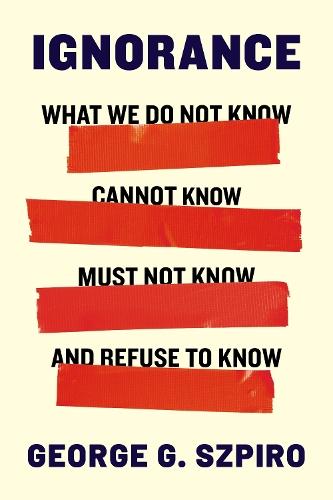
Does the lack of evidence mean that aliens don't exist? Why does an unproven mathematical hypothesis have profound consequences? Are humans capable of grasping the nature of divinity? Is it ethical to give a patient a placebo? Why do people persist in demonstrably false beliefs like flat earth theory? Should someone want to know when they will die? George G. Szpiro examines these questions and many others, offering an engaging and witty tour of what we can learn from ignorance. In a series of fast-paced chapters, he unravels problems ranging across science, mathematics, law, economics, politics, religion, psychology, and philosophy-some esoteric, others drawn from everyday life. Ignorance comes in many forms, Szpiro shows. Some questions are only temporarily unsolved; others are inherently unanswerable. Sometimes authorities keep answers from us, for good or ill. Often our assumptions and biases keep us from overcoming our ignorance, and occasionally we choose to remain ignorant-for surprisingly rational reasons. Ultimately, Szpiro argues, ignorance is not purely negative. It can motivate the pursuit of learning and wisdom-as long as we acknowledge it. Presenting sophisticated topics in an accessible way, this book shows how ignorance sheds light on the nature of knowledge.
Full Product Details
Author: George G. Szpiro
Publisher: Columbia University Press
Imprint: Columbia University Press
ISBN: 9780231221658
ISBN 10: 0231221657
Pages: 344
Publication Date: 07 April 2026
Audience:
General/trade
,
General
Format: Hardback
Publisher's Status: Active
Availability: Manufactured on demand

We will order this item for you from a manufactured on demand supplier.
Reviews
Ignorance has become a hip topic in academia and beyond. George G. Szpiro's book masterfully weaves together different aspects of this trend by considering the flip side of knowledge from everyday perspectives, that is, the normalcy of nonknowledge, intentionally or not, in basically all areas of life. By so doing, Szpiro detects sixty ""normal"" instances of ignorance, no less. If you truly want to know about not knowing, then this is the book to read. -- Matthias Gross, author of <i>Ignorance and Surprise: Science, Society, and Ecological Design</i> Szpiro returns with a witty, thought-provoking exploration of life, history, and the meaning of our existence. Fun to read yet deeply educational, this lively journey through ideas reminds us why books still matter. -- William Eimicke, Columbia University School of International and Public Affairs Szpiro has opened a curiosity cabinet of queries and answers about what is knowable, what is somewhat knowable, and what is not. Ignorance is crafted superbly, with thoroughly engaging origin stories and vignettes of discovery that investigate belief, doubt, uncertainty, and suspicion—illuminating from beginning to end. -- Joseph Mazur, author of <i>The Clock Mirage: Our Myth of Measured Time</i>
Ignorance has become a hip topic in academia and beyond. George Szpiro’s new book masterfully weaves together different streams of this trend by delving into the flipside of knowledge from everyday perspectives, that is, the normalcy of nonknowledge, intentionally or not, in basically all areas of life. By so doing, Szpiro detects sixty “normal” instances of ignorance, no less. If you truly want to know about not knowing, then this is the book to read. -- Matthias Gross, author of <i>Ignorance and Surprise</i>
Ignorance has become a hip topic in academia and beyond. George Szpiro’s new book masterfully weaves together different streams of this trend by delving into the flipside of knowledge from everyday perspectives, that is, the normalcy of nonknowledge, intentionally or not, in basically all areas of life. By so doing, Szpiro detects sixty “normal” instances of ignorance, no less. If you truly want to know about not knowing, then this is the book to read. -- Matthias Gross, author of <i>Ignorance and Surprise</i> Szpiro returns with a witty, thought-provoking exploration of life, history, and the meaning of our existence. Fun to read yet deeply educational, this lively journey through ideas reminds us why books still matter. -- William Eimicke, Columbia University School of International and Public Affairs
Author Information
George G. Szpiro is an author and journalist who was a longtime correspondent for the Swiss daily Neue Zürcher Zeitung. His previous Columbia University Press books are Risk, Choice, and Uncertainty: Three Centuries of Economic Decision-Making (2020) and Perplexing Paradoxes: Unraveling Enigmas in the World Around Us (2024). Szpiro was on the faculty at the Wharton School, University of Pennsylvania, and the Hebrew University in Jerusalem.