|
|
|||
|
||||
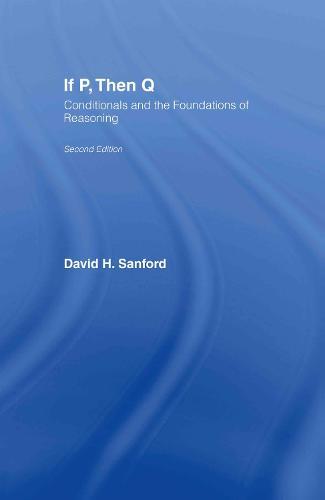
OverviewSince its publication in 1989, David Sanford's If P Then Q has become one of the most widely respected works in the field of conditionals. This new edition includes three new chapters, thus updating the book to take into account developments in the area over the past fifteen years. Part One gives an historical overview of the history of philosophical treatments of conditionals, from ancient times to the contemporary development of possible worlds. In Part Two, Sanford puts forward his own treatment of conditionals. Full Product DetailsAuthor: David SanfordPublisher: Taylor & Francis Ltd Imprint: Routledge Edition: 2nd edition Dimensions: Width: 15.60cm , Height: 2.80cm , Length: 23.40cm Weight: 0.700kg ISBN: 9780415283687ISBN 10: 041528368 Pages: 292 Publication Date: 19 December 2002 Audience: College/higher education , Professional and scholarly , Tertiary & Higher Education , Undergraduate Format: Hardback Publisher's Status: Active Availability: In Print This item will be ordered in for you from one of our suppliers. Upon receipt, we will promptly dispatch it out to you. For in store availability, please contact us. Table of ContentsIntroduction Conditionals in Everyday Life and in Philosophy; I: The History of Philosophical Treatments of Conditionals; I: Ancient History; II: Medieval and Post-medieval History; III: Rediscovery of the Material Conditional; IV: Rediscovery of the Strict Conditional; V: Subjunctive Conditionals and Covering Laws; VI: Belief and Probability; VII: Possible Worlds; II: A New Treatment of Conditionals; VIII: Inference, Entailment, and the Purposes of Theories; IX: Problems with the Ramsey Test, Possible Worlds, and Probability; X: Various Visions of Possible Worlds; XI: Laws and Conditions; XII: Counterfactual Dependence and Backtracking; XIII: Patterns of Dependence; XIV: Objective Dependence; XV: A Problem with ValidityReviews'Undergraduates will find the book useful as a resource. It covers a lot of ground mentioning most of the issues and positions that need to be addressed in a course on conditionals over the years. This is a good place to learn about conditionals or to have one's ideas about them challenged.' - Notre Dame Journal of Formal Logic 'A useful starting point for a course on conditionals. The introductions to the issues are clear and well-illustrated with examples.' - Dialogue 'If Then Q is recommended reading for all who want to work in this suprisingly rich field.' - Australasian Journal of Philosophy; 'Some delightfully insightful comments on the probability account of conditionals, on the Ramsey test, and especially on possible world semantics... it also provides a healthy dose of humbling realism.' - Journal of Philosophy of Science; 'Undergraduates will find the book useful as a resource. It covers a lot of ground mentioning most of the issues and positions that need to be addressed in a course on conditionals over the years. This is a good place to learn about conditionals or to have one's ideas about them challenged.' - Notre Dame Journal of Formal Logic; 'A useful starting point for a course on conditionals. The introductions to the issues are clear and well-illustrated with examples.' - Dialogue 'I can recommend Sanford's book as a throughly well-informed, intelligent and original contribution to the field.' - Philosophical Books Author InformationDavid Sanford is Professor of Philosophy at Duke University, North Carolina, USA. Tab Content 6Author Website:Countries AvailableAll regions |
||||