Overview
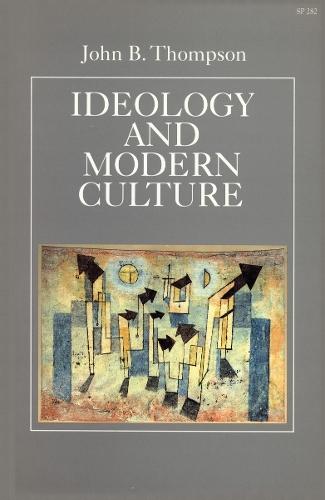
In this major work, informed by materials from several disciplines and theoretical orientations, the author develops a distinctive and new account of the theory of ideology and relates it to the analysis of culture and mass communication in modern societies. In the two centuries since it first appeared in France, the concept of ideology has undergone many transformations. It has been twisted, reformulated, recast, and finally filtered back into the everyday language of social and political life. Although there is much that is misleading and erroneous in the tradition of ideology, the author shows that it still defines a terrain of analysis that remains central to contemporary social sciences and continues to be the site of lively theoretical debate. The author first offers a concise and critical analysis of major contributions to the theory of ideology, from Marx and Mannheim to Althusser and Habermas. He argues that many of these views have failed to take adequate account of the nature and impact of mass communication in the modern world. In an effort to overcome this deficiency - to rethink the theory of ideology in light of the development of mass communication - the author analyzes mass communication by focusing on the emergence of broadcasting and the deployment of new communication technologies. The key to his analysis is what he terms the 'mediazation' of the culture - the general process by which the transmission of symbolic forms becomes increasingly reliant on the technical and institutional apparatuses of the media industries. Building on the work of Geertz and others, the author asserts that symbolic forms are embedded in such structured social contexts as power relations, forms of conflict, and inequalities in the distribution of resources, and that any discussion of mass communication must embrace its political as well as its epistemological content. The book concludes with an elaboration of a systematic interpretative methodology that can be used to analyze different aspects of mass communication, highlighting the ways in which media products are appropriated by individuals in the varied contexts of everyday life.<
Full Product Details
Author: John B. Thompson
Publisher: Stanford University Press
Imprint: Stanford University Press
Edition: New edition
Dimensions:
Width: 15.20cm
, Height: 3.10cm
, Length: 22.90cm
Weight: 0.549kg
ISBN: 9780804718462
ISBN 10: 0804718466
Pages: 372
Publication Date: 01 February 1991
Audience:
College/higher education
,
Professional and scholarly
,
Undergraduate
,
Postgraduate, Research & Scholarly
Format: Paperback
Publisher's Status: Active
Availability: In Print

This item will be ordered in for you from one of our suppliers. Upon receipt, we will promptly dispatch it out to you. For in store availability, please contact us.
Reviews
This is a pathbreaking work which will undoubtedly become one of the fundamental texts in the theory of ideology. -William Outhwaite, University of Sussex
'It is impossible in a few sentences to do justice to the enormous theoretical richness and sustained power of argument of Thompson's analysis. This is a pathbreaking work which will undoubtedly become one of the fundamental texts in the theory of ideology. Yet despite the author's formidable theoretical sophistication, the text is written in a quite remarkably clear and approachable style'.William Outhwaite, University of Sussex
Author Information
John B. Thompson is Lecturer in Sociology at the University of Cambridge and Fellow of Jesus College, Cambridge.