Overview
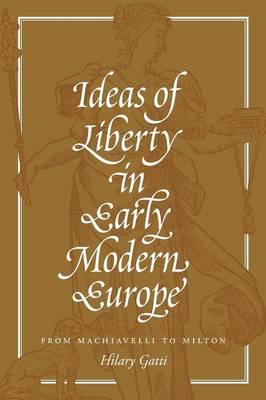
Europe's long sixteenth century--a period spanning the years roughly from the voyages of Columbus in the 1490s to the English Civil War in the 1640s--was an era of power struggles between avaricious and unscrupulous princes, inquisitions and torture chambers, and religious differences of ever more violent fervor. Ideas of Liberty in Early Modern Europe argues that this turbulent age also laid the conceptual foundations of our modern ideas about liberty, justice, and democracy. Hilary Gatti shows how these ideas emerged in response to the often-violent entrenchment of monarchical power and the fragmentation of religious authority, against the backdrop of the westward advance of Islam and the discovery of the New World. She looks at Machiavelli's defense of republican political liberty, and traces how liberty became intertwined with free will and religious pluralism in the writings of Luther, Erasmus, Jean Bodin, and Giordano Bruno. She examines how the St. Bartholomew's Day Massacre and the clash of science and religion gave rise to concepts of liberty as freedom of thought and expression.Returning to Machiavelli and moving on to Jacques Auguste de Thou, Paolo Sarpi, and Milton, Gatti delves into debates about the roles of parliamentary government and a free press in guaranteeing liberties. Drawing on a breadth of canonical and lesser-known writings, Ideas of Liberty in Early Modern Europe reveals how an era stricken by war and injustice gave birth to a more enlightened world.
Full Product Details
Author: Hilary Gatti
Publisher: Princeton University Press
Imprint: Princeton University Press
Dimensions:
Width: 15.20cm
, Height: 1.30cm
, Length: 23.50cm
Weight: 0.340kg
ISBN: 9780691176116
ISBN 10: 0691176116
Pages: 232
Publication Date: 28 February 2017
Audience:
College/higher education
,
Professional and scholarly
,
Undergraduate
,
Postgraduate, Research & Scholarly
Format: Paperback
Publisher's Status: Active
Availability: Available To Order

We have confirmation that this item is in stock with the supplier. It will be ordered in for you and dispatched immediately.
Language: English
Reviews
Gatti offers a lucid primer of some famous and other less well known texts and debates of the period ... an eloquent analysis of the rich tradition of thinking about liberty in the early modern period. --Victoria Kahn, Times Literary Supplement [An] illuminating book. --Jacqueline Broad, Times Higher Education [Gatti] offers thorough, sweeping treatments of major figures in this period--Machiavelli, Luther, Shakespeare, Bruno, Milton--as well as many minor writers... Gatti helpfully situates all the discussions of the period in historical context. This book will be useful for upper-level students and scholars of the history of political thought. --J. Church, Choice Ideas of Liberty is a learned, carefully wrought, and fine-grained study. --Henry C. Clark, Review of Politics
Reconstructs in an original and profound fashion the historical foundations of the debate about liberty and tolerance in the early modern period. --Stefano Colavecchia, Sixteenth Century Journal Ideas of Liberty is a learned, carefully wrought, and fine-grained study. --Henry C. Clark, Review of Politics [Gatti] offers thorough, sweeping treatments of major figures in this period--Machiavelli, Luther, Shakespeare, Bruno, Milton--as well as many minor writers. . . . Gatti helpfully situates all the discussions of the period in historical context. This book will be useful for upper-level students and scholars of the history of political thought. --J. Church, Choice [An] illuminating book. --Jacqueline Broad, Times Higher Education Gatti offers a lucid primer of some famous and other less well known texts and debates of the period . . . an eloquent analysis of the rich tradition of thinking about liberty in the early modern period. --Victoria Kahn, Times Literary Supplement Gatti offers a lucid primer of some famous and other less well known texts and debates of the period ... an eloquent analysis of the rich tradition of thinking about liberty in the early modern period. --Victoria Kahn, Times Literary Supplement [An] illuminating book. --Jacqueline Broad, Times Higher Education [Gatti] offers thorough, sweeping treatments of major figures in this period--Machiavelli, Luther, Shakespeare, Bruno, Milton--as well as many minor writers... Gatti helpfully situates all the discussions of the period in historical context. This book will be useful for upper-level students and scholars of the history of political thought. --J. Church, Choice Ideas of Liberty is a learned, carefully wrought, and fine-grained study. --Henry C. Clark, Review of Politics
Ideas of Liberty is a learned, carefully wrought, and fine-grained study. --Henry C. Clark, Review of Politics [Gatti] offers thorough, sweeping treatments of major figures in this period--Machiavelli, Luther, Shakespeare, Bruno, Milton--as well as many minor writers. . . . Gatti helpfully situates all the discussions of the period in historical context. This book will be useful for upper-level students and scholars of the history of political thought. --J. Church, Choice [An] illuminating book. --Jacqueline Broad, Times Higher Education Gatti offers a lucid primer of some famous and other less well known texts and debates of the period . . . an eloquent analysis of the rich tradition of thinking about liberty in the early modern period. --Victoria Kahn, Times Literary Supplement
Author Information
Hilary Gatti taught for many years at the Sapienza University of Rome. Her books include Essays on Giordano Bruno (Princeton), Giordano Bruno and Renaissance Science, and The Renaissance Drama of Knowledge: Giordano Bruno in England.