|
|
|||
|
||||
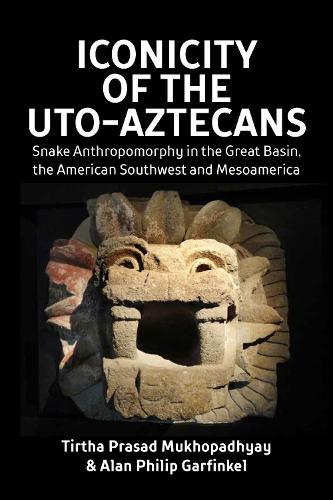
OverviewUto-Aztecan iconic practices are primarily conditioned by the consciousness of the snake as a death-dealing power, and as such, an animal that displays the deepest fears and anxieties of the individual. The attempt to study a snake simulacrum thus constitutes the basic objective of this volume. A long, all-embracing iconicity of snakes and related snake motifs are evident in different cultural expressions ranging from rock art templates to other cultural artifacts like basketry, pottery, temple architecture and sculptural motifs. Uto-Aztecan iconography demonstrates a symbolic memorial order of emotional valences, as well as the negotiations with death and a belief in rebirth, just as the skin-shedding snake reptile manifests in its life cycle. Full Product DetailsAuthor: Tirtha Prasad Mukhopadhyay , Alan Philip GarfinkelPublisher: Berghahn Books Imprint: Berghahn Books ISBN: 9781836950837ISBN 10: 1836950837 Pages: 266 Publication Date: 01 October 2025 Audience: Professional and scholarly , Professional & Vocational Format: Paperback Publisher's Status: Active Availability: In Print This item will be ordered in for you from one of our suppliers. Upon receipt, we will promptly dispatch it out to you. For in store availability, please contact us. Table of ContentsIntroduction Chapter 1. Inmigrations of the First Uto-Aztecans Chapter 2. The Uto-Aztecan Homeland Chapter 3. The Primordial Snake Religion Chapter 4. How Does Prehistoric Iconicity Emerge and Function? Chapter 5. Anthropomorphism of the Uto-Aztecans, Animism, and Animalism Chapter 6. Temporal Horizons of Uto-Aztecan Iconography Chapter 7. Hunting Tool Iconography Chapter 8. The Coso Anthropomorph and its Untold Secrets and Mysteries Chapter 9. The Circular Snake of Time Chapter 10. Outlier Indices in Aztec Icons Chapter 11. Iconicity of Tlaloc in the Rain Praying Cultures of del Bajio Chapter 12. The Binding Liberating Chain of Chupicuaro Pottery Chapter 13. Mother Earth Snakes ConclusionReviews“The authors’ approach is wide ranging and multidisciplinary. The methodology is based on a deep understanding of the subject and exceptional in its scholarship. The authors’ make many interesting links by drawing diverse data together to provide new ways of understanding rock art, the art of Southwest America/Mesoamerica, and how it relates to socio-cultural behavior.” • Derek Hodgson “The authors present an interesting hypothesis (more a series of hypotheses) for the antiquity of Uto-Aztecan iconography based on possible, probable, and “if we accept” observations of rock art in the American West through central Mexico. They rely on a unique blend of linguistic analyses, archaeological data, and comparative similarities in iconography.” • William D. Hyder, University of California Santa Cruz Author InformationTirtha Prasad Mukhopadhyay is Professor of Aesthetics at the University of Guanajuato, Mexico. He has taught at the University of Calcutta and Presidency College, India, and also briefly at the University of Texas at Dallas prior to his appointment in Mexico. An interdisciplinary scholar and former Fulbright Fellow, he travelled extensively across the American Southwest and Mexico to develop an interpretative view of Native American iconography. Tab Content 6Author Website:Countries AvailableAll regions |
||||