Overview
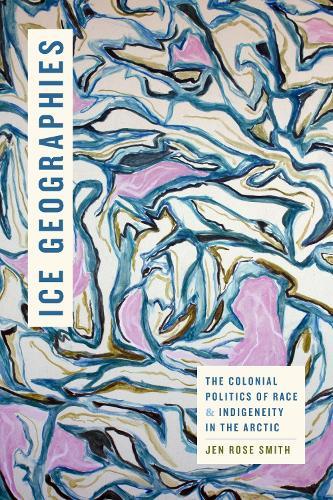
Ice animates the look and feel of climate change. It is melting faster than ever before, causing social upheaval among northern coastal communities and disrupting a more southern, temperate world as sea levels rise. Economic, academic, and activist stakeholders are increasingly focused on the unsettling potential of ice as they plan for a future shaped by rapid transformation. Yet, in Ice Geographies, Jen Rose Smith demonstrates that ice has always been at the center of making sense of the world. Ice as homeland is often at the heart of Arctic and sub-Arctic ontologies, cosmologies, and Native politics. Reflections on ice have also long been a constitutive element of Western political thought, but it often privileges a pristine or empty “nature” stripped of power relations. Smith centers ice to study race and indigeneity by investigating ice relations as sites and sources of analysis that are bound up with colonial and racial formations as well as ice geographies beyond those formations. Smith asks, How is ice a racialized geography and imaginary, and how does it also exceed those frameworks? Duke University Press Scholars of Color First Book Award
Full Product Details
Author: Jen Rose Smith
Publisher: Duke University Press
Imprint: Duke University Press
Weight: 0.572kg
ISBN: 9781478028536
ISBN 10: 147802853
Pages: 248
Publication Date: 16 May 2025
Audience:
College/higher education
,
Postgraduate, Research & Scholarly
Format: Hardback
Publisher's Status: Active
Availability: Out of stock

The supplier is temporarily out of stock of this item. It will be ordered for you on backorder and shipped when it becomes available.
Reviews
"""In this stunning book Jen Rose Smith makes visible the imperial norms that are embedded in how we think about ice geographies. She shows how these norms do the explicit and implicit work of racialization and dispossession while demonstrating that ice, which is far from neutral, sits at the center of some of the most commonly held ideas in the West about humanity, life, and history. Ice Geographies will make a major impact in Native and Indigenous studies, environmental studies, literary studies, and ethnic studies.""--Hi'ilei Julia Kawehipuaakahaopulani Hobart, author of ""Cooling the Tropics: Ice, Indigeneity, and Hawaiian Refreshment"" ""Jen Rose Smith's innovative use of particularly Alaska Native but also other Indigenous literatures as a theoretical form will inspire many scholars, as will the clarity of her interdisciplinary arguments that tie how ice has been used to support projects of white supremacy and colonization. The expansiveness of Smith's theoretical vision and the precision of her analysis make Ice Geographies a truly original work.""--Bathsheba Demuth, author of ""Floating Coast: An Environmental History of the Bering Strait"""
Author Information
Jen Rose Smith is Assistant Professor of American Indian Studies and Geography at the University of Washington.