Overview
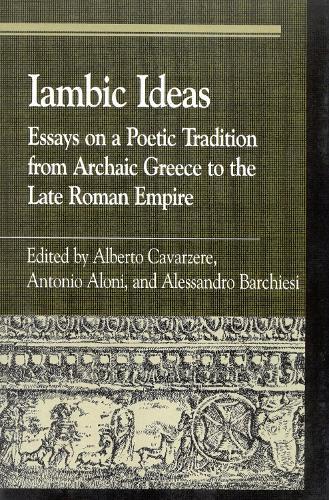
This text explores the concept of the ""iambic"" as a genre. In a set of detailed studies, the contributors examine, across time, the idea of the iambic through a wide variety of cultural settings: Greek, Hellenistic, Roman, and Late Antiquity. What emerges is that the iambic idea is impossible to define in absolute terms; rather, the form of iambic keeps varying in response to different historical contingencies. The variation is evident in such critical terms as the ""iambic tendency"" in Sappho, the ""re-using of iambi"" for Roman epodes, and even the instances of ""iambic absence"" in comedy and other such related forms. In the end, what is most characteristic about the iambic is its own inherent variability.
Full Product Details
Author: Alberto Cavarzere ,
Antonio Aloni ,
Alessandro Barchiesi ,
Gianfranco Agosti
Publisher: Bloomsbury Publishing Plc
Imprint: Rowman & Littlefield
Dimensions:
Width: 15.00cm
, Height: 2.00cm
, Length: 22.80cm
Weight: 0.413kg
ISBN: 9780742508170
ISBN 10: 074250817
Pages: 278
Publication Date: 16 November 2001
Audience:
General/trade
,
Professional and scholarly
,
General/trade
,
General
,
Postgraduate, Research & Scholarly
Format: Paperback
Publisher's Status: Active
Availability: In Print

This item will be ordered in for you from one of our suppliers. Upon receipt, we will promptly dispatch it out to you. For in store availability, please contact us.
Reviews
With its judicious sampling of topics, each developed in impressive detail, Iambic Ideas itself rates as a perfectly brilliant idea. The book provides a much-needed sense of 'iambic' as a self-standing generic enterprise within the literatures of Greece and Rome, poetry that both writes and plays by its own rules. The book is thus a first of its kind, and fundamental to the study of verse invective in antiquity. -- Kirk Freudenburg, Ohio State University The collection is strong and provocative in both its breadth and its depth. Iambic Ideas is nicely produced, organized, and balanced. Bryn Mawr Classical Review Iambic Ideas offers a rich selection of essays from a range of international experts...Each contribution is of considerable value on its own merits, and the collection as a whole reveals both the coherence and the diversity of the 'genre.' Greek and Rome, Oxford Academic Journals The collection as a whole is useful and important. Journal Of Roman Studies Iambic Ideas is a must read for anyone interested in Greek and Roman poetry. These twelve thought-provoking essays are constructed to move beyond formal generic classifications and to focus on the broader continuities, interactions, and significance of the iambic impulse from the archaic to late antique. The temporal span of these essays enables the readers to gain access to material that might otherwise be unfamiliar and allows for a far richer understanding of poetic processes in play. -- Susan Stephens, Stanford University
With its judicious sampling of topics, each developed in impressive detail, Iambic Ideas itself rates as a perfectly brilliant idea. The book provides a much-needed sense of 'iambic' as a self-standing generic enterprise within the literatures of Greece and Rome, poetry that both writes and plays by its own rules. The book is thus a first of its kind, and fundamental to the study of verse invective in antiquity.--Kirk Freudenburg
Author Information
Alessandro Barchiesi is Professor of Latin Literature at the University of Verona, Italy. Antonio Aloni is Professor of Greek Literature at the University of Torino, Italy. Alberto Cavarzere is Professor of Latin Literature at the University of Trento, Italy.