Overview
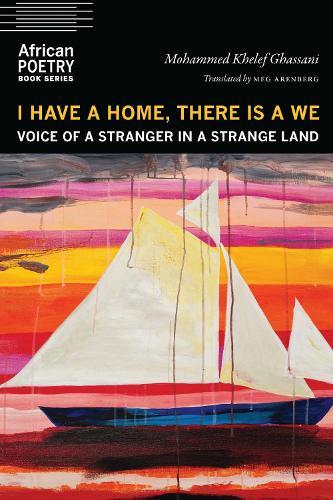
I Have a Home, There Is a We, whose original Swahili edition was in 2015 the first book of poetry to win the Safal-Cornell Kiswahili Prize for African Literature, brings the acclaimed verse of prolific Zanzibari poet, journalist, and cultural changemaker Mohammed Khelef Ghassani to English-language readers for the first time. The book explores the poet's life as a migrant in Germany: linguistic and cultural alienation, nostalgia, and longing for his homeland on the island of Pemba. These poems form a catalog of sorrow and love addressed to the family he left behind, to the children whose roots ""he tore forcefully from the ground"" in hopes of offering them a better life, and above all to the country he calls home, using the deeply resonant Swahili term ""kwetu""—our place—named over and over again as Zanzibar. Utilizing the structured verse forms of traditional Swahili prosody, the collection is modern, unique, and innovative, speaking to a global diasporic experience even as it draws deeply on an idiom specific to the poet's tiny island home. A ripple of political defiance suffuses the poems as Ghassani positions himself against layered forms of oppression and marginalization both at home and abroad in this synthesis of love song, lamentation, and freedom declaration.
Full Product Details
Author: Mohammed Khelef Ghassani ,
Meg Arenberg
Publisher: University of Nebraska Press
Imprint: University of Nebraska Press
ISBN: 9781496244284
ISBN 10: 1496244281
Pages: 124
Publication Date: 13 February 2026
Audience:
General/trade
,
General
Format: Paperback
Publisher's Status: Active
Availability: Not yet available

This item is yet to be released. You can pre-order this item and we will dispatch it to you upon its release.
Reviews
""The journeys Mohammed Ghassani's poetry beautifully takes raise questions about home: Is it a place that only poetry can find? Is it a road map back home or is poetry itself the destination, our final home? In Meg Arenberg's translation is home to be found in many languages? And for the reader, do you now see you live in many homes? Come to Ghassani's poetry all packed and prepared, with your arms wide open ready to embrace your many selves. Home here is a train traveling faster than the speed of light to all destinations at the same time.""--Mukoma Wa Ngugi, cofounder of the Safal-Cornell Kiswahili Prize for African Literature and author of Logotherapy ""This beautiful translation introduces to an English reading audience Mohammed Ghassani's captivating poetry. It is representative of new, young, confident, patriotic, hopeful, and vibrant voices currently emerging out of a long tradition of Kiswahili verse. This is a daring voice very much worth listening to.""--Abdilatif Abdalla, Kenyan political activist, author of Sauti ya Dhiki (Voice of Agony), and retired teacher of Kiswahili language and African literature at the University of Leipzig
""This beautiful translation introduces to an English reading audience Mohammed Ghassani's captivating poetry. It is representative of new, young, confident, patriotic, hopeful, and vibrant voices currently emerging out of a long tradition of Kiswahili verse. This is a daring voice very much worth listening to.""—Abdilatif Abdalla, Kenyan political activist, author of Sauti ya Dhiki (Voice of Agony), and retired teacher of Kiswahili language and African literature at the University of Leipzig ""The journeys Mohammed Ghassani's poetry beautifully takes raise questions about home: Is it a place that only poetry can find? Is it a road map back home or is poetry itself the destination, our final home? In Meg Arenberg's translation is home to be found in many languages? And for the reader, do you now see you live in many homes? Come to Ghassani's poetry all packed and prepared, with your arms wide open ready to embrace your many selves. Home here is a train traveling faster than the speed of light to all destinations at the same time.""—Mukoma Wa Ngugi, cofounder of the Safal-Cornell Kiswahili Prize for African Literature and author of Logotherapy
Author Information
Mohammed Khelef Ghassani was born in 1977 on the island of Pemba, Zanzibar. He studied translation at the Open University of Tanzania, where he received a master's degree in 2014. He now works as a reporter and editor of the broadcasting company Deutsche Welle in Bonn, Germany. He is the author of seven previous collections of poetry in Swahili. Meg Arenberg is a scholar and translator with specializations in Anglophone African, Indian Ocean, and Swahili literatures. Her work has won recognition from the American Comparative Literature Association and the American Literary Translators Association.