Overview
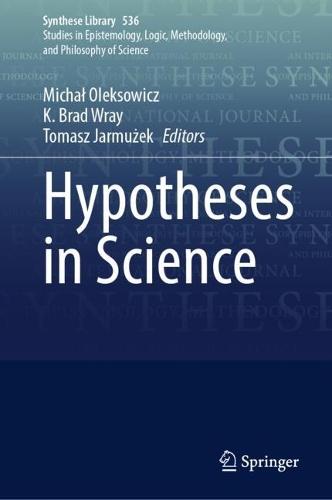
This book focuses on the different and complementary components of scientific hypothetical thinking as a multifaceted phenomenon in order to shed light on its crucial role in scientific development. It is now a common view that hypotheses play important roles in science, that they can bring order to data. However, the exact nature of their roles deserves more careful and systematic scrutiny. This book’s novelty consists in being directly focused on the fact that hypotheses can provide suggestive clues for further scientific studies. That is, they can play a more constructive and creative role. Furthermore, it answers not only “why” hypotheses are so important, but also “how” they work within scientific context. The contributions are written by renowned philosophers of science, specifically for this volume, ensuring it is an important read for both philosophers and scientists.
Full Product Details
Author: Michał Oleksowicz ,
K. Brad Wray ,
Tomasz Jarmużek
Publisher: Springer Nature Switzerland AG
Imprint: Springer Nature Switzerland AG
ISBN: 9783032136497
ISBN 10: 3032136490
Pages: 224
Publication Date: 05 April 2026
Audience:
Professional and scholarly
,
Professional & Vocational
Format: Hardback
Publisher's Status: Active
Availability: In Print

This item will be ordered in for you from one of our suppliers. Upon receipt, we will promptly dispatch it out to you. For in store availability, please contact us.
Author Information
Michał Oleksowicz is a researcher at the Faculty of Philosophy and Social Sciences (Institute of Philosophy, Department of Logic) at Nicolaus Copernicus University in Toruń. He has been 2022-2025 a board member of the Polish Association for Logic and Philosophy of Science. From 2022–2024, he was the principal investigator of the research project New Mechanicism and theology (2021/41/N/HS1/01338), funded by the National Science Centre in Poland. Currently, he is the principal investigator (2024–2027) of the project Philosophical-logical foundations of mechanistic causation (2024/52/C/HS1/00179), funded by the National Science Centre in Poland. His main research interests are: history and philosophy of science, philosophical aspects of causation and causal explanations, especially mechanistic explanation and its application to various explanatory contexts. K. Brad Wray works at the Centre for Science Studies at Aarhus University, in Denmark. He has published three books: Kuhn’s Intellectual Path (CUP 2021), Resisting Scientific Realism (CUP 2018), and Kuhn’s Evolutionary Social Epistemology (CUP 2011). He has also edited Interpreting Kuhn: Critical Essays (CUP 2021), and is one of the two editors for the Springer/Nature journal Metascience. His research is on the social epistemology of science, the realism/anti-realism debate, the philosophy of Thomas Kuhn, and scientific publication practices. He has held visiting fellowships at Cornell University (Fall 2008), Massachusetts Institute of Technology (Fall 2015), and University of Cambridge (Fall 2020). Tomasz Jarmużek is a member of editorial board of Studia Logica An International Journal for Symbolic Logic. His research is on non-classical logics, proof theory and application of logic to philosophical problems. He publishes over 30 papers and 5 books. His main topics are relating semantics, relating logic and metatheory of tableau proofs. He has been 2022-2025 the president of the Polish Association for Logic and Philosophy of Science.