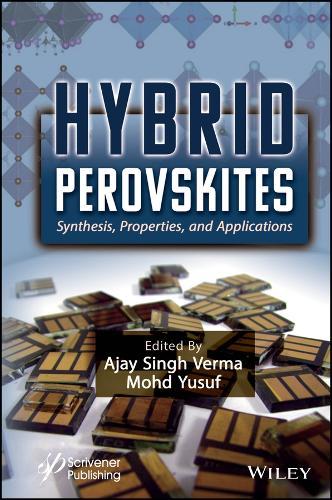
Hybrid Perovskites: Synthesis, Properties, and Applications

Author:   Ajay Singh Verma (Uttaranchal University, India) ,  Mohd Yusuf (Glocal University, India)
Publisher:   John Wiley & Sons Inc
ISBN:  

9781119864974


Pages:   304
Publication Date:   28 April 2026
Format:   Hardback
Availability:   Out of stock   Availability explained


Our Price $403.95 Quantity:  
Pre-Order

Share |

Hybrid Perovskites: Synthesis, Properties, and Applications


Overview

Advance your research in high-efficiency energy and technology with this essential book, which provides comprehensive coverage of hybrid perovskite materials, detailing their fundamental optoelectronic properties and groundbreaking applications. The innovative, game-changing semiconductor materials known as hybrid perovskites possess all the advantageous optoelectronic properties required to produce solar cells with high efficiency. Hybrid perovskite photovoltaics’ outstanding qualities, such as their superior material qualities, ease of fabrication through solution-based processing, large-area device fabrication through inkjet technology, and straightforward solar cell structures, have drawn attention and accelerated the development of solar cell technology. This book provides comprehensive coverage of hybrid perovskite materials, covering their fundamental principles and advanced applications. It explores the physical and chemical properties of hybrid perovskites while highlighting their potential in quantum computing, neuromorphic devices, radiation scintillators, LEDs, and lasing technologies. Hybrid perovskites, particularly those with flexible organic frameworks, offer high carrier mobility and efficiency, making them high-potential for optoelectronic applications. However, challenges like long-term stability persist. This book examines their tunable structural properties and charge carrier dynamics, highlighting their potential for low-cost, high-performance energy and technology applications. Designed for researchers, academicians, and students in materials science, physics, chemistry, and engineering, this book serves as a valuable resource, bridging knowledge gaps and supporting advancements in photovoltaics and emerging technologies. Readers will find the volume: Addresses environmental impact, scalability, cost, and efficiency of hybrid perovskites; Showcases practical examples of how perovskite technology is transforming renewable energy; Explores hybrid perovskites and solution-based processing technology for large-scale production; Covers multiple applications of perovskites across materials science, physics, chemistry, nanotechnology, and engineering fields. Audience Academics, scientists, and researchers in materials science, applied physics, chemistry, engineering, and technology stream working.

Full Product Details

Author:   Ajay Singh Verma (Uttaranchal University, India) ,  Mohd Yusuf (Glocal University, India)
Publisher:   John Wiley & Sons Inc
Imprint:   Wiley-Scrivener
ISBN:  

9781119864974


ISBN 10:   1119864976
Pages:   304
Publication Date:   28 April 2026
Audience:   Professional and scholarly ,  Professional & Vocational
Format:   Hardback
Publisher's Status:   Forthcoming
Availability:   Out of stock   Availability explained

Table of Contents

Preface xiii 1 Insights into Hybrid Perovskite Materials 1 Mohd Yusuf, Deepa Sharma and Wasim Khan 1.1 Introduction 1 1.2 Fabrication Strategies 4 1.3 Applications of Perovskite Materials 7 1.4 Conclusion and Future Outlook 12 2 Hybrid Halide Double Perovskites and Their Future Aspects 15 Upasana Rani 2.1 Introduction 16 2.2 Alternatives to Si Solar Cells: Perovskite-Structured Solar Cells (PSCs) 17 2.3 Summary and Perspective 21 3 Stabilities of Hybrid Perovskite Crystals and Photovoltaics 29 Takeo Oku 3.1 Introduction 29 3.2 Flexibility of Crystals 32 3.3 Degradation Mechanism of Perovskite Halides 34 3.4 Stabilization by Structural Control of Crystals: Co-Substitution of Alkali Elements and Cu 36 3.5 Stabilization by Co-Substitution of Organic Molecules and Cu 36 3.6 Stabilization of FA0.83Cs0.17PbI3 by Ge Addition 39 3.7 Possible Stabilization of FAPbI3 by Cu Substitution 41 3.8 Co-Additive Effects of EA and GA 43 3.9 Stabilization by Highly (100)-Oriented Thin Films 44 3.10 Surface Modification Stabilization by DPPS 48 3.11 Summary 51 4 Hybrid Perovskites in Flexible Electronics and Wearable Devices 59 Md. Reazuddin Repon, Chowdhury Mashfik Ahmed, Tarekul Islam, Md. Sarowar Hossain and Daiva Mikucioniene 4.1 Introduction 60 4.2 Preparation Methods 63 4.3 Applications of Hybrid Perovskites in Flexible Electronics and Wearable Devices 68 4.4 Challenges and Future Prospects 75 4.5 Conclusion 77 5 Organometallic Halide Perovskites: Futuristic Materials for a More Efficient and Sustainable Electronic World 87 Peeyush Kumar Kamlesh, Sheetal Sharma, Shivraj Kumar Bhardwaj and Ajay Singh Verma 5.1 An Introduction: Renewable Energy and PVs 88 5.2 PVs' Production Technologies 90 5.3 Organic PV Technology 91 5.4 Perovskite Material: Origin and its History 94 5.5 Semiconducting Perovskite: Parameters Affecting Optoelectronic Properties 97 5.6 Perovskite Materials for PSC Fabrication 107 5.7 Optoelectronic Applications of Halide Perovskites 109 5.8 Summary and Conclusions 124 6 Greening Solar Energy: Harnessing Nontoxic Hybrid Perovskites for Sustainable Photovoltaics 141 Nasreen Musheer, Anam Choudhary, Mohd Yusuf and Sabiha Saeed 6.1 Solar Energy Cell Working 145 6.2 Environmental Concerns with Traditional Solar Cell Materials 147 6.3 Environmental Challenges Associated with Traditional Materials, Including Resource Depletion and Hazardous Waste 150 6.4 Introduction to Perovskite Materials and their Relevance in Photovoltaics 150 6.5 Nontoxic and Less Toxic Hybrid Perovskites: A Green Solution 152 6.6 Composition and Structure of Hybrid Perovskites 154 6.7 Hybrid Perovskite Properties Attractive for Solar Cells 156 6.8 Advantages of Nontoxic Hybrid Perovskites in Terms of Environmental Impact 156 6.9 Environmental Impact Assessment 158 6.10 Implications for Sustainability and Green Energy Transition 160 6.11 Commercialization and Market Potential 161 6.12 Current Status of Nontoxic Hybrid Perovskite Solar Cell Commercialization 161 6.13 Economic and Policy Considerations for Promoting Sustainable Photovoltaic Technologies 162 6.14 Challenges and Research Directions 163 6.15 Ongoing Research Efforts to Address these Challenges 163 6.16 Future Prospects and Potential Breakthroughs in the Field 164 6.17 Conclusion 164 7 Thin Films for Planar Solar Cells of Organic-Inorganic Perovskite Composites 181 Muhammad Umar Iqbal and Madiha Ashraf 7.1 Introduction 181 7.2 Solar Cell Composites Based on Perovskites 184 7.3 Materials Design of Perovskite Composites 187 7.4 Techniques of Thin-Film Fabrication 191 7.5 Planar Configurations of Solar Cells Using Perovskite Composites 195 7.6 Photovoltaic Performance Metrics 198 7.7 Challenges in Perovskite Composite Thin Films 201 7.8 Emerging Trends and Applications 204 7.9 Summary 207 8 Efficacy of Porphyrin-Based Supramolecular Structures in Organic-Inorganic Hybrid Perovskite Solar Cells (OIHPSCs) 211 Vikrant Jayant, Sanjay Kumar Saroj, Rahul Kumar and Mohd Yusuf 8.1 Introduction 212 8.2 Impact of Porphyrin-Based Supramolecular Structural Framework as an Additive in PSC Film 217 8.3 Importance of Porphyrin-Based Supramolecular Structural Framework as Hole-Transport Materials or Layers (HTL/HTM) in PSCs 221 8.4 Utility of Porphyrin-Based Supramolecular Structural Framework as Electron-Transport Materials or Layers (ETM or ETL) in PSCs 228 8.5 Significance of Porphyrin-Based Supramolecular Structural Framework as a Bulk Heterojunction (BHJ) Layer in PSCs 229 8.6 Conclusion and Summary of the Porphyrin-Based Supramolecular Structural Framework 231 9 Detection and Purification of Toxic Materials: Advancements, Perovskite, and MXene-Based Approaches 235 Kumari Vandana Singh and Ashish Kumar Srivastava 9.1 Introduction 236 9.2 Traditional Methods of Detoxification 241 9.3 Current Detoxification Technologies 246 9.4 Role of Perovskite and MXenes in Developing Future Detoxification Technologies 251 9.5 Challenges and Prospects 261 9.6 Conclusion 262 10 Power Conversion Efficiency and Physical Properties of Chalcogenide Perovskite Solar Cells 271 Naincy Pandit and Anusha Dubey 10.1 Introduction 271 10.2 Perovskite Materials: Structural Characteristics 274 10.3 Theoretical Description 276 10.4 Computational Details 278 10.5 Conclusion and Future Aspects 280 References 281 Index 285

Reviews

Author Information

Ajay Singh Verma, PhD is a Professor in the Division of Research and Innovation at Uttaranchal University, India. He has contributed significantly to academia by authoring and editing physics syllabi and reference books, in addition to publishing over 200 scientific articles. His research focuses on natural dyes, plant products, green materials, and green chemistry. Mohd Yusuf, PhD is an associate professor in the School of Science and Technology at Glocal University, India. He has extensively published research articles, reviews, books, and chapters in edited volumes with international publishers. His research interests include green and sustainable materials, functional biomaterials, composite and applied materials, nanomaterials, wastewater treatment, and energy storage technologies.

Tab Content 6

Author Website:  

Countries Available

All regions
Latest Reading Guide

April RG 26_2


Shopping Cart
Your cart is empty
Shopping cart
Mailing List